- SMALL ORDERS FOR STANDARD ITEMS. Contact Now
- OUTDOOR COOLING SOLUTIONS, MADE IN‑HOUSE. Contact Now
- COOLER BOXES THAT FIT REAL OUTDOOR LIFE. Contact Now

 LANGUAGE
 日本語
 Español
 عربى

Content
- 1 1. Product Overview
- 2 2. Foam Insulation for Everyday Cooling Needs
- 3 3. Food-Grade Materials and Easy Cleaning
- 4 4. Compact Capacity with Practical Organization
- 5 5. Portability and User-Friendly Handling
- 6 6. Elevated Non-Slip Base and Improved Stability
- 7 7. Exterior Customization for Commercial Buyers
- 8 8. Manufacturing Capabilities Behind the Product
- 9 9. Quality Management and Product Development
- 10 10. Advantages Compared with Common Alternatives
- 11 11. Applications Across Consumer and Commercial Markets
- 12 12. Packaging, Logistics, and Import Planning
- 13 13. Responsible Use and Care Recommendations
- 14 14. Why the Manufacturer Is Suitable for OEM and ODM Projects
- 15 15. Key Buying Considerations
- 16 16. Frequently Asked Questions
- 16.1 Q1: What is the capacity of the cooler?
- 16.2 Q2: What are the dimensions and weight?
- 16.3 Q3: What materials are used?
- 16.4 Q4: Is the cooler suitable for food and baby products?
- 16.5 Q5: How does the foam insulation work?
- 16.6 Q6: Does the cooler have a handle?
- 16.7 Q7: What is the purpose of the non-slip base?
- 16.8 Q8: Is the cooler easy to clean?
- 16.9 Q9: Can the cooler be customized?
- 16.10 Q10: What types of companies may buy this product?
- 16.11 Q11: Is this a large camping cooler?
- 16.12 Q12: What manufacturing capabilities does the supplier have?
- 16.13 Q13: Can the product be shipped in large quantities?
- 16.14 Q14: What should buyers check before mass production?
- 17 17. Conclusion
- 18 References
- 19 Product: 8L Portable Foam Insulated Cooler with Non-Slip Base
Choosing a cooler is not simply a matter of selecting the largest available capacity. For short trips, daily commuting, beach visits, picnics, office storage, and family car journeys, a compact cooler can be more practical than a large model. The ideal small cooler should be easy to carry, simple to clean, stable on different surfaces, sufficiently insulated, safe for contact with food and beverages, and adaptable to different usage scenarios.
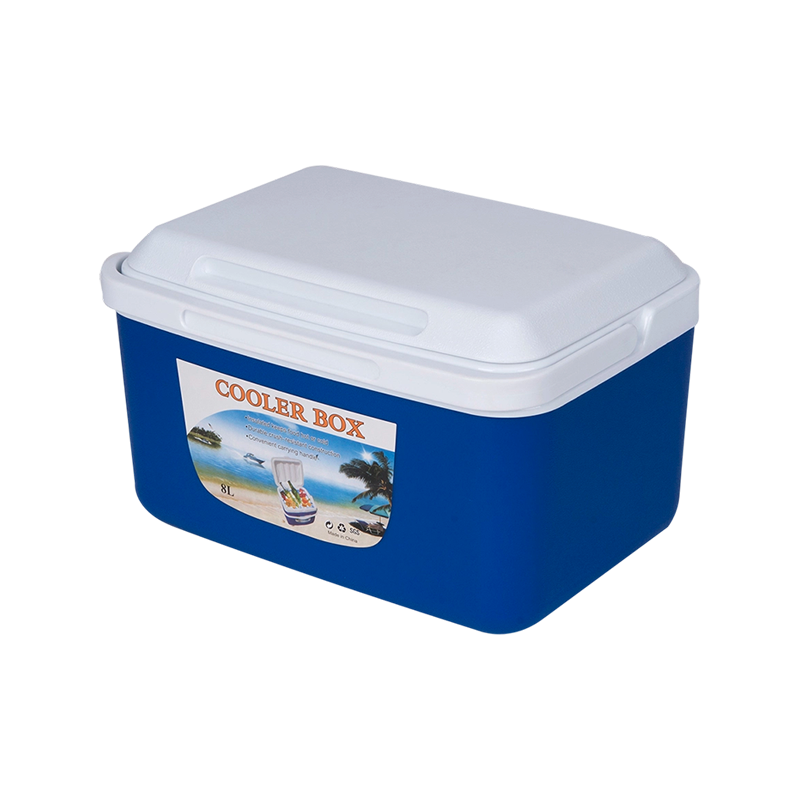
The 8L Portable Foam Insulated Cooler with Non-Slip Base is designed around these everyday requirements. With an 8-liter capacity, a compact rectangular profile, food-grade PP and PE construction, and EPS foam insulation, it provides a balanced solution for personal cooling needs. Its dimensions of 325 × 240 × 200 mm make it small enough for convenient transport while offering enough room for drinks, snacks, packed meals, baby food, or other temperature-sensitive essentials.
Unlike oversized coolers that can become heavy and inconvenient when partially filled, this model focuses on portability and efficient use of space. It is suitable for users who need a dependable cooler for several hours rather than a large storage chest for extended group travel. The elevated non-slip base, recessed latch, hidden handle, smooth internal walls, and customizable exterior further strengthen its practical value.
Manufactured by Ningbo Junlong Outdoor Products Co., Ltd., the cooler reflects the capabilities of an established Chinese manufacturer specializing in outdoor cooling and water storage products. The company integrates product development, injection molding, blow molding, foaming, quality management, and sales support within its own manufacturing operation. This combination allows buyers to source a ready-made product or develop customized versions for retail, promotional, hospitality, food distribution, and outdoor equipment programs.
This article examines the cooler’s design, performance-oriented features, manufacturing advantages, customization potential, and the reasons it can compete effectively in the small cooler box market.
8L Portable Foam Insulated Cooler with Non-Slip Base
1. Product Overview
The product is an 8-liter portable cooler box intended for short trips and personal essentials. It belongs to the small cooler box category, generally covering capacities from approximately 5 to 13 liters. This category serves a distinct purpose: providing enough insulated storage for personal or small-family use without the bulk of a large camping cooler.
The cooler measures 325 × 240 × 200 mm and weighs approximately 1.18 kg. Its relatively low empty weight makes it suitable for users who may need to carry it from a vehicle to a picnic area, workplace, sports field, beach, campsite, or outdoor event. Because the cooler has a slim, compact shape, it can also be placed on a desk, in a car, under a seat where space permits, or in a storage cabinet when not in use.
The 8-liter internal volume is suitable for drinks, snacks, packed lunches, fruit, sandwiches, medicine packs, or baby food. According to the product specifications, it can accommodate eight 330 ml cola cans. Actual capacity may vary depending on the arrangement of ice packs and the shape of the contents, but the example demonstrates that the cooler is designed for practical personal beverage storage rather than merely decorative use.
| Product Attribute | Specification |
| Product type | Portable foam-insulated cooler box |
| Capacity | 8 liters |
| Dimensions | 325 × 240 × 200 mm |
| Approximate weight | 1.18 kg |
| Materials | Food-grade PP, PE, and EPS |
| Category | Small cooler box, approximately 5–13 liters |
| Structural features | Recessed latch, hidden handle, elevated non-slip base |
| Customization | Color, logo, printing, packaging, and OEM/ODM development |
| Typical uses | Day trips, beaches, offices, cars, baby food, snacks, and beverages |
The product’s value comes from the way these specifications work together. Capacity alone does not determine whether a cooler is useful. A cooler that is large but difficult to transport may be less convenient for a daily user. A cooler with insulation but an unstable base may be inconvenient on a picnic table or vehicle floor. A cooler with a large handle may be easy to carry but difficult to stack or store. This design addresses several of these concerns in one compact format.
2. Foam Insulation for Everyday Cooling Needs
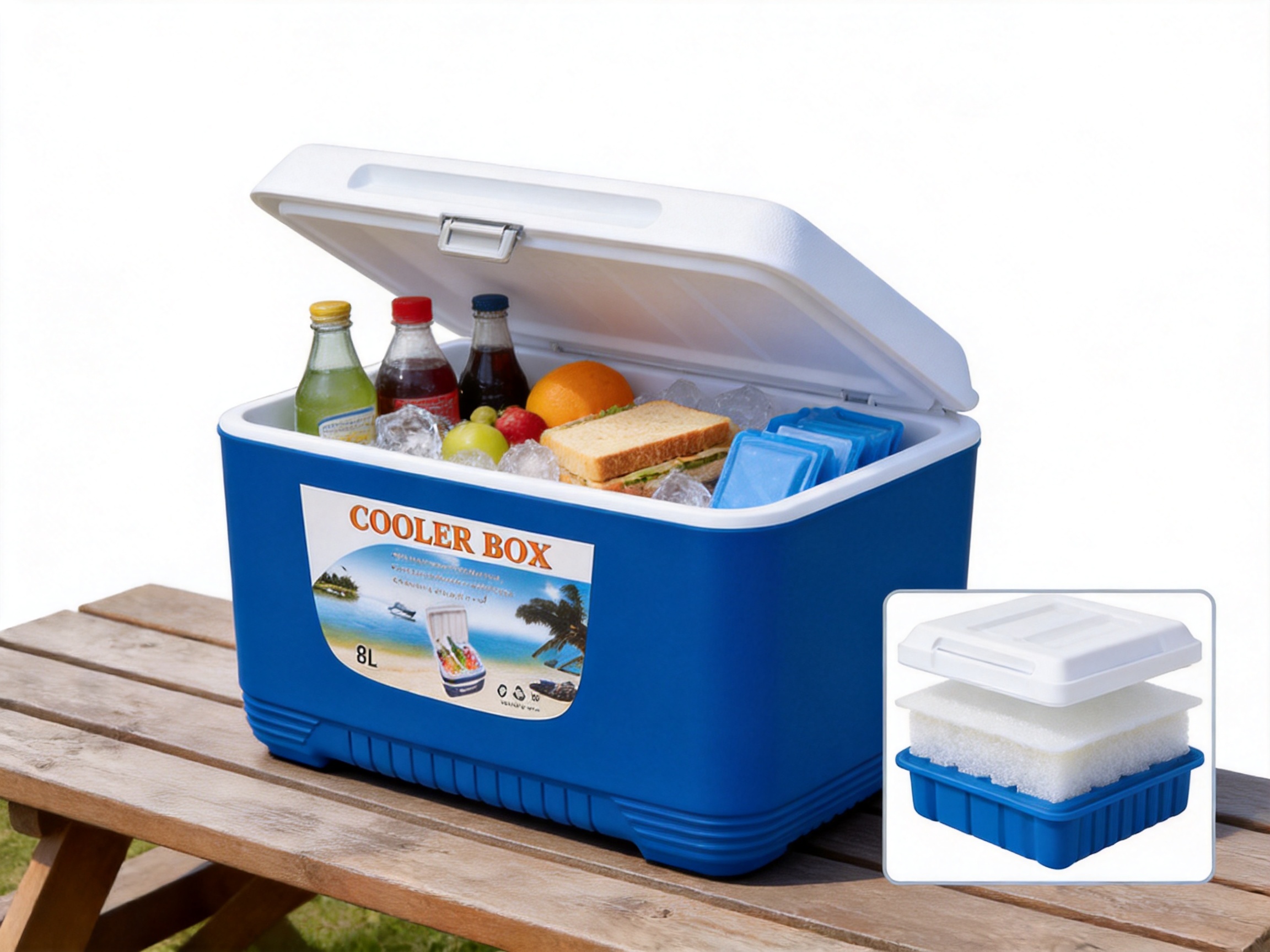
The cooler uses EPS foam insulation between its structural layers. Expanded polystyrene, commonly known as EPS, is widely used in insulated containers because it contains a high proportion of trapped air. This structure helps reduce the transfer of heat between the outside environment and the contents inside the cooler.
In practical use, insulation helps ice packs, chilled drinks, and refrigerated food remain cool for longer than they would in an ordinary uninsulated plastic box. The actual holding time depends on factors such as ambient temperature, the starting temperature of the contents, the quantity and type of ice, how often the lid is opened, and whether the cooler is exposed to direct sunlight. Nevertheless, the EPS layer provides an important thermal barrier for short trips and daily cooling applications.
A compact cooler also has an inherent efficiency advantage. When users select a container that matches the quantity of items they need to carry, there is less unused internal air space. Properly arranging the contents and using suitable ice packs can help improve cooling efficiency. The 8-liter capacity is therefore appropriate for individual meals, a small selection of beverages, or a child’s food supplies.
Compared with a thin-wall plastic storage box, a foam-insulated cooler offers more meaningful temperature protection. Compared with a large heavy-duty chest, this smaller format requires less material, occupies less space, and is easier to carry. It occupies a useful middle ground for consumers who want insulation without the weight and size associated with high-capacity outdoor coolers.
The insulation is also helpful for non-beverage applications. Parents may use the cooler for baby food during car rides, workers may carry chilled meals to a jobsite, and travelers may store temperature-sensitive snacks during a day trip. The product is not intended to replace specialized medical refrigeration or controlled-temperature transport equipment, but it can provide practical short-term cooling support for ordinary daily needs.
3. Food-Grade Materials and Easy Cleaning
The cooler is made from food-grade PP and PE with an EPS insulating layer. Polypropylene and polyethylene are widely used in food storage and household products because they can provide a combination of durability, low weight, moisture resistance, and cleanability when properly processed.
Food-grade material selection is especially important for a cooler that may hold drinks, packed meals, fruit, sandwiches, or baby food. The product’s material specification gives buyers a clear basis for evaluating its intended application. As with all food-contact products, users should follow appropriate cleaning practices and avoid placing contents in the cooler in a way that could cause contamination. Food should be packed in suitable containers or sealed bags when necessary.
The smooth inner walls are designed to simplify cleaning. Textured or irregular interiors can collect moisture, crumbs, and residue in difficult-to-reach areas. A smoother inner surface can be wiped more quickly after use, helping the cooler remain ready for its next trip. This is particularly beneficial for users who use the cooler frequently for lunches, drinks, or children’s food.
Easy maintenance is a competitive advantage that is sometimes overlooked. Buyers often compare coolers by capacity and insulation but later discover that cleaning time affects long-term satisfaction. A product that can be emptied, wiped, dried, and stored without complicated disassembly is more likely to be used regularly.
The exterior surface also supports practical customization. The product information notes that the smooth surface is easy to print and can accommodate different forms of logos. This gives distributors, retailers, event organizers, food companies, sports clubs, and promotional-product buyers the opportunity to create a branded cooler without changing the basic structural design.
4. Compact Capacity with Practical Organization
An 8-liter cooler is particularly useful when portability matters more than maximum storage. It can hold a modest number of beverages and meals while remaining manageable for one person. The stated ability to hold eight 330 ml cola cans provides a simple reference point for capacity planning.
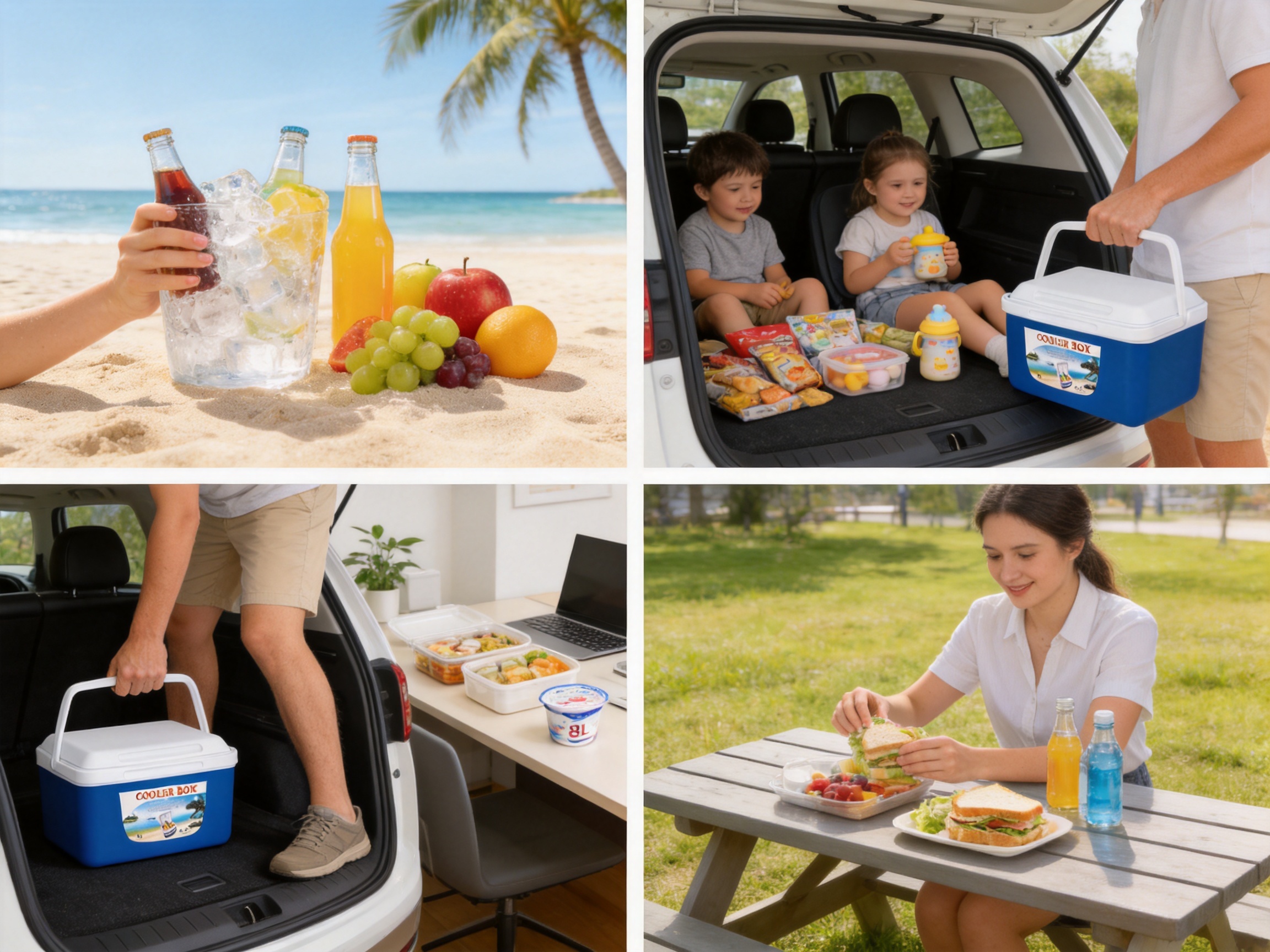
For a day at the beach, the cooler may hold cans or bottles, fruit, sandwiches, and a small ice pack. For a picnic, it can support one or two people with snacks and drinks. In an office, it can act as a personal cold-storage container for lunch items. In a vehicle, it can hold food for children or chilled refreshments during a journey.
The compact external dimensions are also suitable for businesses that need to transport or store many units. The product information indicates that a 40-foot high cabinet can hold 4,056 pieces. This high loading quantity can help improve warehouse planning, export efficiency, and container utilization. Buyers should confirm final packing specifications, carton dimensions, loading methods, and shipping conditions with the manufacturer before placing an order, but the stated figure demonstrates that the product was designed with logistics in mind.
Compared with larger coolers, the slim profile can reduce storage challenges in homes, retail backrooms, vehicles, and hospitality facilities. Retailers can display more units within a limited shelf area. Promotional-product buyers can store inventory without dedicating excessive warehouse space. Importers may also benefit from a product format that supports high-volume loading.
| Use Scenario | Potential Contents | Primary Benefit |
| Day trip | Drinks, sandwiches, fruit, and ice packs | Personal cooling in a compact format |
| Beach visit | Cans, bottled water, snacks, and fruit | Easy transport and stable placement |
| Office lunch | Meals, yogurt, fruit, and chilled drinks | Convenient personal food storage |
| Car journey | Baby food, snacks, juice, and water | Useful backup cooling during travel |
| Outdoor event | Refreshments and promotional items | Customizable surface for branding |
| Retail or distribution | Branded or private-label cooler units | Efficient storage and scalable sourcing |
5. Portability and User-Friendly Handling
Portability is one of the product’s strongest advantages. At approximately 1.18 kg, the cooler is light enough for many users to carry comfortably when filled with a reasonable quantity of contents. Although the total carrying weight increases with drinks, food, and ice, the empty product does not add unnecessary bulk to the load.
The hidden handle contributes to the compact design. A handle that folds into or remains integrated with the body can reduce protruding parts during storage and transportation. It may also create a cleaner exterior appearance for retail display and logo printing. When the cooler is placed in a cabinet or vehicle, a recessed or hidden handle is less likely to catch on nearby objects.
The recessed latch is another detail that supports everyday convenience. A latch should close securely while remaining straightforward to operate. Recessing the latch helps protect it from accidental impacts and keeps the front profile neat. Smooth opening and closing are especially valuable for frequent users who access the contents several times during a trip.
Portability should not be understood only as low weight. A genuinely portable cooler should also be easy to store, easy to carry, easy to open, and easy to clean. This model combines these attributes in a compact product intended for routine use rather than occasional heavy-duty storage alone.
6. Elevated Non-Slip Base and Improved Stability
The elevated non-slip base helps the cooler remain stable on surfaces such as picnic tables, vehicle floors, desks, counters, and outdoor benches. Raising the main body slightly from the supporting surface can reduce direct contact with moisture and dirt while helping protect the bottom of the cooler.
Stability is an important but often underappreciated feature. A cooler that shifts easily can spill drinks, disturb food containers, or slide when a vehicle moves. A non-slip base helps reduce this risk during ordinary use. It also makes the cooler more suitable for use on smooth indoor surfaces, where a lightweight container might otherwise move when opened or closed.
The base does not eliminate the need for careful placement. Users should keep the cooler on a reasonably level surface and secure it appropriately in moving vehicles. However, the design provides a useful layer of stability without adding complicated mechanisms or significant weight.
Compared with a basic plastic box that rests directly on its full bottom surface, an elevated base can offer better separation from wet or dirty ground. This can make the product easier to wipe and maintain after outdoor use. It also supports a more refined appearance for office, hospitality, and promotional applications.
7. Exterior Customization for Commercial Buyers
The smooth exterior creates opportunities for logo printing and private-label presentation. Customization is important for companies that want a cooler to serve not only as a functional product but also as a marketing or brand-communication tool.
Retailers may order the cooler in selected colors and apply their own brand identity. Beverage companies can use branded coolers for promotional campaigns. Food companies may distribute them as customer gifts or sales incentives. Hotels, resorts, tour operators, and event organizers can use them for guest services. Sports clubs and outdoor associations can create coordinated merchandise for members and participants.
Possible customization areas may include product color, logo treatment, print location, packaging design, carton markings, labels, and accessories. The exact printing method, number of colors, artwork format, minimum order quantity, sample procedure, and production schedule should be confirmed with the manufacturer before production. These details depend on the design, order volume, and selected packaging configuration.
OEM and ODM services provide additional flexibility. OEM production generally allows a buyer to place its own branding and packaging on an existing product design. ODM development can involve modifications based on drawings, samples, functional requirements, or market positioning. For example, a buyer may request a different color combination, a revised logo area, updated packaging, or a product variation for a specific sales channel.
The ability to customize an existing mold-based product can shorten the path from concept to market compared with developing an entirely new cooler from the beginning. It may also reduce technical uncertainty because the basic structure has already been designed for production. Buyers should still conduct sample evaluation, artwork approval, packaging confirmation, and quality inspection before mass production.
8. Manufacturing Capabilities Behind the Product
Ningbo Junlong Outdoor Products Co., Ltd. was founded in 2000 and is located in Cixi, Ningbo, Zhejiang Province, China. Cixi is part of the Yangtze River Delta manufacturing region, an area known for industrial supply chains, export-oriented production, tooling, plastics processing, and logistics connections.
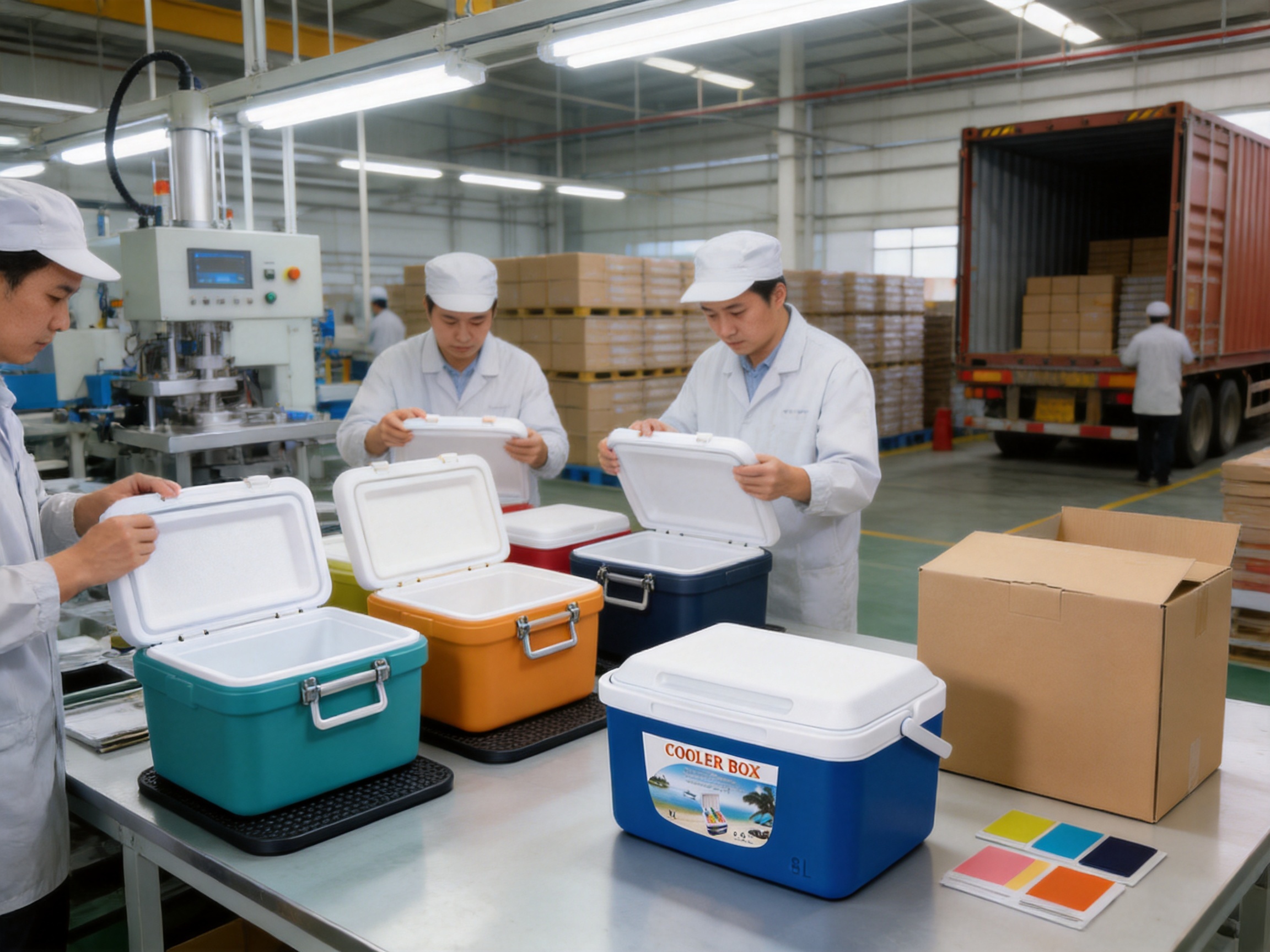
The company operates a 12,000-square-meter independent factory with more than 100 employees. Its production facilities include automatic injection molding machines, blow molding machines, and foaming equipment. These capabilities are relevant to the manufacture of plastic outdoor products because different components and product structures require different processing methods.
Injection molding is commonly used to produce precise plastic parts with consistent dimensions. For a cooler, this type of process may be used for structural shells, lids, latch components, handles, base elements, and other molded parts. Automatic equipment can support repeatable production cycles and stable output when molds, materials, and process parameters are properly controlled.
Foaming equipment is essential for producing insulated structures that incorporate foam material. The foam layer must be formed consistently to support the intended thermal barrier and fit correctly within the outer and inner components. Stable foaming conditions can contribute to product uniformity, appearance, and assembly performance.
Blow molding capability expands the company’s ability to produce other outdoor products, especially hollow plastic containers such as water jugs and certain storage designs. Although the 8-liter cooler is based on a foam-insulated cooler construction, access to multiple production technologies allows the manufacturer to support a broader range of product categories and customer requirements.
The company describes itself as an enterprise integrating product development, production, and sales. This integrated structure can simplify communication between engineering, manufacturing, quality, and commercial teams. For an international buyer, centralized coordination may help reduce delays when discussing product specifications, artwork, samples, packaging, and production planning.
9. Quality Management and Product Development
A cooler’s performance depends on more than the nominal material list. It also depends on dimensional accuracy, assembly quality, lid alignment, latch operation, insulation consistency, surface finish, and resistance to ordinary handling. A structured quality management system helps manufacturers monitor these factors throughout production.
Junlong reports that it maintains a rigorous quality management system and a creative R&D team. Product development can include evaluating market requirements, improving existing designs, checking manufacturing feasibility, preparing samples, and coordinating custom requests.
For an insulated cooler, quality checks may reasonably include visual inspection, dimensional verification, lid and latch testing, surface inspection, handle evaluation, base stability review, and packaging checks. Depending on the buyer’s requirements, additional inspections may cover material documentation, print adhesion, drop resistance, load performance, or thermal performance under defined test conditions.
Buyers should establish clear acceptance criteria before mass production. A purchase specification can define dimensions, capacity, weight tolerance, color references, logo position, printing quality, packaging details, carton markings, and sampling standards. Clear requirements allow both the buyer and manufacturer to evaluate results against an agreed reference.
Product development is also important when a buyer wants to enter a new market. Different markets may have different expectations regarding colors, labeling, packaging languages, recycling marks, food-contact documentation, and retail presentation. An experienced manufacturer can help identify production considerations, although final regulatory responsibility should be confirmed by the importing party for the destination market.
10. Advantages Compared with Common Alternatives
The 8-liter cooler competes with several types of products, including soft-sided coolers, uninsulated plastic boxes, large rigid coolers, and low-cost thin-wall insulated containers. Each alternative has its own strengths, but the foam-insulated design offers a balanced set of benefits.
10.1 Compared with Soft-Sided Coolers
Soft-sided coolers are often flexible and lightweight, but they may be more vulnerable to compression, punctures, stains, and loss of shape. A rigid PP and PE exterior provides a more structured container for cans, lunch boxes, and food packages. The rigid body can also create a cleaner platform for logo application and retail display.
The choice depends on the application. A soft cooler may be useful when users need to fold or compress the product. The rigid foam-insulated cooler is more suitable when shape retention, easy wiping, stable stacking, and organized contents are priorities.
10.2 Compared with Uninsulated Plastic Boxes
An ordinary plastic box can store food and drinks but does not provide the same thermal barrier as a foam-insulated cooler. The EPS layer helps slow heat transfer and supports the use of ice packs for chilled contents. For users who need temperature protection during a day trip or commute, insulation is a major functional advantage.
10.3 Compared with Large Heavy-Duty Coolers
Large coolers can provide greater volume, but they may be excessive for one person or a short outing. They take up more storage space and can become difficult to carry when filled. The 8-liter format is better matched to personal use, small quantities, and situations where convenience is more important than maximum capacity.
10.4 Compared with Very Small Lunch Bags
Small lunch bags can be convenient for a single meal but may lack rigid protection and have less usable space for cans, ice packs, and multiple food containers. The 8-liter cooler provides a more structured alternative for users who need additional capacity while still seeking a compact form.
10.5 Compared with Generic Low-Cost Coolers
Price-focused coolers may omit features such as a non-slip base, recessed latch, hidden handle, smooth interior, and customization support. These details may increase practical value over the life of the product. For commercial buyers, reliable OEM communication and manufacturing capabilities can be as important as the initial unit price.
| Comparison Factor | 8-Liter Foam-Insulated Cooler | Soft-Sided Cooler | Uninsulated Plastic Box | Large Rigid Cooler |
| Portability | High for personal use | High | Moderate to high | Lower when filled |
| Shape retention | Rigid | Flexible | Rigid | Rigid |
| Insulation | EPS foam insulation | Varies by construction | Minimal or none | Usually strong |
| Cleaning | Smooth inner walls support easy wiping | May require more care | Usually simple | Usually simple but larger |
| Storage footprint | Compact | Compact when flexible | Compact | Large |
| Branding potential | Suitable for printed customization | Depends on fabric and construction | Depends on surface | Possible but often more costly |
| Best suited for | Short trips and personal essentials | Flexible carrying needs | Dry storage | Group or extended outings |
11. Applications Across Consumer and Commercial Markets
The product’s compact capacity supports a wide range of consumer applications. A family may use it for a child’s snacks and drinks during a car journey. An individual may carry lunch and beverages to work. A couple may use it for a short beach visit or weekend drive. It can also serve as a backup cooler when a household refrigerator is full or when chilled food needs to be transported temporarily.
Outdoor recreation is a natural market for the product. Hikers, campers, anglers, cyclists, and picnic users may appreciate a compact container that does not consume the space required by a large cooler. The cooler is particularly suitable for outings where users travel by car and need a manageable container for several hours of use.
The product can also serve hospitality and event markets. Hotels may use branded coolers for welcome packages or poolside refreshments. Tour operators may provide them for excursions. Event organizers can fill them with promotional materials, drinks, or food samples. Corporate buyers may use them as employee gifts or campaign merchandise.
Retailers and distributors can position the product as an entry-level or mid-range small cooler. Its combination of practical features and customizable exterior gives it potential for sporting-goods stores, home-and-living retailers, outdoor shops, promotional-product distributors, supermarket seasonal displays, and online marketplaces.
Food and beverage brands may use the cooler as a promotional extension of their product range. A branded cooler can remain in the customer’s home or vehicle after an event, creating repeated visibility. The usefulness of the item is important in this context: a practical cooler is more likely to be retained and reused than a promotional product with limited functionality.
12. Packaging, Logistics, and Import Planning
For international buyers, product design is only one part of the sourcing decision. Packaging, loading efficiency, shipping protection, documentation, and production scheduling also influence total cost and delivery reliability.
The stated loading quantity of 4,056 pieces in a 40-foot high-cube container indicates that the compact design can support efficient logistics. High loading density may help distribute freight costs across more units. However, actual loading results depend on carton dimensions, packaging materials, palletization, stacking limitations, and the shipping route.
Packaging should protect the cooler’s outer surface, latch, handle, and corners during handling. Retail-ready packaging may require different specifications from bulk export cartons. Buyers should determine whether they need individual boxes, polybags, instruction inserts, barcode labels, color boxes, master cartons, or pallet packaging.
Custom packaging can support brand positioning and reduce the need for repacking after import. It may also help retailers place the product directly into a store or fulfillment center. The packaging artwork should be approved carefully before mass production, including product information, dimensions, capacity, material statements, care instructions, and destination-market requirements.
Importers should also confirm the commercial terms, production lead time, sample approval procedure, payment schedule, inspection method, and documentation requirements. These points are not unique to this cooler, but they are essential for a smooth OEM or private-label project.
13. Responsible Use and Care Recommendations
To obtain the best performance, users should pre-chill beverages and food when possible. Placing warm products into a cooler increases the thermal load and can reduce the effective cooling period. Ice packs or suitable ice should be distributed around the contents, leaving enough room for the lid to close properly.
The cooler should not be overfilled. Excessive pressure can interfere with lid alignment or latch operation. Contents should be packed in sealed containers when necessary, especially when transporting foods that may leak. After use, the cooler should be emptied, wiped clean, and allowed to dry before storage.
Users should avoid abrasive cleaners or sharp tools that could damage the inner or outer surfaces. The cooler should also be protected from unnecessary impact and excessive heat. It is intended for portable cooling and storage rather than as a seat, step, or heavy-load platform unless the manufacturer has specifically approved such use.
When used in a vehicle, the cooler should be placed where it will not interfere with driving controls, visibility, airbags, or passenger safety. On boats, campsites, and outdoor surfaces, the non-slip base can improve stability, but the cooler should still be positioned securely.
14. Why the Manufacturer Is Suitable for OEM and ODM Projects
For buyers seeking more than a one-time purchase, the manufacturer’s integrated capabilities are a significant advantage. Ningbo Junlong Outdoor Products Co., Ltd. has operated since 2000 and focuses specifically on outdoor cooling and water storage products. Its product range includes ice buckets, insulated cooler jugs, outdoor water containers, and cooler boxes.
This category focus can help buyers work with a supplier that understands the functional requirements of outdoor plastic products. The company’s own injection molding, blow molding, and foaming equipment supports production control across multiple product types. Its R&D team can assist with product development based on drawings or samples, while its sales and manufacturing teams can coordinate customization and delivery requirements.
OEM/ODM capability is particularly valuable when a buyer wants to create a coordinated product family. For example, a distributor may want a cooler box, water container, and cooler jug in matching colors and packaging. A manufacturer with experience across these categories may be able to support a consistent visual identity and sourcing program.
The company’s factory location in Ningbo also provides access to a mature industrial region and international shipping infrastructure. Buyers should evaluate each project through samples, factory communication, quality documentation, and commercial terms, but the combination of experience, equipment, product focus, and customization options provides a solid foundation for cooperation.
15. Key Buying Considerations
Before ordering the 8-liter cooler, buyers should determine whether the capacity matches their market. The product is intended for short trips and personal essentials, so it should be positioned as a compact everyday cooler rather than a large-capacity camping chest.
Buyers should confirm the final product dimensions, net weight, gross weight, effective internal volume, carton size, and loading quantity. If the product will be sold through retail channels, packaging dimensions and shelf presentation should be reviewed early.
For branded projects, artwork should be supplied in an agreed format and the print position should be confirmed on a physical sample. Color matching should be reviewed using an approved reference because digital images may not accurately represent the final molded plastic color or printed ink.
Material and compliance documentation should be discussed according to the destination market and intended use. If the product will directly contact food or beverages, the buyer should confirm the applicable food-contact requirements and obtain appropriate supporting documents.
Finally, buyers should ask for a clear production schedule, inspection plan, warranty or complaint-handling procedure, and spare-part or replacement policy where relevant. Clear communication before production can reduce misunderstandings and support long-term cooperation.
16. Frequently Asked Questions
Q1: What is the capacity of the cooler?
The cooler has an 8-liter capacity. It is designed for personal essentials, snacks, meals, and beverages during short trips. The product information states that it can hold eight 330 ml cola cans, although the final arrangement will depend on the use of ice packs and the shape of other contents.
Q2: What are the dimensions and weight?
The stated dimensions are 325 × 240 × 200 mm, and the approximate weight is 1.18 kg. These specifications make it suitable for personal transport, vehicle use, office storage, and compact retail display.
Q3: What materials are used?
The cooler uses food-grade PP and PE together with EPS foam insulation. The plastic materials provide the structural body, while the EPS layer supports thermal insulation.
Q4: Is the cooler suitable for food and baby products?
It is designed for food and beverage storage applications, and the stated materials are food-grade. It can be used as a backup cooler for baby food during car rides. Users should pack food appropriately, clean the cooler after use, and confirm any destination-market requirements for food-contact products.
Q5: How does the foam insulation work?
The EPS foam layer contains trapped air that helps slow heat transfer between the outside environment and the cooler’s contents. Performance depends on ambient temperature, initial product temperature, ice quantity, opening frequency, and exposure to sunlight.
Q6: Does the cooler have a handle?
Yes. It has a hidden handle designed to support carrying while maintaining a compact exterior profile. The handle also helps with storage and can reduce interference when the cooler is placed in a cabinet or vehicle.
Q7: What is the purpose of the non-slip base?
The elevated non-slip base helps improve stability on desks, tables, vehicle floors, counters, and outdoor surfaces. It also raises the main body slightly from the supporting surface, which can help protect the bottom from direct contact with moisture and dirt.
Q8: Is the cooler easy to clean?
The smooth inner walls are designed for convenient wiping and cleaning. After use, the cooler should be emptied, cleaned with an appropriate method, dried thoroughly, and stored with the lid in a suitable position to prevent unwanted moisture buildup.
Q9: Can the cooler be customized?
Yes. The smooth outer surface is suitable for logo printing, and OEM/ODM services can include color, logo, packaging, and product development based on drawings or samples. Specific printing methods, minimum order quantities, and packaging options should be confirmed with the manufacturer.
Q10: What types of companies may buy this product?
Potential buyers include outdoor retailers, promotional-product distributors, beverage companies, food brands, hotels, resorts, event organizers, sports clubs, supermarkets, and importers of private-label household or outdoor products.
Q11: Is this a large camping cooler?
No. It is a small 8-liter cooler intended for personal essentials and short trips. It is more suitable for individual or small-quantity storage than for large groups or extended camping trips requiring substantial food and drink capacity.
Q12: What manufacturing capabilities does the supplier have?
The supplier operates an independent 12,000-square-meter factory with more than 100 employees. Its equipment includes automatic injection molding machines, blow molding machines, and foaming equipment. The company also provides product development, production, sales, and OEM/ODM customization services.
Q13: Can the product be shipped in large quantities?
The product information states that a 40-foot high cabinet can hold 4,056 pieces. Actual loading depends on packaging, carton dimensions, palletization, and shipping requirements, so buyers should request a final packing and loading plan for their specific order.
Q14: What should buyers check before mass production?
Buyers should check the approved sample, dimensions, capacity, material documentation, colors, logo position, printing quality, latch and handle operation, base stability, packaging, carton markings, inspection standards, and shipping schedule.
17. Conclusion
The 8L Portable Foam Insulated Cooler with Non-Slip Base offers a practical combination of compact capacity, thermal insulation, food-grade materials, easy cleaning, stable placement, and commercial customization. Its 325 × 240 × 200 mm dimensions and approximately 1.18 kg empty weight make it easier to carry and store than many larger rigid coolers, while its EPS insulation gives it a clear functional advantage over ordinary uninsulated plastic boxes.
The hidden handle, recessed latch, smooth inner walls, elevated non-slip base, and printable exterior are meaningful details for both individual users and commercial buyers. Together, they support daily convenience, attractive presentation, and reliable handling across a range of settings, including day trips, beaches, offices, cars, family outings, promotional events, and retail programs.
Its competitive position is also strengthened by the capabilities of Ningbo Junlong Outdoor Products Co., Ltd. The company’s long operating history, dedicated factory, injection molding, blow molding, foaming equipment, R&D resources, and OEM/ODM services provide a suitable platform for private-label and customized cooler projects.
For buyers seeking a small cooler that balances portability, insulation, material quality, stability, and branding potential, this 8-liter model is a versatile option. It is not intended to replace a large expedition cooler, but within its intended category, it offers a focused and efficient solution for short-term cooling and personal outdoor storage.
References
1. Product specification sheet for the 8L Portable Foam Insulated Cooler with Non-Slip Base, including dimensions, capacity, materials, weight, and product features.
2. Manufacturer-provided company information for Ningbo Junlong Outdoor Products Co., Ltd., including factory scale, production equipment, product categories, and OEM/ODM capabilities.
3. General technical references on expanded polystyrene insulation and its use in temperature-protective packaging and containers.
4. General references on polypropylene and polyethylene materials used in food storage and household plastic products.
5. General guidance on cooler loading practices, ice-pack placement, cleaning, food storage, and short-term temperature management.
6. General references on injection molding, blow molding, and foam-processing methods for plastic outdoor products.
Product: 8L Portable Foam Insulated Cooler with Non-Slip Base

Product Recommendation
link
Office
- TEL: +86-574-63787606
- Phone: +86-13777994798
- E-mail: sales@nbjunlong.com
- WhatsApp: 13777967488
- Address: No. 1, Lane 3, Development Road, Longtouchang, Longshan Town, Cixi City, Zhejiang Province, China
Get In Touch
Copyright © Ningbo Junlong Outdoor Products Co., Ltd. All Rights Reserved.
China Plastic Insulated Cooler Box Manufacturer Custom Cooler Box Supplier
