- SMALL ORDERS FOR STANDARD ITEMS. Contact Now
- OUTDOOR COOLING SOLUTIONS, MADE IN‑HOUSE. Contact Now
- COOLER BOXES THAT FIT REAL OUTDOOR LIFE. Contact Now

 LANGUAGE
 日本語
 Español
 عربى

Content
- 1 Designed for Mobile Cooling in Demanding Environments
- 2 Capacity That Fits Commercial and Family Requirements
- 3 Layered Construction for Strength and Thermal Performance
- 4 Advantages Over Conventional Non-Wheeled Cooler Boxes
- 5 Benefits for Market Vendors and Mobile Sellers
- 6 Benefits for Camping, Travel, and Outdoor Recreation
- 7 Ergonomic Mobility and Practical Handling
- 8 Manufacturing Expertise Behind the Product
- 9 Integrated Production from Development to Delivery
- 10 OEM and ODM Customization Opportunities
- 11 Construction Details That Support Long-Term Use
- 12 Using the Cooler for Better Temperature Retention
- 13 Applications Across Different Customer Segments
- 14 Why the Product Is a Strong Choice for Importers
- 15 Recommended Evaluation Before Bulk Purchase
- 16 Care, Storage, and Responsible Use
- 17 Q&A: Common Questions About the Wheeled Cooler
- 17.1 What is the capacity of the cooler?
- 17.2 What are the external dimensions?
- 17.3 What are the internal dimensions?
- 17.4 How does the wheeled system work?
- 17.5 Is the cooler suitable for market vendors?
- 17.6 Is it suitable for camping and family trips?
- 17.7 What materials are used?
- 17.8 How long can it keep contents cold?
- 17.9 Does the lid include any special feature?
- 17.10 How much does the cooler weigh?
- 17.11 Can the product be customized?
- 17.12 What should users do to maximize cooling performance?
- 17.13 Can the cooler be used on sand or rough ground?
- 17.14 What makes this cooler different from a soft insulated bag?
- 17.15 What makes it different from a large stationary ice chest?
- 18 Conclusion
- 19 References
- 20 Product: 38 Litres Wheeled Foam Insulated Cooler for Market Stall
For market vendors, caterers, campers, event organizers, and families spending long days outdoors, keeping food and drinks cold is only part of the challenge. The cooler must also be easy to move, strong enough for repeated use, spacious enough for a practical quantity of goods, and reliable under changing outdoor conditions. A stationary ice chest can preserve temperature, but it may become inconvenient when it is filled with beverages, produce, prepared food, or ice. A small personal cooler may be portable, but it often lacks the capacity required for commercial or family use.
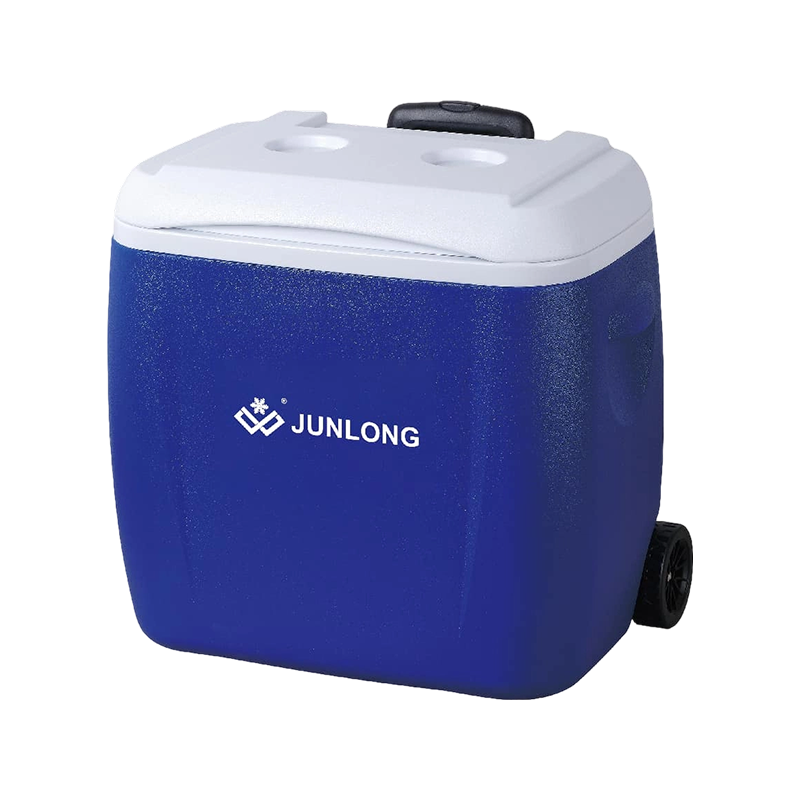
The 38-litre wheeled foam insulated cooler is designed to balance these requirements in one mobile cooling solution. It combines a generous internal volume with a telescopic handle, two smooth-rolling wheels, thick polyurethane foam insulation, a durable molded shell, and a lid-mounted cup holder. The result is a cooler that can be pulled like compact luggage while providing the thermal storage space expected from a medium-sized commercial cooler box.
With external dimensions of 490 × 350 × 470 millimeters, internal dimensions of 420 × 265 × 385 millimeters, and a product weight of approximately 5,000 grams, this cooler is sized for practical transport without becoming excessively bulky. Its 38-litre capacity makes it suitable for cold beverages, market produce, picnic provisions, fishing supplies, fresh ingredients, and other temperature-sensitive goods. It is equally useful at a market stall, on a beach, beside a sports field, at a campsite, or during a long road trip.
38 Litres Wheeled Foam Insulated Cooler for Market Stall
Designed for Mobile Cooling in Demanding Environments
Many cooler boxes are built around a simple concept: place a container on the ground, open the lid, and remove the contents. That design is adequate for short trips, but it becomes less convenient when the cooler must be carried over a long distance or moved several times during the day. A filled cooler can become heavy, especially when it contains ice, bottled water, canned drinks, fresh produce, or prepared food.
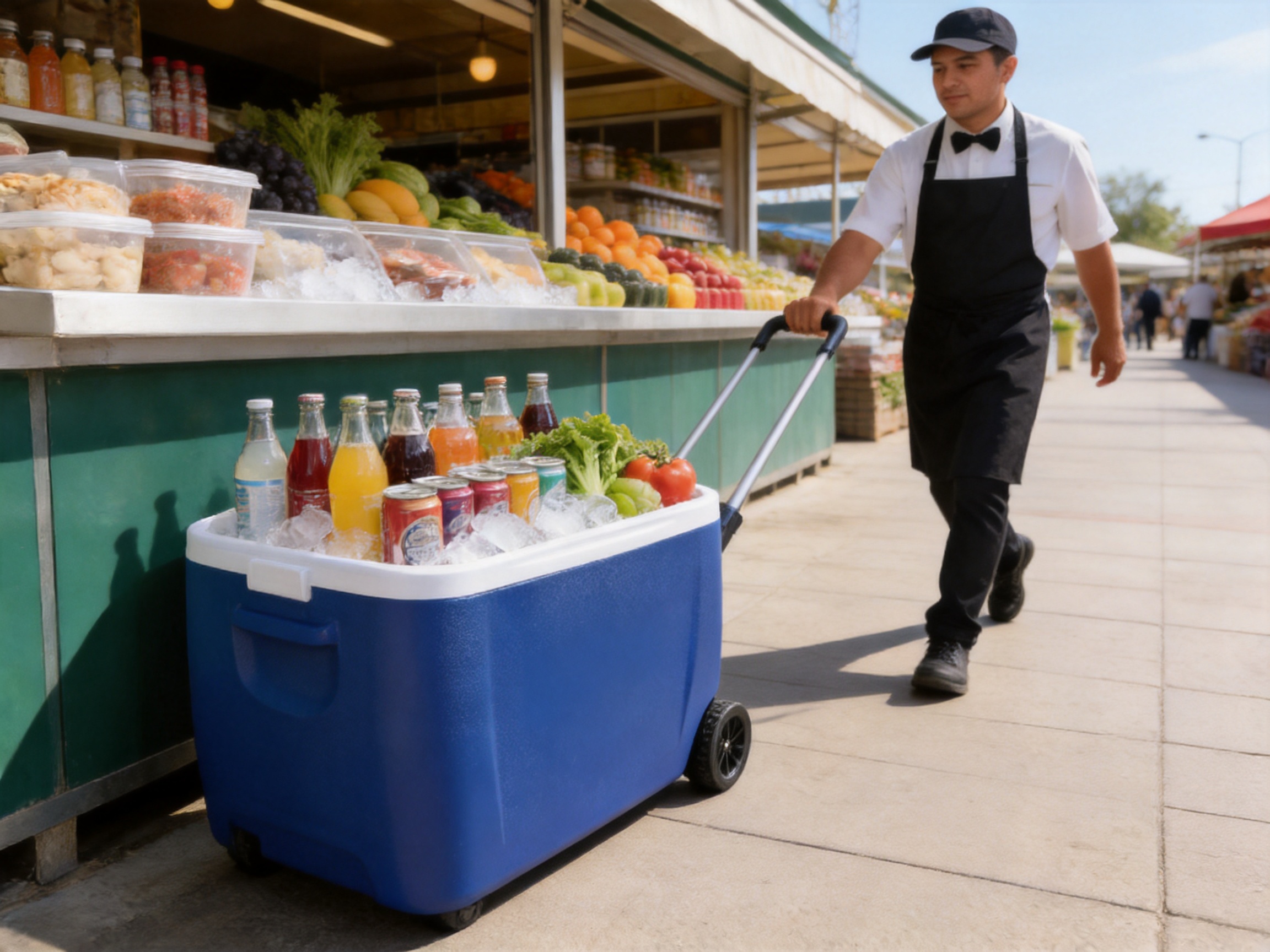
The wheeled configuration addresses this common limitation. Instead of lifting the full unit, the user can extend the handle and pull the cooler across suitable surfaces. The two-wheel system transfers much of the load from the user’s arms to the ground, helping reduce carrying effort during setup, restocking, relocation, and closing operations. This is particularly valuable for market vendors who may need to move supplies from a vehicle to a stall, or for event staff who must position cold products in different areas.
The telescopic handle contributes to both mobility and storage efficiency. It can be extended when the cooler is in transit and retracted when the unit is placed beside a table, inside a vehicle, or in a storage area. The luggage-style movement pattern also makes the cooler familiar and intuitive for users who already travel with wheeled bags. Rather than learning a complicated transport system, the operator can tilt the cooler and guide it with one hand.
A wheeled cooler also supports more organized outdoor work. A vendor can bring chilled beverages to a sales point without using a separate trolley. A camping group can move food supplies from the car to the campsite. A family can transport refreshments from a parking area to a picnic location. The same product can therefore serve commercial, recreational, and household applications without requiring different equipment for each environment.
Capacity That Fits Commercial and Family Requirements
The 38-litre capacity places the cooler in the medium cooler box category, between compact personal coolers and large bulk-storage chests. This size is large enough for a useful quantity of drinks or food while remaining manageable for transport and placement. For a market stall, it can hold chilled cans, bottles, packaged snacks, fresh produce, or ingredients awaiting sale or preparation. For a family outing, it can accommodate refreshments and food for several people without occupying the entire available space in a vehicle.
Internal dimensions of approximately 420 × 265 × 385 millimeters create a relatively deep storage area. This shape can be helpful for standing bottles upright, stacking containers, organizing packaged goods, or placing ice around food and drinks. The vertical dimension also allows the user to make better use of the cooler’s internal volume instead of relying only on a broad, shallow storage area.
Capacity should always be considered together with the way a cooler is used. A beverage vendor may use the space for cans, small bottles, and ice. A caterer may use sealed food containers and ingredient packs. A camper may combine drinks, fruit, vegetables, dairy products, and prepared meals. Because the cooler has a molded interior rather than a flexible soft bag, it provides a stable enclosure that helps protect stored items from compression and accidental impact.
The cooler’s capacity is also appropriate for customers who need a portable backup cold-storage unit. During an outdoor event, a primary refrigerator may be unavailable or too far from the service point. This wheeled cooler can act as a temporary cold-storage station near the point of use. At a market, it can supplement a larger display refrigerator. At a campsite, it can separate drinks from food. During transport, it can provide an insulated buffer against ambient temperatures.
| Specification | Details | Practical Benefit |
|---|---|---|
| Product type | Wheeled foam insulated cooler | Combines cold storage with mobile transport |
| Volume | 38 litres | Suitable for beverages, food, produce, and outdoor supplies |
| Outer dimensions | 490 × 350 × 470 mm | Compact enough for vehicle and stall placement |
| Inner dimensions | 420 × 265 × 385 mm | Provides useful vertical storage capacity |
| Primary materials | PP, PE, and PU foam | Combines structural durability with insulation |
| Approximate product weight | 5,000 g | Reasonable balance between portability and strength |
| Transport system | Telescopic handle and two wheels | Allows the cooler to be pulled like luggage |
| Lid feature | Integrated cup holder | Keeps a drink accessible while reducing spill risk |
| Insulation construction | PU foam insulation in the lid and body | Helps slow heat transfer and preserve cold conditions |
Layered Construction for Strength and Thermal Performance
The product uses a combination of polypropylene, polyethylene, and polyurethane foam. Each material contributes a different function to the overall construction. This layered approach is more effective than relying on a single plastic material for both structural and insulation performance.
Polypropylene is commonly used in molded products that require rigidity, impact resistance, and a practical balance between weight and strength. In a cooler application, it can contribute to the protective outer structure and interior components. Its molded form supports consistent dimensions and helps the cooler retain its shape during repeated handling.
Polyethylene is valued for toughness and resistance to everyday wear. It can help the cooler withstand contact with vehicle interiors, stall equipment, campsite surfaces, and other outdoor surroundings. The combination of PP and PE provides a durable plastic structure suitable for regular commercial use, transportation, and outdoor activities.
Polyurethane foam is the principal insulation layer. Foam insulation contains a large number of small cells that slow the movement of heat through the cooler walls and lid. When ice or chilled products are placed inside, the insulation helps reduce the rate at which outside heat enters. When the cooler is exposed to warm air, sunlight, or repeated opening, effective insulation gives the stored contents a better chance of remaining cold for longer.
The specification identifies PU insulation in both the lid and the body. This is important because the lid is one of the most significant heat-transfer areas in an insulated container. A highly insulated body can still lose cooling performance if the top is thin or poorly insulated. By incorporating foam into both sections, the design supports more balanced thermal protection around the storage compartment.
The listed insulation time is up to 48 hours under suitable conditions. Actual performance depends on several factors, including the starting temperature of the cooler, the amount and temperature of ice, how frequently the lid is opened, ambient temperature, exposure to direct sunlight, and how fully the interior is packed. Users seeking the best result should pre-chill the cooler, load cold products, minimize unnecessary opening, and keep the unit shaded whenever possible.
Advantages Over Conventional Non-Wheeled Cooler Boxes
A conventional box cooler may provide good storage volume, but it often requires two-handed lifting or carrying. This can be inconvenient when the unit is full. The wheeled design provides a clear functional advantage by turning a heavy load into a rolling load. The difference becomes especially noticeable when moving across parking areas, market floors, paved walkways, or campsite paths.
The cooler also offers an advantage over soft-sided bags when structural protection is important. Soft bags are lightweight and easy to fold, but they may not protect bottles, containers, or delicate food items as effectively. Their walls can collapse, and their insulation may be compressed during transport. The molded PP and PE construction of this cooler creates a firm enclosure that protects the contents and supports organized loading.
Compared with small personal coolers, the 38-litre format provides greater flexibility. Users are not limited to carrying only a few drinks or individual lunch containers. The increased capacity supports a full day of refreshments, product samples, ingredients, or market inventory. This can reduce the need for repeated trips between a vehicle and a selling or gathering area.
Compared with very large stationary ice chests, this model is easier to position and transport. A large chest may provide more total capacity, but it can become difficult for one person to lift or relocate. The 38-litre wheeled format offers a practical middle ground: enough room for meaningful storage, but not so much bulk that mobility becomes impractical.
The integrated cup holder is another useful distinction. A cooler lid often becomes an improvised surface for drinks, but a flat lid can allow cups and cans to slide or tip. A built-in cup holder creates a designated location for a beverage and improves convenience during outdoor use. At a stall, it can help keep the operator’s drink close at hand. At a campsite or picnic, it provides a small but valuable feature when tables are limited.
Benefits for Market Vendors and Mobile Sellers
Market vendors frequently work in environments where cold products must remain accessible, visible, and easy to transport. A wheeled cooler can support beverage sales, fresh-food service, temporary sampling, and mobile food preparation. Its compact footprint allows it to be positioned beneath or beside a market table without consuming excessive selling space.
For cold beverage sellers, the cooler can function as a mobile stock container. Drinks can be loaded in advance, cooled with ice, and moved directly to the sales point. The handle and wheels reduce the physical burden of transporting the inventory. When the event ends, the same system can be used to return remaining stock to the vehicle.
For produce vendors, the insulated interior may help protect temperature-sensitive fruits, vegetables, dairy items, and packaged foods during temporary outdoor display. The cooler does not replace a certified refrigerated transport system for regulated products, but it can provide useful short-term insulated storage when used according to the needs of the goods and applicable food-safety rules.
Mobile caterers can use the cooler to separate product categories. One unit may hold drinks, another may hold ingredients, or the cooler can serve as a temporary reserve during service. The molded interior is easier to organize than a loose collection of insulated bags, and the wheels make it practical to move between preparation and serving areas.
The cooler can also improve the appearance of a temporary sales operation. A clean, structured storage unit presents a more organized impression than loose cartons or soft bags. The lid can remain closed between transactions, helping limit unnecessary exposure of chilled products to warm air. The cup holder provides a convenient place for the operator’s own drink without requiring an additional table accessory.
Benefits for Camping, Travel, and Outdoor Recreation
Outdoor recreation often combines distance, uneven schedules, and limited access to refrigeration. A cooler for these conditions must be portable enough to move from a car to a campsite, spacious enough for group provisions, and insulated enough to support extended use. The wheeled 38-litre format addresses these needs without requiring users to carry every item by hand.
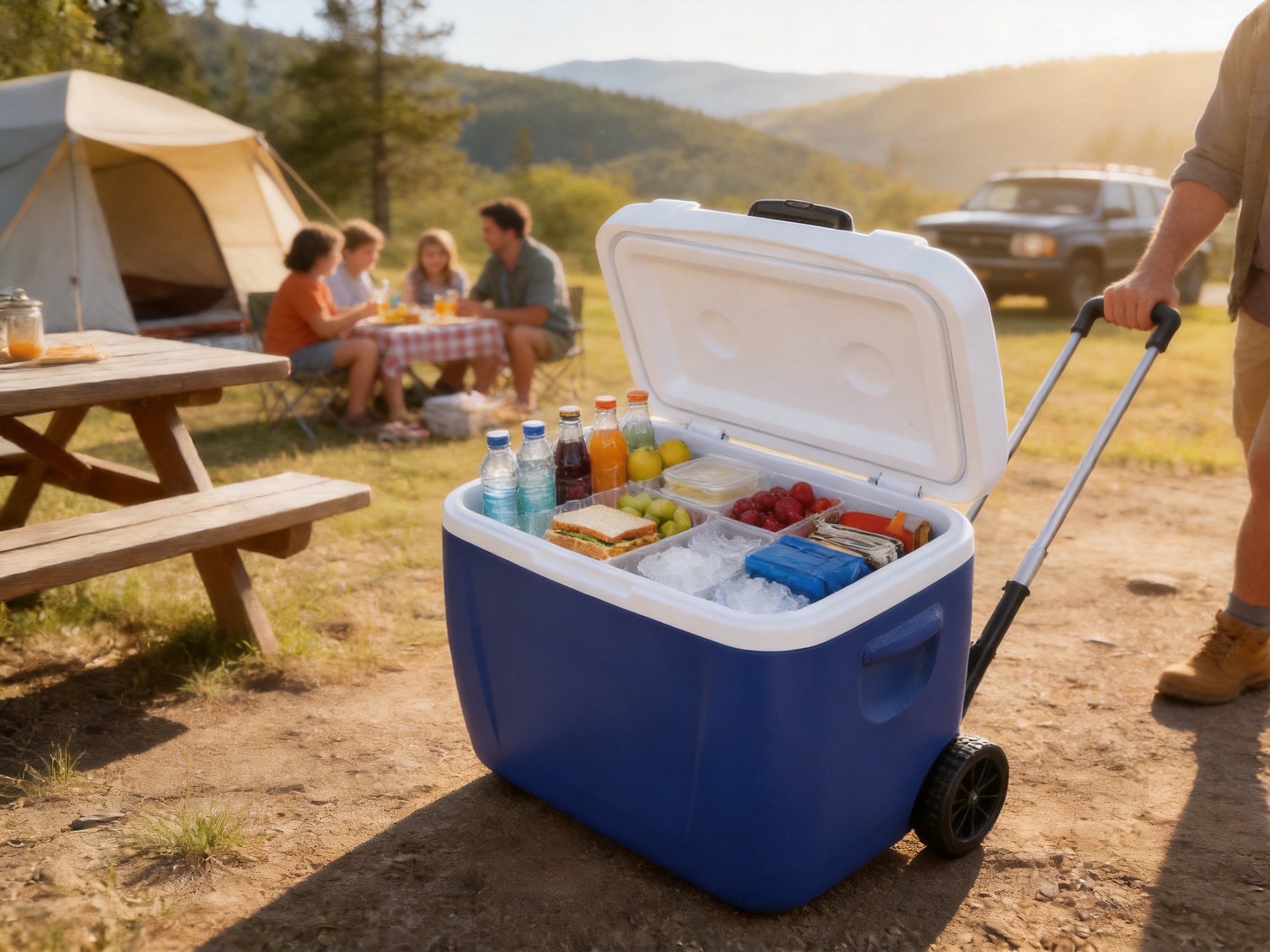
For camping, the cooler can store drinks, meat, dairy products, vegetables, prepared meals, and snacks. The deep interior can be arranged with reusable containers or baskets to reduce searching and limit the amount of time the lid remains open. A clear loading plan helps users find items quickly and improves temperature retention by reducing repeated opening.
At the beach, the cooler can transport cold drinks and food from a vehicle or access point to the chosen location. The wheels are most effective on firm, relatively smooth surfaces, so users should lift or carry the unit over deep sand, stairs, large stones, or other difficult terrain. Once positioned, the insulated body helps protect contents from warm outdoor conditions.
For road trips, the cooler can act as a supplementary cold-storage container. It can be loaded before departure and placed in an accessible area of the vehicle. The dimensions are suitable for many car-storage arrangements, although users should measure their vehicle before purchase and ensure that the cooler does not obstruct visibility, emergency equipment, or passenger movement.
Outdoor sports teams, fishing groups, and event volunteers can also benefit from the capacity. A single wheeled cooler can hold bottled water, electrolyte drinks, fruit, and other refreshments for a group. The rolling design is particularly helpful when the cooler must be moved around a sports ground or between an equipment vehicle and a sideline area.
Ergonomic Mobility and Practical Handling
Mobility is not only a matter of adding wheels. A useful wheeled cooler must combine a stable base, a functional handle, suitable balance, and a construction that can tolerate repeated pulling. The telescopic handle allows the user to adopt a natural pulling position, while the two-wheel arrangement provides a straightforward movement path.
The cooler is designed to tilt slightly during transport so that the wheels carry much of the load. Users should avoid dragging it sideways or forcing it over obstacles, as these actions can increase stress on the wheels, axle, handle, and molded body. On smooth ground, the system is intended to make movement easier and reduce the need for lifting.
The approximate 5-kilogram empty weight is an important part of the overall design balance. A cooler must be strong enough to protect the contents and contain insulation, but it should not be so heavy that its empty weight consumes the product’s portability advantage. The selected material combination provides a practical compromise for users who need a durable commercial-style cooler that remains movable by one person.
For safety and handling, the contents should be distributed evenly. Heavy bottles or ice should not be concentrated on one side, particularly when the cooler is being pulled over a distance. Even loading helps improve stability and can reduce unnecessary stress on the wheels and handle. The lid should be fully closed before moving, and the handle should be retracted when the unit is not being pulled.
Manufacturing Expertise Behind the Product
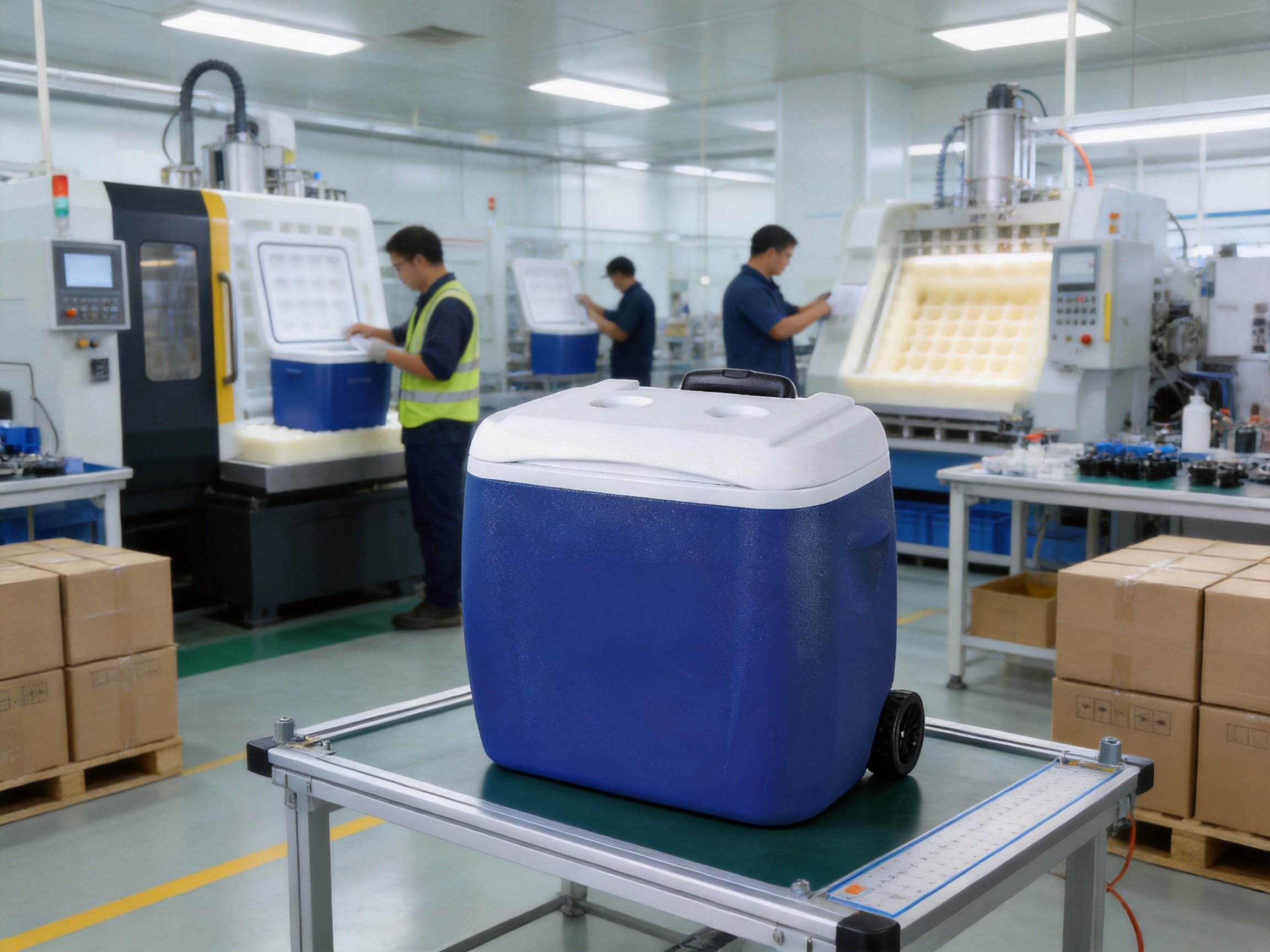
The cooler is produced by a manufacturer specializing in outdoor cooling and water-storage products. The company operates an independent factory of approximately 12,000 square meters and employs more than 100 people. Its production capabilities include automatic injection molding machines, blow molding machines, and foaming equipment. These facilities support the manufacture of molded plastic shells, insulated bodies, lids, and related outdoor products.
Automatic injection molding is important for producing consistent plastic components at commercial scale. In this process, prepared plastic material is heated and injected into a shaped mold under controlled pressure. Once the material cools and solidifies, the molded part can be removed and inspected. Consistent molding helps maintain reliable dimensions, repeatable fit between the lid and body, and a uniform exterior appearance across production batches.
For a cooler box, dimensional consistency affects more than appearance. The lid must align correctly with the body. The inner cavity must provide the specified capacity. Wheel and handle mounting points must be located accurately. Wall thickness must be controlled to support structural strength while avoiding unnecessary material use. A professional injection molding operation provides the process control necessary for these requirements.
Blow molding capability further strengthens the manufacturer’s ability to develop hollow plastic products and specialized outdoor containers. Although different products may use different molding methods, having multiple technologies available allows the factory to select an appropriate production process based on shape, volume, wall structure, and performance requirements. This flexibility supports a broader product range, including cooler jugs, outdoor water containers, and other molded products.
Foaming equipment is especially relevant to insulated coolers. The insulation layer must be formed within the intended body and lid structure with controlled distribution. Consistent foaming helps reduce weak areas in the insulation and supports more predictable thermal performance. The factory’s ability to combine molding and foaming operations helps streamline production and maintain closer control over the finished cooler.
Manufacturing capability is supported by product development and quality management. The company reports an internal research and development team that works on new products, functional improvements, and customer-specific requirements. A rigorous quality system helps monitor materials, production processes, assembly, and finished products. For importers and distributors, this type of integrated capability can reduce dependence on multiple outside suppliers and simplify communication during product development.
Integrated Production from Development to Delivery
A manufacturer that integrates product development, production, and sales can respond more efficiently to customer requirements than a business focused only on trading finished products. Product concepts can be reviewed against available tooling, materials, production equipment, packaging needs, and target markets. This integrated approach is useful when a buyer wants to modify a cooler’s color, branding, packaging, or functional details.
For distributors, the ability to communicate directly with a factory can improve project coordination. Questions about sample development, production timing, tooling, material selection, and packaging can be handled within a connected manufacturing organization. This can help reduce misunderstandings between a buyer’s specifications and the final product.
The factory’s experience in producing outdoor cooling and water-storage products also provides category knowledge. Cooler boxes, insulated jugs, ice buckets, and outdoor water containers must all address portability, durability, cleaning, thermal performance, and user convenience. Experience across these related product categories can support more practical design decisions and help identify potential production issues at an earlier stage.
Quality control is particularly important for products used outdoors and in commercial settings. The cooler must be checked for molding defects, incomplete surfaces, sharp edges, incorrect assembly, wheel and handle function, lid fit, and general structural condition. Insulated products may also require attention to foam distribution and sealing. A systematic inspection process helps improve consistency between units delivered to customers.
OEM and ODM Customization Opportunities
The product platform is suitable for OEM and ODM cooperation. OEM services allow a buyer to use an existing product structure with customized branding and presentation. ODM services provide a broader opportunity to develop a product around a buyer’s requirements, drawings, samples, target market, or intended application.
Customization may include color selection, logo placement, packaging design, product labeling, and carton specifications. For a market-equipment distributor, a distinctive color or printed identity may help create a coordinated product range. For a beverage company, a logoed cooler can support promotional campaigns and field marketing. For a retailer, customized packaging can align the cooler with a private-label brand and the visual standards of the sales channel.
More advanced projects may involve changes to the exterior shape, internal arrangement, handle design, wheels, lid configuration, or accessory features. Any structural modification should be reviewed against tooling cost, minimum order quantity, production time, insulation performance, and testing requirements. A professional development process should begin with a clear specification and progress through drawings, samples, evaluation, and approval before mass production.
Customization is most successful when the buyer provides detailed information about the intended use. Important questions include where the cooler will be sold, how it will be transported, what type of goods it will hold, what climates it will encounter, how frequently it will be opened, and what packaging or regulatory requirements apply. This information allows the manufacturer to recommend appropriate materials, colors, accessories, and quality checks.
Construction Details That Support Long-Term Use
Repeated outdoor use exposes a cooler to impacts, temperature changes, moisture, dirt, and frequent handling. The hard molded structure helps resist the deformation that can occur with soft containers or thin-walled products. A stable body also makes cleaning and loading more straightforward because the internal space remains open and accessible.
The PP and PE construction is intended for demanding everyday use, including commercial transport and outdoor activities. Nevertheless, durability depends on correct handling. The cooler should not be used as a step, seat, or platform unless the manufacturer specifically approves that function. Excessive point loads can damage the lid, hinges, shell, or insulation even when the product is otherwise robust.
The iron rod and wheel components contribute to transport strength. These parts should be kept free of excessive mud, sand, and debris. After use in dirty conditions, the wheels and lower body should be cleaned so that accumulated particles do not interfere with rolling. If the cooler is stored for an extended period, it should be dry, clean, and positioned in a way that avoids unnecessary pressure on the handle or wheels.
Cleaning should be performed with mild soap, clean water, and a soft cloth or sponge. Abrasive pads, aggressive solvents, and high heat may damage plastic surfaces or seals. The interior should be dried before storage to minimize odors and moisture buildup. Food residues should be removed promptly, especially after use with meat, dairy products, sauces, or other perishable goods.
Using the Cooler for Better Temperature Retention
Insulation slows heat transfer, but it does not actively produce cold. The user’s loading and operating practices therefore have a significant effect on performance. The cooler should be pre-cooled before loading whenever possible. This can be done by placing ice or cold packs inside for a short period and removing the meltwater before adding the final contents.
Products should be chilled in a refrigerator or other suitable cold-storage system before they are placed in the cooler. Loading warm drinks into an insulated box forces the ice or cold packs to remove a large amount of heat. Starting with cold contents allows the insulation to perform its intended role more efficiently.
The cooler should be filled efficiently without blocking the lid from closing completely. Empty air space can allow warm air to circulate when the lid is opened. Ice, reusable cold packs, or properly sealed cold-storage materials can be positioned around the contents to improve contact with the stored items. Food should be packed in sealed containers or protective bags to maintain hygiene and reduce the risk of leakage.
Every lid opening allows warmer ambient air to enter. Users should organize the contents before departure so frequently needed items are easy to find. At a market stall, popular drinks can be placed near the top. At a campsite, meals for the next serving period can be grouped together. A simple organization system reduces the duration and frequency of openings.
Direct sunlight should be avoided whenever possible. The cooler can be placed beneath a canopy, table, vehicle shade, or other protective cover. A shaded cooler absorbs less heat than one exposed to strong sunlight, particularly during hot weather. The unit should also be kept away from hot engines, exhaust outlets, cooking equipment, and other heat sources.
The stated insulation duration of up to 48 hours should be understood as a performance reference under suitable conditions rather than a universal guarantee for every environment. A fully loaded, pre-chilled cooler that remains closed and shaded may perform much better than a partially filled cooler that is opened repeatedly in direct summer sun. Users should evaluate the product according to their operating conditions and the temperature requirements of the stored goods.
Applications Across Different Customer Segments
The versatility of the cooler makes it suitable for several customer groups. Outdoor retailers can position it as a family picnic product, a camping accessory, or a road-trip cooler. Commercial equipment suppliers can offer it to food vendors, market sellers, sports organizers, and event contractors. Promotional-product distributors can explore branded versions for beverage companies, hospitality businesses, and outdoor campaigns.
For hospitality operations, the cooler can provide mobile beverage support at outdoor receptions, garden events, poolside activities, and temporary service stations. Its wheels allow staff to reposition supplies without carrying a full container. The lid-mounted cup holder adds convenience for informal settings, although it does not replace dedicated service tables or food-safe operating procedures where those are required.
For construction and field-service teams, the cooler can hold drinking water, chilled beverages, and packed meals at temporary work locations. The durable structure and rolling transport can be beneficial when workers operate away from permanent facilities. Employers should still observe workplace requirements concerning hydration, food storage, cleaning, and safe manual handling.
For sports clubs and schools, it can serve as a sideline refreshment cooler. Bottled water, fruit, and cold drinks can be stored in one mobile unit and moved between training areas. The 38-litre capacity offers a useful balance for smaller teams and practices, while multiple units can be combined for larger events.
For families, the cooler provides a reusable alternative to disposable packaging and multiple small bags. Its hard-shell construction supports repeated seasonal use, and the wheels simplify transport when the cooler is fully loaded. The unit can be used for picnics, fishing, beach visits, camping holidays, outdoor celebrations, and long-distance travel.
Why the Product Is a Strong Choice for Importers
Importers and wholesalers generally evaluate more than the appearance of a cooler. They consider capacity, packaging, shipping efficiency, durability, product differentiation, production reliability, and customization potential. This wheeled model offers several features that can help create a clear market position: a medium commercial capacity, visible mobility hardware, PU foam insulation, a molded plastic body, and a convenient lid accessory.
The product’s dimensions create a useful balance between shelf presence and transport practicality. It is large enough to communicate meaningful capacity, but not so large that retailers must dedicate excessive warehouse or display space. Its wheels and telescopic handle are immediately visible benefits that can be communicated easily in product listings, catalogs, and retail packaging.
The cooler can also be sold through different channels. Outdoor stores may emphasize camping and travel. Market-equipment suppliers may focus on vendors and food businesses. Home-and-garden retailers may present it as a family picnic or garden-party product. The same core product can therefore support several marketing messages without requiring a completely different design.
Factory-based OEM and ODM support adds value for buyers seeking product differentiation. Custom colors and logos can help create a recognizable range. Packaging can be adapted for regional language requirements and retail presentation. Product development based on drawings or samples can help larger customers create a version aligned with a specific application.
Stable manufacturing capacity is also important for repeat orders. An independent factory with injection molding, blow molding, and foaming equipment can support ongoing production rather than relying entirely on temporary sourcing arrangements. A dedicated research and development team and quality management system further support continuous product improvement and consistent output.
Recommended Evaluation Before Bulk Purchase
Before placing a large order, buyers should evaluate samples under realistic use conditions. The sample should be inspected for external finish, lid alignment, handle movement, wheel rolling, interior dimensions, and overall stability. If the cooler will be used for commercial transport, it should also be tested with a representative load across the types of surfaces expected in the target market.
Thermal testing should reflect the intended application. Buyers may compare results using pre-chilled products, different ice quantities, different ambient temperatures, and different opening frequencies. The test should record the starting conditions and loading arrangement so the results can be interpreted consistently. If the product is intended for regulated food transport, the buyer should determine whether additional testing, documentation, or certification is required in the destination market.
Packaging should be reviewed for protection during shipping and storage. The handle, wheels, lid, and corners may require suitable protection against compression and impact. Carton dimensions should be considered together with container loading, palletization, warehouse space, and retail display. The manufacturer and buyer should agree on labeling, product markings, barcode requirements, and instruction materials before production.
Buyers should also clarify production details such as material specifications, color references, logo artwork, sampling procedure, quality standards, inspection method, lead time, and after-sales support. Clear documentation helps ensure that the final order matches the approved sample and reduces avoidable disagreements.
Care, Storage, and Responsible Use
After each use, the cooler should be emptied and cleaned. Meltwater should not be left inside for extended periods. Food residue, sugary drinks, and organic material can create odors and make cleaning more difficult. The interior should be wiped dry before the lid is closed for long-term storage.
The cooler should be stored in a dry, ventilated area away from sharp objects, extreme heat, and direct sunlight. Prolonged exposure to intense ultraviolet radiation may affect the appearance and long-term condition of plastic products. Keeping the cooler protected when it is not in use helps preserve both the shell and accessory components.
The handle should be extended and retracted smoothly without excessive force. Wheels should be checked periodically for visible damage or obstruction. If the cooler is transported in a vehicle, it should be positioned securely so that it cannot slide during braking or turning. A stable placement protects the cooler and reduces the risk of injury or damage to other cargo.
The cooler is intended for insulated storage and transport. It should not be used to store hazardous chemicals, combustible materials, dry ice without appropriate procedures, or items that may damage plastic and insulation. Perishable food should be managed according to applicable food-safety requirements, including safe temperatures, clean packaging, and suitable handling time.
Q&A: Common Questions About the Wheeled Cooler
What is the capacity of the cooler?
The cooler has a nominal capacity of 38 litres. This makes it suitable for a combination of drinks, food, produce, ice, cold packs, or other outdoor supplies. The usable arrangement will vary depending on the size and shape of the items loaded inside.
What are the external dimensions?
The external dimensions are approximately 490 × 350 × 470 millimeters. These measurements should be compared with the available space in a vehicle, storage room, market stall, or retail display before purchase.
What are the internal dimensions?
The internal dimensions are approximately 420 × 265 × 385 millimeters. The interior is relatively deep, which can be useful for upright bottles, stacked food containers, and organized storage.
How does the wheeled system work?
The cooler has a telescopic handle and two wheels. The user extends the handle, tilts the cooler slightly, and pulls it across a suitable surface in a luggage-like motion. It is best used on firm, reasonably smooth ground.
Is the cooler suitable for market vendors?
Yes. Its capacity, molded structure, insulation, handle, and wheels make it suitable for mobile beverage sellers, temporary food stalls, market vendors, caterers, and event operators. Users should apply appropriate food-safety practices for the products they store and sell.
Is it suitable for camping and family trips?
Yes. The 38-litre capacity can hold refreshments and food for family outings, camping trips, fishing activities, beach visits, and road travel. The wheels help reduce the effort required to move the cooler from a vehicle to an outdoor location.
What materials are used?
The product uses PP and PE for the molded structure and PU foam for insulation. This combination is intended to provide a balance of durability, structural stability, and resistance to heat transfer.
How long can it keep contents cold?
The stated insulation performance is up to 48 hours under suitable conditions. Actual results depend on ice or cold-pack quantity, starting temperature, ambient conditions, sunlight, loading density, and how often the lid is opened.
Does the lid include any special feature?
Yes. The lid includes an integrated cup holder. This provides a designated place for a drink and can help reduce spills during outdoor use.
How much does the cooler weigh?
The product weight is approximately 5,000 grams, or 5.0 kilograms, before adding ice, drinks, food, or other contents.
Can the product be customized?
OEM and ODM customization options may include color, logo, packaging, and product development based on drawings or samples. Custom projects should be discussed in detail because minimum order quantities, tooling, sampling, and production requirements may vary.
What should users do to maximize cooling performance?
Pre-chill the cooler and its contents, use an appropriate amount of ice or cold packs, keep the lid closed as much as possible, avoid direct sunlight, and organize frequently used items near the top. These practices help the insulation work more effectively.
Can the cooler be used on sand or rough ground?
The wheels are most effective on firm, smooth surfaces. Deep sand, stairs, large stones, and heavily uneven ground may require the cooler to be lifted or carried. Users should avoid forcing the wheels over obstacles that could damage the wheel assembly or handle.
What makes this cooler different from a soft insulated bag?
The hard molded body provides a more stable structure and better protection for the contents. The wheeled design also supports the movement of a larger load, while the PU foam insulation in the body and lid supports longer-lasting cold storage than a lightly insulated bag may provide.
What makes it different from a large stationary ice chest?
The 38-litre format is more manageable for one-person transport, and the telescopic handle with two wheels allows it to be pulled like luggage. It provides useful capacity without the bulk and handling difficulty often associated with very large stationary chests.
Conclusion
The 38-litre wheeled foam insulated cooler is a practical solution for users who need capacity, mobility, and dependable insulation in one product. Its PP and PE molded structure provides a durable enclosure, while PU foam in the body and lid helps slow heat transfer. The telescopic handle and two-wheel system reduce the effort required to move a loaded cooler, making it particularly suitable for market stalls, mobile vending, camping, road trips, beach outings, sports events, and family gatherings.
The product’s medium capacity creates a useful balance. It is larger and more capable than a personal cooler, but easier to handle than an oversized stationary chest. The integrated cup holder adds convenience, while the deep internal dimensions provide practical space for bottles, containers, produce, and packaged food. With suitable loading, shading, and handling practices, the cooler can support extended outdoor use and provide insulation performance of up to 48 hours under appropriate conditions.
Its value is strengthened by the manufacturer’s integrated production capabilities. Automatic injection molding, blow molding, foaming equipment, product development resources, and quality management systems provide a foundation for consistent manufacturing. OEM and ODM services allow distributors, retailers, and commercial customers to request customized colors, logos, packaging, and product solutions based on specific market requirements.
For buyers seeking a versatile cooler box with visible functional advantages and commercial customization potential, this wheeled model offers a strong combination of storage volume, transport convenience, construction quality, and outdoor practicality. It is designed not merely to hold cold items, but to make the entire process of moving, organizing, selling, and enjoying chilled goods easier.
References
1. Product specification sheet for the 38-litre wheeled foam insulated cooler, including dimensions, capacity, material composition, product weight, and feature information.
2. Manufacturer-provided information concerning molded plastic production, polyurethane foaming equipment, product development, quality management, and OEM/ODM services.
3. General principles of insulated container operation, including pre-chilling, thermal transfer reduction, cold-pack placement, and minimizing lid openings.
4. General outdoor food-storage and cooler-care practices concerning cleaning, temperature management, transport, and safe handling.
5. General product-development practices for molded plastic goods, including sample approval, dimensional inspection, packaging review, and production quality control.
Product: 38 Litres Wheeled Foam Insulated Cooler for Market Stall

Product Recommendation
link
Office
- TEL: +86-574-63787606
- Phone: +86-13777994798
- E-mail: sales@nbjunlong.com
- WhatsApp: 13777967488
- Address: No. 1, Lane 3, Development Road, Longtouchang, Longshan Town, Cixi City, Zhejiang Province, China
Get In Touch
Copyright © Ningbo Junlong Outdoor Products Co., Ltd. All Rights Reserved.
China Plastic Insulated Cooler Box Manufacturer Custom Cooler Box Supplier
