- SMALL ORDERS FOR STANDARD ITEMS. Contact Now
- OUTDOOR COOLING SOLUTIONS, MADE IN‑HOUSE. Contact Now
- COOLER BOXES THAT FIT REAL OUTDOOR LIFE. Contact Now

 LANGUAGE
 日本語
 Español
 عربى

Content
- 1 A Flexible Cooling Solution for Different Activities
- 2 Product Overview
- 3 Insulation Designed for Practical Temperature Retention
- 4 Food-Contact Materials and Durable Construction
- 5 Advantages Over Single-Size and Low-Insulation Alternatives
- 6 Applications for Outdoor and Everyday Use
- 7 Manufacturing Strengths and Production Capabilities
- 8 Product Development, Quality, and Customization
- 9 Why the Two-Piece Format Is Attractive for Commercial Buyers
- 10 Efficient Use and Care Recommendations
- 11 Important Considerations for Temperature-Sensitive Contents
- 12 Quality and Supply Advantages from an Integrated Factory
- 13 Brand and Private-Label Opportunities
- 14 Comparison of Use Scenarios
- 15 Purchasing and Specification Checklist
- 16 Frequently Asked Questions
- 16.1 What does the set include?
- 16.2 What is the main advantage of having two cooler sizes?
- 16.3 What materials are used?
- 16.4 Is the 8-liter cooler suitable for ice packs?
- 16.5 Is the 30-liter cooler BPA-free?
- 16.6 Can the coolers be used for food?
- 16.7 Can the set replace a refrigerator?
- 16.8 Can the product be customized?
- 16.9 What manufacturing processes are available?
- 16.10 Where is the manufacturer located?
- 16.11 Is the product suitable for private-label sales?
- 16.12 What should users do after using the cooler?
- 17 Conclusion
- 18 References
- 19 Product: 2-Piece Insulated Cooler Box Set – Outdoor & Family Combo (8L+30L)
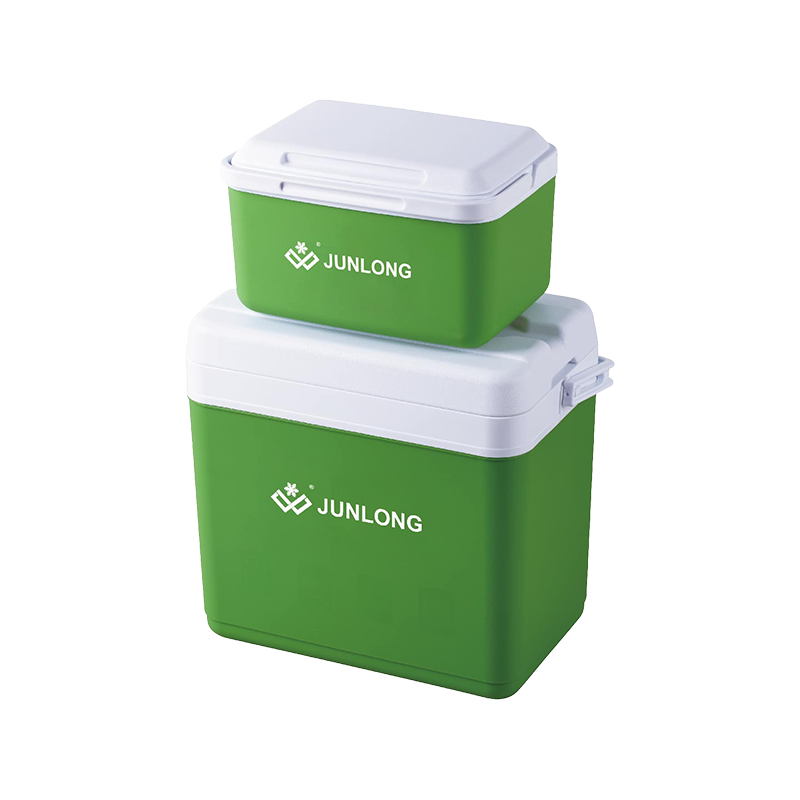
2-Piece Insulated Cooler Box Set – Outdoor & Family Combo (8L+30L)
Outdoor cooling needs are rarely identical from one occasion to the next. A person taking lunch to work may need only a compact container, while a family spending the day at the beach may require considerably more storage. A campsite, road trip, sporting event, fishing excursion, or grocery journey can create an entirely different demand for carrying chilled food and beverages. The 2-Piece Insulated Cooler Box Set, combining an 8-liter cooler with a 30-liter cooler, is designed to answer these different requirements with one coordinated solution.
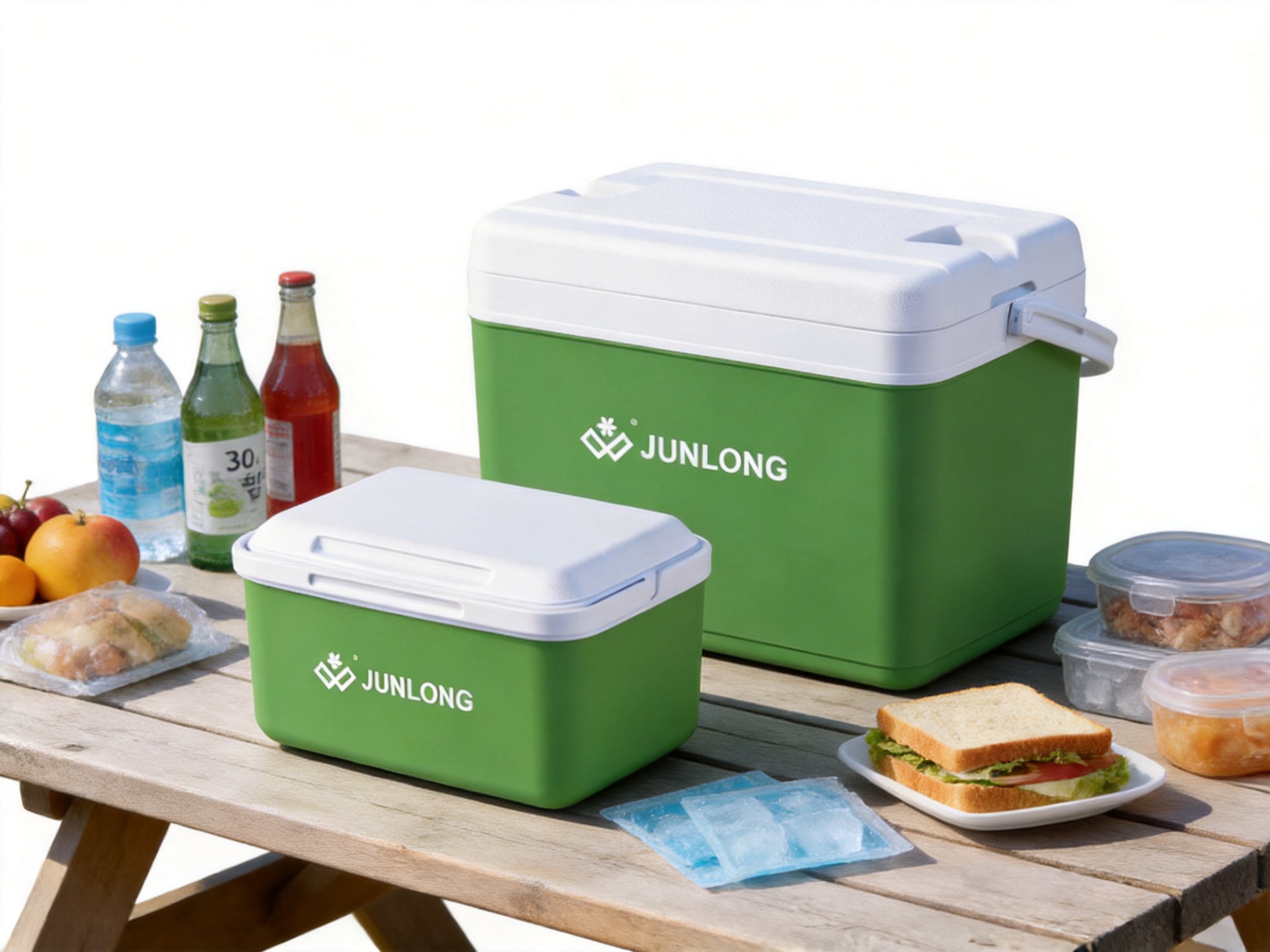
Instead of forcing users to select between a small cooler and a large ice box, this set provides both. The compact 8-liter unit is suitable for personal refreshments, snacks, medicines that require short-term temperature protection, or a small meal. The larger 30-liter unit offers the capacity needed for family provisions, multiple bottles, prepared food, produce, and ice packs. Used together, the two coolers create a flexible storage system. Used separately, they allow customers to take only the capacity required for a particular activity.
The set is manufactured by Ningbo Junlong Outdoor Products Co., Ltd., an experienced Chinese manufacturer specializing in insulated cooler boxes, cooler jugs, ice buckets, and outdoor water containers. The company combines product development, injection molding, blow molding, foaming, assembly, quality management, and sales support within an integrated manufacturing operation. This production foundation is important for distributors, wholesalers, retailers, hospitality buyers, and private-label customers seeking consistent products rather than isolated trading-company supply.
A Flexible Cooling Solution for Different Activities
The central advantage of a two-piece cooler set is flexibility. A single cooler has a fixed capacity, but a paired set gives users more control. The 8-liter cooler can accompany one or two people on a short outing, while the 30-liter box can be reserved for larger gatherings or longer trips. When the whole group travels, both units can be used together to separate drinks from food, organize raw ingredients away from ready-to-eat items, or divide products according to temperature and access frequency.
This flexibility also improves everyday practicality. A large cooler is useful for a family picnic but can be unnecessarily bulky for a quick lunch. A small cooler is convenient for personal use but becomes restrictive when several people need refreshments. The two-piece format removes that compromise. Users can select the smaller cooler for a short errand, the larger cooler for a family outing, or both when carrying capacity is more important than portability.
For retailers, a set can be easier to position than two unrelated cooler products. It provides a clear value proposition: customers receive two sizes in one purchase and can use them for different situations. For promotional campaigns, the combination can be marketed as an outdoor family package, a travel-ready cooling set, or a practical food and beverage storage solution. The format is also suitable for seasonal displays during summer, holiday travel periods, camping seasons, and outdoor sporting events.
The 8-liter and 30-liter capacities are deliberately complementary. The smaller size supports convenience and portability, while the larger size supports volume. This arrangement is more useful than offering two nearly identical coolers because each piece has a distinct role. It also enables better organization. For example, the compact cooler can hold drinks and frequently accessed snacks, while the larger box can store bulk food and reserve ice.
Product Overview
| Item | Specification | Practical Value |
|---|---|---|
| Product type | Two-piece insulated cooler box set | Provides two capacities for different users and activities |
| Small cooler | 8 liters | Suitable for personal meals, snacks, drinks, and short outings |
| Large cooler | 30 liters | Suitable for family provisions, group refreshments, and longer trips |
| Overall listed size | 450 × 270 × 405 mm | Supports planning for storage, transport, and retail display |
| Listed weight | 3,800 g | Offers a practical balance between structure and portability |
| Materials | Food-grade PP and PE with EPS foam insulation | Supports safe contact, durability, and thermal protection |
| Small-unit feature | Ice-pack-equipped design | Helps users prepare the compact cooler for chilled contents |
| Large-unit feature | BPA-free construction | Supports consumer confidence for food and beverage storage |
| Customization | OEM and ODM services | Allows changes to color, logo, packaging, drawings, or samples |
The listed dimensions for the product are 450 × 270 × 405 millimeters, with a listed weight of 3,800 grams. Buyers should confirm final carton dimensions, individual-unit dimensions, loading quantities, and packaging specifications during commercial discussions, particularly when planning container loading or retail distribution. The set format makes packaging development especially important because both cooler sizes must be protected while remaining easy to handle and display.
Insulation Designed for Practical Temperature Retention
Insulation is the fundamental performance feature of a cooler box. A cooler must slow the transfer of heat from the outside environment to its internal storage area. The faster heat enters, the faster ice melts and the sooner food and drinks lose their desired temperature. This set uses EPS foam insulation within a food-grade PP and PE construction. The combination is intended to create a durable outer structure and a thermal barrier that supports temperature retention during ordinary outdoor use.
EPS foam is widely used in insulated containers because its cellular structure contains many small air spaces. Air is a relatively poor conductor of heat, so these spaces help reduce the speed of thermal transfer. The effectiveness of a cooler depends on more than insulation alone. Wall thickness, lid fit, sealing design, internal volume, outdoor temperature, loading temperature, ice quantity, and how frequently the lid is opened all influence actual results. Nevertheless, an EPS-insulated structure provides a practical foundation for keeping chilled contents cooler for longer than an ordinary uninsulated plastic container.
The use of a coordinated insulation system in both sizes gives the product set a consistent performance identity. A customer who uses the 8-liter cooler for a short trip and the 30-liter cooler for a family outing receives the same general approach to construction and temperature protection. This is useful for brand owners and retailers because the set can be presented as a unified product family rather than two unrelated containers.
The compact 8-liter cooler is equipped for use with an ice pack, making it particularly suitable for quick preparation. Ice packs can be pre-frozen and placed inside the cooler before departure. This approach avoids the mess associated with loose melting ice and can help preserve usable internal space. It is convenient for packed lunches, beverages, small quantities of fresh food, and other items that benefit from a chilled environment during transport.
The 30-liter cooler provides more room for ice packs, chilled bottles, meal containers, and larger food packages. Because a larger cooler may be used for longer or more demanding outings, proper loading remains important. Pre-cooling the container, using sufficiently chilled contents, minimizing unnecessary lid opening, and arranging cold sources around the stored goods can all improve practical performance.
Food-Contact Materials and Durable Construction
The cooler set is based on food-grade PP and PE materials. Polypropylene and polyethylene are commonly selected for outdoor storage products because they offer a useful balance of toughness, processability, moisture resistance, and ease of cleaning. In a cooler box, the material must withstand regular handling, contact with condensation, changing outdoor conditions, and the repeated loading and unloading of food and beverages.
Food-grade material selection is especially relevant when a cooler is used for prepared meals, produce, bottled drinks, or packaged ingredients. The material specification gives buyers a clearer basis for evaluating the product than a generic statement such as “plastic cooler.” For commercial purchasers, it also supports the preparation of product information, compliance documentation, packaging claims, and customer instructions. Any market-specific food-contact requirements should still be reviewed with the manufacturer and relevant testing bodies before sale.
Polypropylene can contribute to a rigid, impact-resistant outer structure, while polyethylene may support toughness and smooth molded surfaces. The exact distribution of materials within the final construction should be confirmed in technical documentation, but the combined PP and PE approach reflects the needs of a practical reusable outdoor container. Unlike thin disposable packaging, a rigid cooler is designed for repeated use, transport, and storage between trips.
A durable cooler can provide value in several ways. It reduces the need to replace a container after occasional outdoor use, supports repeated seasonal sales, and gives customers confidence that the product is intended for more than a single event. Durability also matters during wholesale distribution. Products may be moved through factories, freight terminals, warehouses, retail stores, and customer vehicles before they reach their final use environment. Strong material selection and controlled molding help reduce the risk of damage during this journey.
Advantages Over Single-Size and Low-Insulation Alternatives
Compared with a single-size cooler, the two-piece set offers a broader range of use. A single 8-liter product may be easy to carry but insufficient for group use. A single 30-liter box may offer adequate storage but be excessive for a personal lunch or short trip. The set gives users an option for both situations without requiring separate purchases at different times.
Compared with ordinary plastic storage boxes, the insulated construction provides a clear functional advantage. A standard storage box may organize items, but it is not designed to slow heat transfer in the same way. The EPS insulation layer helps the cooler perform a temperature-retention function in addition to its storage function. This makes the product appropriate for chilled drinks, picnic food, groceries, campsite provisions, and other temperature-sensitive contents during short-term transport and outdoor use.
Compared with disposable foam containers, a reusable PP and PE cooler box offers a more durable and organized solution. Disposable containers may be useful for one-time service, but they are less suitable for repeated family activities, retail food transport, or long-term household ownership. A reusable cooler can be cleaned, stored, and used again, allowing customers to obtain value over many outings.
Compared with soft-sided cooler bags, a rigid insulated box can provide greater structural support. It is less likely to collapse when loaded with bottles or containers and may offer better protection for delicate food packaging. A hard-sided design can also be easier to stack in a vehicle or storage area, although users should follow the product’s intended loading and handling instructions.
Compared with poorly coordinated cooler bundles, this set has a logical capacity relationship. The 8-liter and 30-liter sizes are not random additions. They cover personal and group-use scenarios and can be used individually or together. The shared material and insulation foundation also helps maintain a consistent appearance and product experience across the set.
Applications for Outdoor and Everyday Use
Family Picnics
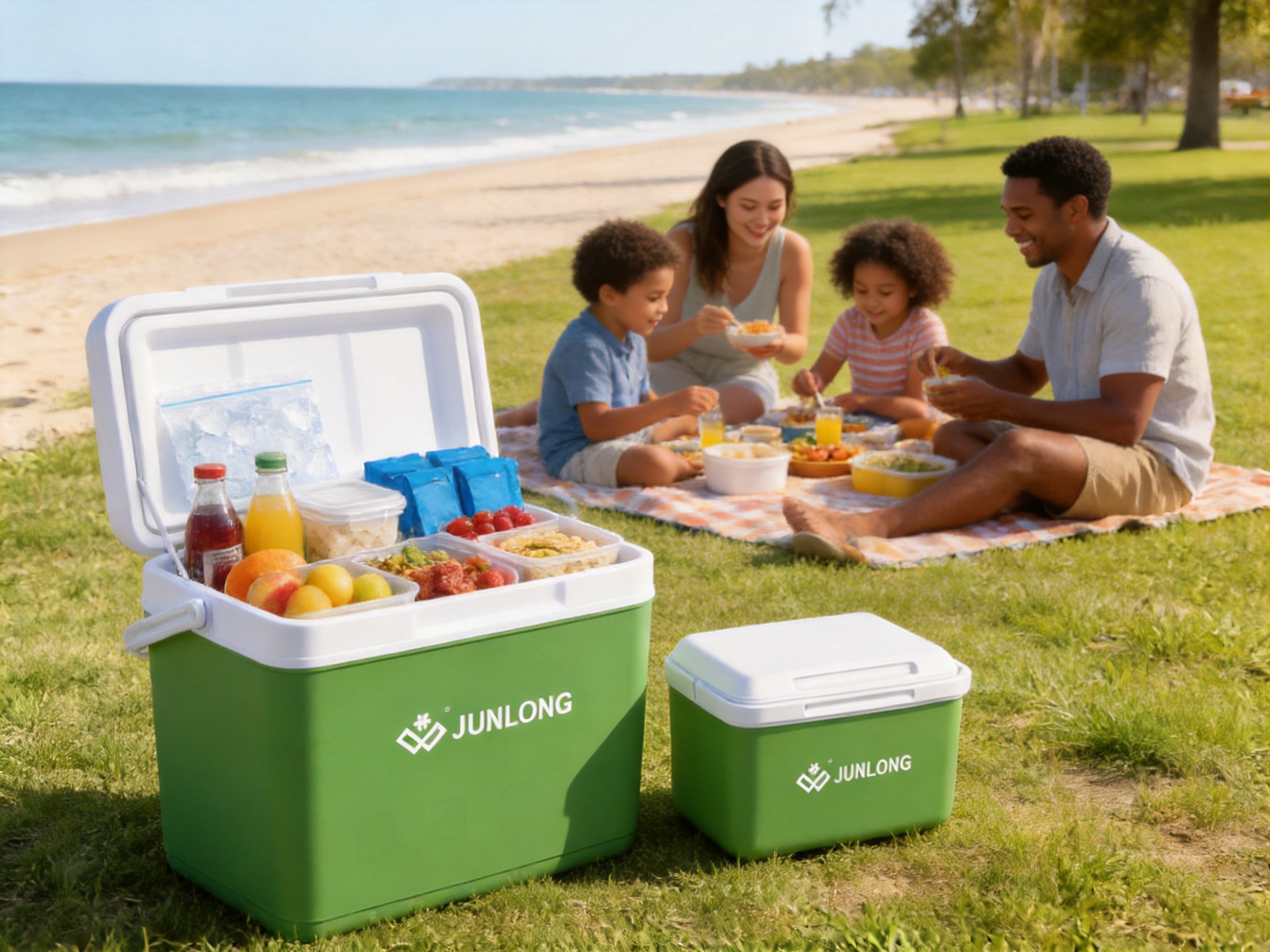
Family picnics often require multiple categories of food and drinks. The 30-liter cooler can hold larger quantities of chilled beverages, sandwiches, fruit, containers, and ice packs. The 8-liter cooler can be used for snacks, children’s drinks, frequently accessed items, or special foods that the family wants to keep separately organized. Carrying two sizes can make the outing more manageable because users do not need to open the large cooler every time someone wants a drink.
Beach and Park Trips
Beach and park environments typically involve warm weather, direct sunlight, and repeated access to refreshments. The insulated design helps slow warming, while the compact size is convenient for a small group or short visit. For a larger party, both units can divide beverages and food according to use. Keeping the coolers closed when not needed and placing them away from unnecessary direct heat can help preserve their cooling performance.
Camping and Road Travel
Camping and road travel require efficient use of limited vehicle and storage space. The 30-liter cooler is appropriate for carrying a larger supply of food and beverages, while the 8-liter unit can serve as a day-use cooler when the main provisions remain at the campsite or in the vehicle. This two-stage approach reduces the need to move the entire food supply every time users leave the main camp area.
Fishing and Outdoor Recreation
Outdoor recreation often involves long periods away from kitchens and refrigeration. A cooler can be used to protect packed meals, drinks, and other provisions from ambient heat. The paired sizes allow different users to select the unit that matches the duration and group size of the activity. As with all cooler applications, contents should be packed and handled in accordance with applicable food-safety practices.
Sports Events and Community Activities
Sports teams, school groups, and community organizations may need to transport drinks and snacks to practices, matches, tournaments, or outdoor events. The 30-liter cooler can carry shared supplies, while the 8-liter cooler can be assigned to a smaller group or used for special dietary items. The set can also be useful for event organizers who need a flexible solution rather than one oversized container.
Grocery and Meal Transport
The cooler set can support short-term transport of chilled groceries from a store to a home, especially during warm weather or when the journey includes several stops. The larger cooler can accommodate multiple packages, while the smaller unit can protect a few particularly temperature-sensitive items. It is not a replacement for regulated long-term cold-chain equipment, but it provides practical short-term insulation for ordinary consumer and household transportation needs.
Manufacturing Strengths and Production Capabilities
The product is supported by the manufacturing capabilities of Ningbo Junlong Outdoor Products Co., Ltd., which was founded in 2000 and operates in Cixi, Ningbo, Zhejiang Province. Cixi is located in the Yangtze River Delta, a major manufacturing region with established supply chains, engineering resources, logistics connections, and plastics-processing expertise. This industrial environment supports efficient sourcing, production coordination, and export-oriented business operations.
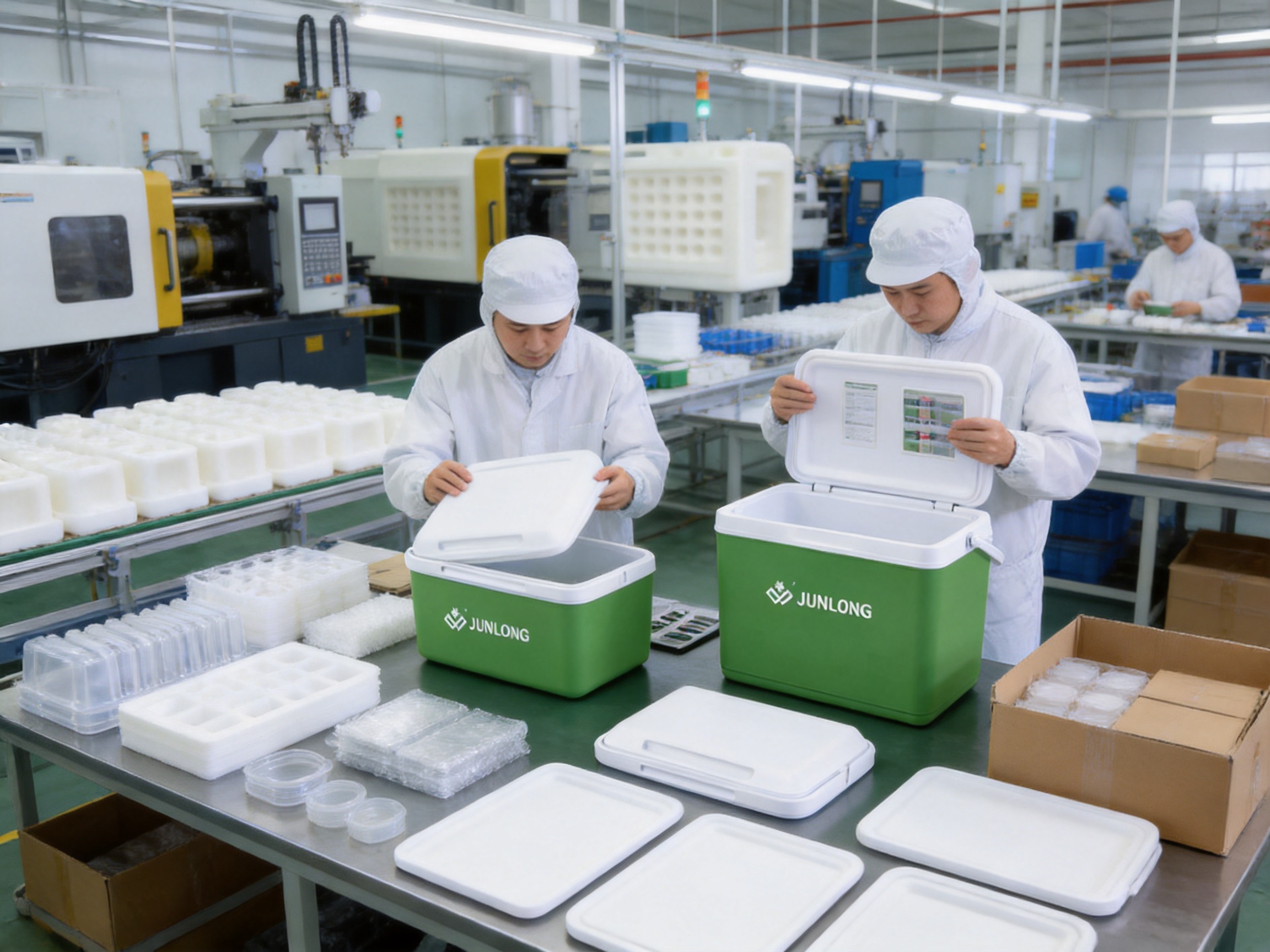
The company operates an independent factory covering approximately 12,000 square meters and employs more than 100 people. Its equipment includes automatic injection molding machines, blow molding machines, and foaming equipment. These capabilities are highly relevant to cooler manufacturing because insulated outdoor products often require multiple production processes. Rigid plastic components may be injection molded, hollow or formed components may require blow molding, and thermal insulation elements may require controlled foaming operations.
In-house access to these processes gives the manufacturer greater control over production coordination. Rather than depending entirely on unrelated subcontractors, an integrated factory can manage material preparation, molding, foaming, assembly, inspection, and packaging with closer communication between teams. This can help reduce delays caused by handoffs, improve repeatability between production batches, and make technical changes easier to implement.
Automatic injection molding equipment can support consistent production of plastic components when molds, materials, temperatures, pressures, and cycle conditions are properly controlled. Consistency matters for cooler lids, bodies, handles, structural parts, and other components that must fit together accurately. A well-controlled molding process can also improve surface appearance and reduce variation in wall structure.
Blow molding capability broadens the company’s ability to develop outdoor water containers, cooler jugs, and other hollow plastic products. The process is suitable for creating hollow forms with useful strength and volume. Having both injection molding and blow molding available allows the manufacturer to select an appropriate production method according to the design, geometry, and intended use of each product.
Foaming equipment is particularly significant for insulated cooler products. The insulation must be formed and integrated in a way that supports thermal performance and structural stability. Process control during foaming can influence density, distribution, and consistency. The company’s investment in dedicated foaming equipment reflects an understanding that cooler manufacturing is not simply a matter of assembling an outer plastic box around a generic insert.
Product Development, Quality, and Customization
The manufacturer describes itself as an enterprise integrating product development, production, and sales. This integrated structure can benefit buyers who need more than a standard catalog item. Product development based on drawings or samples allows an OEM or ODM customer to discuss a new shape, capacity, closure, handle arrangement, color, logo, packaging format, or other commercial requirement.
Customization is valuable in the cooler market because retailers and distributors often need products that match their own brand identity. Color can be adjusted for a specific retail program, seasonal campaign, sports team, hospitality group, or corporate promotion. Logos can be applied according to an approved artwork file and production method. Packaging can be adapted to support multilingual instructions, barcode requirements, retail hooks, shipping protection, or a particular sales channel.
Design customization should be approached systematically. A buyer may begin with a concept or sample, after which the manufacturer evaluates dimensions, material selection, mold requirements, insulation arrangement, assembly method, expected volume, and target cost. Prototypes or pre-production samples can then be reviewed before mass manufacturing. This process helps identify practical issues early, such as lid fit, handle strength, packing efficiency, label placement, and compatibility between the two sizes in a set.
A rigorous quality management system is also important for a product with multiple components and production stages. Quality checks may include incoming material verification, molding inspections, dimensional checks, appearance inspection, assembly evaluation, lid and handle testing, packaging review, and final shipment sampling. The exact inspection plan should be agreed with the buyer and documented in the product specification or purchase contract.
For international customers, quality consistency is as important as the initial sample. A sample demonstrates what a product can look like, but repeat production demonstrates whether the manufacturer can maintain the agreed standard. Factory capacity, trained personnel, process equipment, and internal communication all contribute to that repeatability. Junlong’s long operating history and dedicated manufacturing site provide a foundation for serving customers who require continuing supply.
Why the Two-Piece Format Is Attractive for Commercial Buyers
Distributors and wholesalers often look for products that can serve more than one customer profile. The two-piece cooler set can be marketed to individual consumers, families, outdoor enthusiasts, travelers, event organizers, and small businesses. This broad application range can reduce dependence on one narrow sales segment.
Retailers can use the set as a value-oriented package. Instead of presenting a customer with an isolated cooler and leaving them to decide whether the capacity is sufficient, the retailer can explain the role of each piece. The compact cooler addresses convenience, and the larger cooler addresses capacity. This simple product story can make the set easier for sales staff to demonstrate and easier for consumers to understand.
The set can also support seasonal merchandising. In spring and summer, it can be promoted for beaches, picnics, camping, travel, and sports. During holiday periods, it can be presented as a practical gift for families and outdoor users. Grocery retailers may position it near reusable food-storage products, while outdoor retailers may place it alongside camping accessories, travel equipment, and hydration products.
For hospitality, catering, and promotional applications, the product may be customized with a logo or coordinated color. A company organizing an outdoor event could use the coolers for refreshments while displaying its branding. A food or beverage brand could include a customized set in a promotional campaign. A resort, campsite, or tour operator could purchase sets for guest use, provided the final design and durability requirements are confirmed in advance.
Commercial buyers should evaluate several points before ordering. These include the final capacity of each unit, insulation construction, material declarations, color options, logo process, packaging, carton size, minimum order quantity, production lead time, sample approval procedure, and export documentation. Because the product is sold as a set, buyers should also confirm how the two pieces are packed together and whether retail packaging protects both units during transportation.
Efficient Use and Care Recommendations
Users can improve cooler performance by pre-cooling food and beverages whenever possible. Placing warm products into a cooler forces the insulation and ice source to remove a larger amount of heat. Chilled contents require less cooling energy and can help the internal temperature remain stable for longer.
Ice packs should be frozen according to their instructions before use. The compact cooler is equipped for ice-pack use, and the larger cooler can also be organized with suitable cold sources. Cold packs should be distributed around the contents rather than placed in a way that blocks the lid from closing properly. Overloading can prevent efficient cooling and may place unnecessary pressure on the lid or handles.
The cooler should remain closed as much as practical. Every opening allows warm air to enter and cold air to escape. For group activities, separating frequently accessed drinks from less frequently accessed food can reduce the number of times the main provision cooler is opened. This is one reason the two-piece arrangement can provide functional benefits beyond simple capacity.
After use, the interior should be emptied, cleaned with an appropriate mild cleaning solution, and dried before storage. Users should avoid harsh tools or chemicals that could damage surfaces. If condensation or spilled liquid remains inside, it should be removed promptly. Storing the cooler dry and with adequate ventilation can help maintain cleanliness and reduce unwanted odors.
The exterior should be handled carefully even though the product is designed for outdoor use. Users should avoid placing excessive weight on the lid unless the product is specifically rated for that purpose. Handles should be lifted with the load distributed appropriately, and the cooler should not be dragged over rough surfaces if doing so could damage the base. Careful handling helps preserve the product’s appearance and service life.
Important Considerations for Temperature-Sensitive Contents
An insulated cooler is designed to slow warming, not to create refrigeration or replace professionally controlled cold-chain equipment. Food, beverages, medicines, and other temperature-sensitive products should be packed according to the requirements applicable to those items. Users should consider the starting temperature, surrounding climate, duration of transport, quantity of cold source, and frequency of opening.
For food use, the cooler should be cleaned regularly and raw ingredients should be separated from ready-to-eat foods. Sealed containers or protective packaging can help reduce leakage and cross-contamination. The larger 30-liter cooler may be divided internally through the use of containers or bags, while the smaller 8-liter cooler can be assigned to one category of items.
For medical or laboratory applications, buyers must verify the precise temperature requirements and validation standards before use. A general-purpose insulated cooler should not be represented as a certified medical transport container unless it has undergone the required testing and approvals. The product’s value lies in practical short-term cooling support for outdoor, household, and general transport situations.
Quality and Supply Advantages from an Integrated Factory
An integrated production site can provide advantages in communication and accountability. When product development, molding, foaming, assembly, quality management, and sales support are connected within one organization, technical questions can move more directly between the customer and the responsible production teams. This can be valuable when a buyer requests a design adjustment or needs clarification about materials and packaging.
Factory ownership or direct factory operation also helps buyers distinguish the supplier from a company that only resells finished goods. Direct manufacturing experience allows the supplier to discuss mold feasibility, production limitations, material performance, and realistic customization options. It can also make it easier to investigate quality issues because production records and process information are closer to the commercial contact.
The 12,000-square-meter facility and equipment base support the production of several related product categories. A buyer interested in cooler boxes may also require cooler jugs, ice buckets, or outdoor water containers. Working with a manufacturer that specializes in these connected products can simplify supplier management and support a more coherent product portfolio.
More than 100 employees contribute to the company’s production and business operations. Personnel are important in areas that cannot be managed by machinery alone, including mold setup, production inspection, assembly, packaging, order coordination, export communication, and customization review. Equipment provides capability, but trained staff and quality procedures determine whether that capability is used consistently.
Brand and Private-Label Opportunities
The JUNLONG product range includes ice buckets, insulated cooler jugs, outdoor water containers, and cooler boxes. This product family allows customers to develop a broader outdoor cooling and water-storage assortment rather than purchasing one isolated item. A retailer could combine the two-piece cooler set with a matching water container or cooler jug, creating a coordinated seasonal collection.
OEM and ODM services provide additional flexibility for customers that want their own market identity. OEM projects may use an existing product platform with customized color, logo, and packaging. ODM projects may involve more extensive design development based on a drawing, sample, or performance requirement. The appropriate route depends on the customer’s budget, order volume, launch schedule, and desired level of product differentiation.
Packaging is an important part of private-label development. A well-designed package can explain the two capacities, show outdoor applications, communicate material information, and provide care instructions. It can also display barcodes, regulatory information, importer details, and multilingual text where required. For a two-piece set, packaging should make it immediately clear that both cooler sizes are included.
Color selection can influence product positioning. Neutral colors may suit general household and outdoor retail, while bright colors can attract attention in seasonal displays. A coordinated two-color approach can distinguish the 8-liter and 30-liter units while preserving a unified family appearance. Final color availability depends on material, production volume, color-matching requirements, and the manufacturer’s technical evaluation.
Comparison of Use Scenarios
| Use scenario | Recommended configuration | Reason |
|---|---|---|
| Individual lunch or short outing | 8-liter cooler | Compact capacity for a meal, snacks, and drinks |
| Small family day trip | 8-liter cooler or both units | Choice depends on food quantity and access needs |
| Large picnic | 30-liter cooler | More space for shared provisions and cold sources |
| Weekend campsite | Both units | Large cooler stores provisions; small cooler supports day trips |
| Road-trip refreshments | Both units or 30-liter cooler | Allows separation of drinks, food, and reserve supplies |
| Grocery transport | 30-liter cooler | Accommodates multiple chilled packages during short transport |
| Sports event | Both units | Supports team refreshments and separately organized snacks |
| Promotional program | Customized set | Provides two useful branded products in one package |
Purchasing and Specification Checklist
Before confirming an order, buyers should request a complete technical specification for both cooler sizes. The specification should identify the capacity, external dimensions, internal dimensions where available, net weight, gross packed weight, materials, insulation construction, lid arrangement, handle details, color, and applicable testing information.
Buyers should also clarify whether the listed 450 × 270 × 405 millimeter measurement applies to the complete set, the packaging, or a particular product configuration. Dimension confirmation is essential for shipping calculations, retail shelving, warehouse planning, and vehicle loading. The listed 3,800-gram weight should likewise be confirmed as net product weight or another defined measurement.
Sample approval is recommended before mass production. A sample allows the buyer to inspect color, surface finish, logo placement, lid fit, cooler proportions, insulation arrangement, packaging, and the relationship between the two sizes. For customized products, the approved sample or signed specification should become the reference for production inspection.
Packaging tests may be appropriate when the set will travel long distances or pass through multiple distribution stages. The package should protect the plastic surfaces and prevent the two coolers from damaging one another during movement. Buyers may also request carton drop testing, compression evaluation, or other transport assessments depending on the sales channel.
Commercial terms should address minimum order quantities, mold charges if applicable, sample fees, production lead time, payment conditions, inspection arrangements, shipping marks, documentation, and warranty or claims procedures. Clear expectations reduce misunderstandings and help both parties manage a repeat-order program.
Frequently Asked Questions
What does the set include?
The set includes one 8-liter insulated cooler and one 30-liter insulated cooler. The two units are intended to be used together or separately, allowing users to select the capacity that matches each activity.
What is the main advantage of having two cooler sizes?
The two sizes provide flexibility. The 8-liter cooler is suitable for personal use and short outings, while the 30-liter cooler is better suited to family provisions, group refreshments, and longer outdoor activities. Both can be used together when users need separation or additional capacity.
What materials are used?
The product is described as using food-grade polypropylene and polyethylene, together with EPS foam insulation. The material combination is intended to support food and beverage storage, structural durability, and temperature retention.
Is the 8-liter cooler suitable for ice packs?
Yes. The 8-liter cooler is described as ice-pack-equipped, making it convenient for users who prefer reusable cold packs rather than loose ice. Buyers should confirm the exact ice-pack configuration and whether an ice pack is included in the commercial package.
Is the 30-liter cooler BPA-free?
The 30-liter cooler is described as BPA-free. Buyers should request the appropriate material declaration or market-specific documentation if formal verification is required for a particular region or sales channel.
Can the coolers be used for food?
They are designed for outdoor cooling and food or beverage storage applications. Users should clean the coolers properly, keep food protected, separate raw and ready-to-eat items, and follow appropriate food-safety practices.
Can the set replace a refrigerator?
No. The coolers are insulated containers that slow warming when used with chilled contents and suitable cold sources. They do not actively refrigerate products and should not be treated as a replacement for a refrigerator or regulated cold-chain system.
Can the product be customized?
Yes. The manufacturer offers OEM and ODM services, including development based on drawings or samples and customization of color, logo, and packaging. The exact options depend on design feasibility, order quantity, mold requirements, and production conditions.
What manufacturing processes are available?
The factory includes automatic injection molding machines, blow molding machines, and foaming equipment. These capabilities support the production of rigid plastic components, hollow outdoor products, and insulated structures.
Where is the manufacturer located?
The manufacturer is located in Cixi, Ningbo, Zhejiang Province, China, within the Yangtze River Delta manufacturing region. The company operates an independent factory of approximately 12,000 square meters.
Is the product suitable for private-label sales?
Yes. The set can be considered for private-label programs involving customized color, logo application, packaging, and product presentation. Buyers should approve artwork and pre-production samples before mass manufacturing.
What should users do after using the cooler?
Users should empty the cooler, clean it with a suitable mild cleaning solution, remove moisture, and allow it to dry before storage. Proper cleaning and dry storage help maintain hygiene and reduce odors.
Conclusion
The 2-Piece Insulated Cooler Box Set provides a practical response to the fact that outdoor cooling needs vary. Its combination of an 8-liter compact cooler and a 30-liter large cooler gives users personal portability, family capacity, and the ability to organize food and drinks according to the activity. The set is suitable for picnics, beach trips, camping, road travel, sports events, grocery transport, and everyday chilled-food handling.
Its value is supported by a food-grade PP and PE construction, EPS foam insulation, an ice-pack-equipped compact unit, and a BPA-free 30-liter cooler. Compared with ordinary storage boxes, disposable containers, and single-capacity alternatives, the set offers reusable construction, practical temperature-retention support, and broader usability.
For commercial buyers, the product is backed by an established manufacturer with experience dating to 2000, an independent 12,000-square-meter factory, more than 100 employees, automatic injection molding equipment, blow molding machines, foaming equipment, product development resources, and OEM/ODM service capabilities. These strengths make the set relevant not only to consumers but also to distributors, wholesalers, retailers, hospitality businesses, and private-label customers seeking a dependable outdoor cooling product family.
With proper specification confirmation, sample approval, packaging planning, and quality control, the two-piece cooler set can serve as a flexible addition to seasonal outdoor product ranges and long-term private-label programs.
References
1. Product specification and commercial information supplied for the 2-Piece Insulated Cooler Box Set, including capacity, dimensions, weight, materials, and product features.
2. Manufacturer information supplied for Ningbo Junlong Outdoor Products Co., Ltd., including company history, factory area, workforce, equipment, product categories, and customization services.
3. General principles of insulated container performance, including the relationship between insulation, cold sources, ambient temperature, loading conditions, and lid-opening frequency.
4. General food-storage and food-transport practices relating to cleanliness, separation of raw and ready-to-eat products, and short-term temperature protection.
5. General plastics-manufacturing references concerning injection molding, blow molding, polymer material selection, and foam insulation production.
Product: 2-Piece Insulated Cooler Box Set – Outdoor & Family Combo (8L+30L)

Product Recommendation
link
Office
- TEL: +86-574-63787606
- Phone: +86-13777994798
- E-mail: sales@nbjunlong.com
- WhatsApp: 13777967488
- Address: No. 1, Lane 3, Development Road, Longtouchang, Longshan Town, Cixi City, Zhejiang Province, China
Get In Touch
Copyright © Ningbo Junlong Outdoor Products Co., Ltd. All Rights Reserved.
China Plastic Insulated Cooler Box Manufacturer Custom Cooler Box Supplier
