- SMALL ORDERS FOR STANDARD ITEMS. Contact Now
- OUTDOOR COOLING SOLUTIONS, MADE IN‑HOUSE. Contact Now
- COOLER BOXES THAT FIT REAL OUTDOOR LIFE. Contact Now

 LANGUAGE
 日本語
 Español
 عربى

18L Portable Insulated Water Jug with Faucet: A Practical Guide to Large-Capacity Outdoor Beverage Storage
Content
- 1 Product Overview
- 2 Why an 18-Liter Capacity Matters
- 3 Insulation for Hot and Cold Beverage Service
- 4 Direct Dispensing Through the Integrated Faucet
- 5 Food-Grade PP and PE Construction
- 6 Secure Lid and Spill-Control Features
- 7 Textured Exterior and User-Friendly Handling
- 8 Applications Across Outdoor and Commercial Settings
- 9 Advantages Compared with Conventional Alternatives
- 10 Manufacturing Capabilities and Factory Strengths
- 11 Product Development and Engineering Support
- 12 Quality Management and Production Consistency
- 13 Wholesale and Bulk Order Benefits
- 14 Packaging, Storage, and Distribution Considerations
- 15 Cleaning and Practical Maintenance
- 16 Safe and Effective Use
- 17 Why This Product Fits the Outdoor Equipment Market
- 18 Customization Possibilities for OEM and ODM Projects
- 19 Evaluation Guide for Importers and Distributors
- 20 Q&A
- 20.1 What is the capacity of the cooler jug?
- 20.2 What are the approximate dimensions?
- 20.3 What materials are used?
- 20.4 Can it keep beverages cold?
- 20.5 Can it be used for hot beverages?
- 20.6 Does the product require electricity?
- 20.7 How does the faucet improve usability?
- 20.8 Can the jug be customized?
- 20.9 Who manufactures this cooler jug?
- 20.10 What manufacturing equipment does the company have?
- 20.11 Is the product suitable for wholesale orders?
- 20.12 How should the product be cleaned?
- 20.13 Is the filled jug easy to lift?
- 20.14 What businesses can use this product?
- 21 Conclusion
- 22 References
- 23 Product: 18L Portable Insulated Water Jug with Faucet
Large-capacity beverage storage is essential for outdoor events, job sites, sports activities, catering operations, family gatherings, and emergency hydration stations. A suitable water container must do more than hold liquid. It should help maintain temperature, provide convenient dispensing, resist daily handling, support hygienic use, and remain practical to transport and clean. The 18L Portable Insulated Water Jug with Faucet is designed around these requirements, combining a substantial 18-liter capacity with insulated construction and direct-access dispensing.
Developed for wholesale, bulk, OEM, and ODM applications, this cooler jug is a versatile solution for distributors, retailers, event suppliers, hospitality businesses, outdoor equipment brands, and commercial users. Its cylindrical form, food-grade PP and PE materials, EPS foam insulation, secure lid, non-slip exterior, and integrated faucet create a balanced product for both hot and cold beverages.
Product Overview
The 18L Portable Insulated Water Jug is a large-capacity cooler jug intended for convenient beverage storage and service. It measures approximately 305 millimeters in diameter by 390 millimeters in height and weighs approximately 1,550 grams when empty. Its 18-liter volume provides enough capacity for group use while remaining easier to manage than many larger commercial beverage dispensers.
The product is made from food-grade PP and PE materials, with EPS foam insulation incorporated into the body. Polypropylene and polyethylene are widely used in reusable food and beverage products because they offer a useful combination of low weight, durability, chemical resistance, and ease of processing. EPS insulation helps slow the transfer of heat between the liquid inside and the surrounding environment.
A built-in faucet allows users to dispense water or other beverages directly from the container. This eliminates the need to lift and tilt a full jug, reducing spillage and making the product more accessible at self-service stations. The twist-open lid provides access for filling, cleaning, and adding ice, while the textured exterior helps users maintain a steady grip during handling.
| Feature | Specification or Benefit |
|---|---|
| Product type | Portable insulated cooler jug with faucet |
| Capacity | 18 liters |
| Approximate dimensions | 305 mm diameter × 390 mm height |
| Approximate empty weight | 1,550 grams |
| Main materials | Food-grade PP, PE, and EPS insulation |
| Dispensing method | Integrated faucet or spigot |
| Lid design | Twist-open lid for filling and closure |
| Exterior handling | Textured, non-slip surface |
| Typical applications | Camping, events, catering, sports, work sites, buffets, and outdoor activities |
| Customization options | Product development, color, logo, and packaging customization |
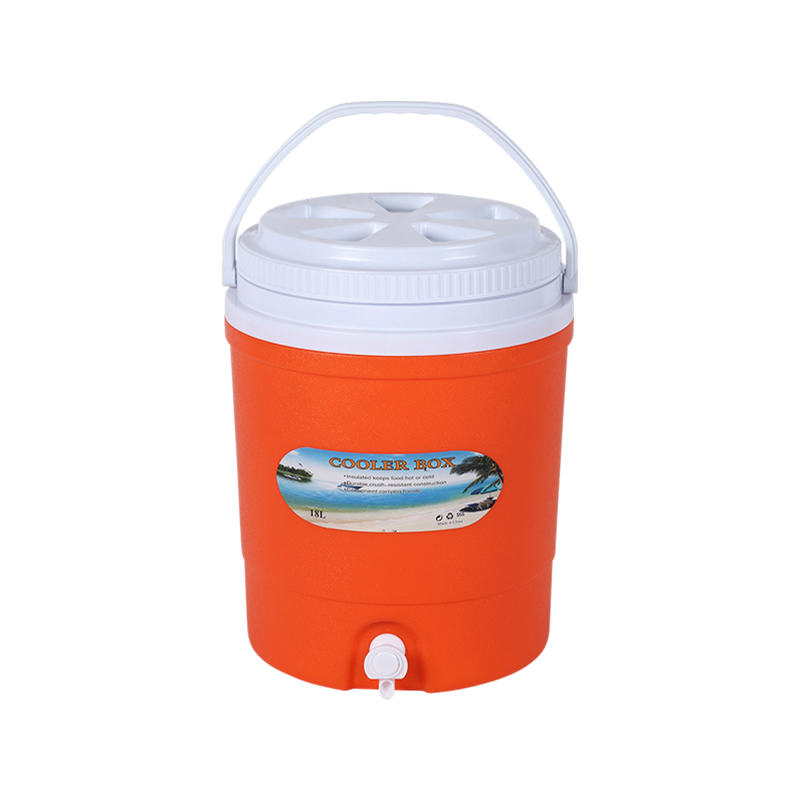
18L Portable Insulated Water Jug with Faucet
Why an 18-Liter Capacity Matters
Capacity is one of the most important factors when selecting an outdoor water container. A small bottle may be convenient for personal use, but it creates frequent refilling requirements when several people need access to water. An 18-liter container offers a practical middle ground between personal hydration products and very large commercial dispensers.
For a family picnic, the jug can provide beverages throughout a meal without requiring repeated trips to a cooler or kitchen. At a sports event, it can serve a team or group of participants from one central station. At a construction or maintenance site, it can supply drinking water or another suitable beverage during a work period. In catering environments, it can hold lemonade, iced tea, fruit punch, coffee, or other beverages for buffet service.
The 18-liter capacity also improves operational efficiency. Event staff can refill one container rather than managing multiple smaller bottles. Retailers can present the product as a high-value solution for customers who need group-serving capability. Distributors can position it between compact insulated jugs and high-volume commercial beverage tanks, creating a product option that serves a broad range of customers.
However, capacity must be considered together with full weight. Water weighs approximately one kilogram per liter, so a completely filled 18-liter jug will contain approximately 18 kilograms of liquid, in addition to the product’s empty weight. For this reason, the faucet is particularly valuable. Users can place the container on a stable table or counter and dispense beverages without lifting the entire filled unit.
Insulation for Hot and Cold Beverage Service
The principal performance advantage of this cooler jug is its insulated construction. EPS foam insulation creates a layer that slows heat exchange between the contents and the external environment. When cold beverages are stored inside, insulation helps reduce the rate at which surrounding heat enters the container. When hot beverages are used, the same principle helps slow heat loss.
Insulation does not generate cold or heat, and the product should not be regarded as an electric refrigeration or heating appliance. Instead, it helps preserve the starting temperature for a longer period than an ordinary single-wall plastic bucket. The actual holding time depends on the initial beverage temperature, the amount of ice used, ambient temperature, exposure to sunlight, frequency of opening, and the volume remaining inside.
For cold service, users can pre-chill the beverage and add suitable ice before closing the lid. Keeping the lid closed as much as possible minimizes unnecessary temperature exchange. Positioning the jug in a shaded area or beneath a canopy can also improve practical cooling performance during outdoor activities.
For hot service, the user should fill the container with a beverage at an appropriate serving temperature and close the lid securely. The faucet can then provide controlled dispensing without repeatedly opening the top. This makes the product useful for hot water, coffee, tea, soup-compatible beverage service where appropriate, and other warm liquids, subject to the user’s safety procedures and the suitability of the beverage for the dispensing system.
Compared with a basic non-insulated water container, the insulated structure offers a more complete service solution. It supports temperature retention, improves the user experience, and reduces the need to place additional ice or reheating equipment immediately beside the serving station.
Direct Dispensing Through the Integrated Faucet
One of the clearest advantages over conventional water buckets is the built-in faucet. Traditional containers often require users to lift, tilt, or scoop the contents. That approach can be difficult when the container is full, especially for children, older users, event guests, or workers wearing protective equipment.
The integrated faucet allows the jug to remain stationary while users fill cups, bottles, or other suitable vessels. This reduces the risk of sudden tipping and helps create a cleaner serving process. It also makes the product suitable for self-service stations where many people need access to beverages during a short period.
Direct dispensing can improve portion control as well. Users can open the faucet only as much as needed, reducing unnecessary overflow. In a buffet or catering setting, a controlled faucet helps keep the service area more organized than an open bucket or large pitcher. In a workplace, employees can refill personal bottles with less interruption to their normal activities.
The faucet also supports better ergonomics. A full 18-liter container can be difficult to move repeatedly. By placing it on a stable raised platform, users can dispense the contents without handling the full weight. This feature is especially useful when the jug is used at sports tournaments, outdoor markets, temporary work stations, campsites, and community events.
To maintain safe operation, the jug should be positioned on a level and stable surface. The faucet should be checked before each use to confirm that it is correctly installed and not obstructed. After use, the dispensing area should be cleaned according to the beverage type and the operator’s hygiene procedures.
Food-Grade PP and PE Construction
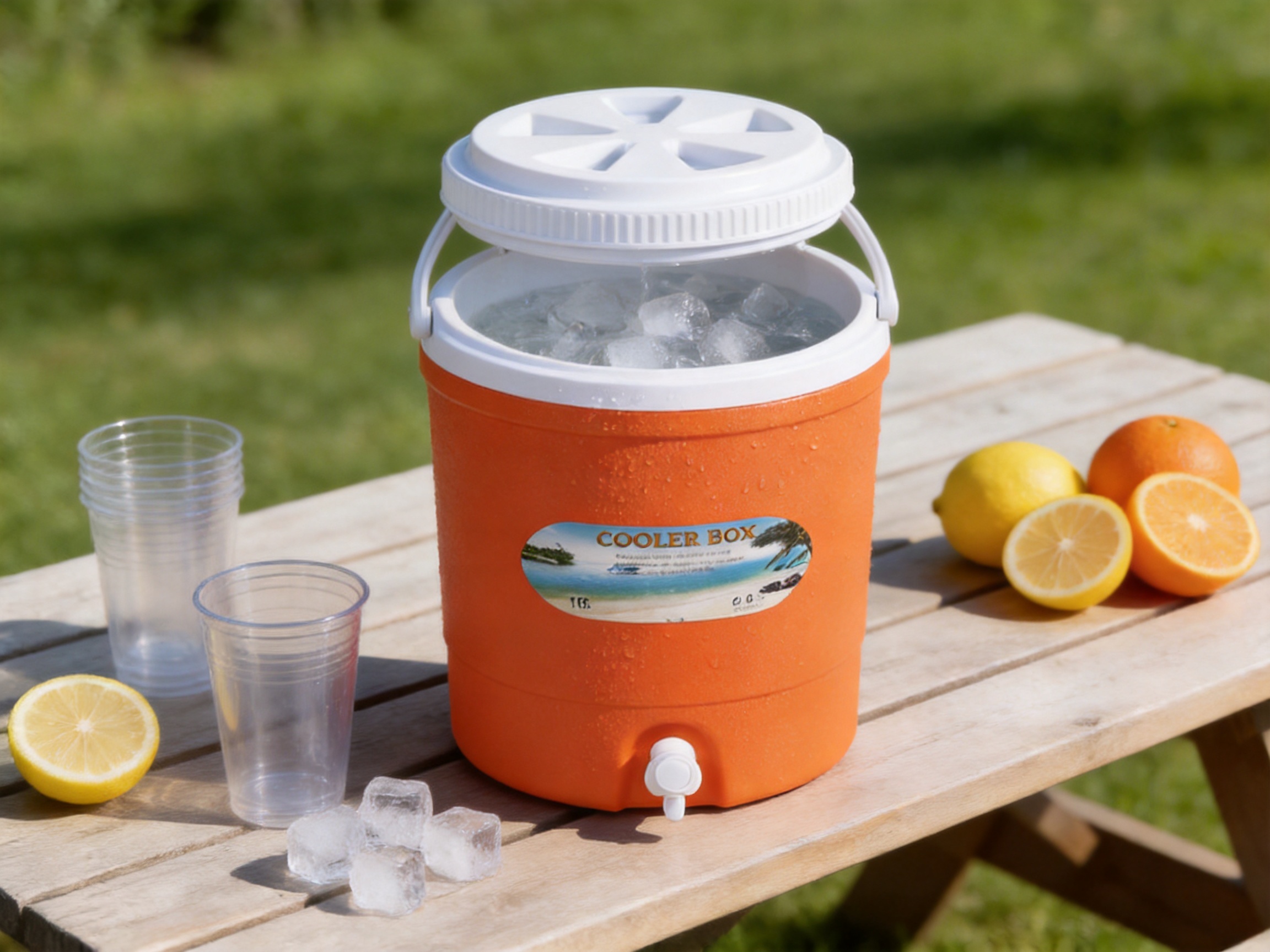
Material selection affects safety, durability, appearance, weight, and manufacturing consistency. The product uses food-grade PP and PE for its main plastic construction. These materials are commonly selected for beverage containers because they can be molded into strong, practical forms while keeping the finished product relatively lightweight.
Polypropylene offers good rigidity and fatigue resistance, which can be valuable for components that are repeatedly opened, closed, handled, or cleaned. Its low density helps reduce product weight, making the empty jug easier to transport and distribute. Polyethylene contributes useful impact resistance and flexibility in suitable product structures.
The food-grade material specification is important for wholesalers and brand owners because it supports positioning the product for beverage-related applications. Material selection should still be combined with appropriate cleaning, storage, and operating procedures. Users should avoid storing incompatible chemicals or substances that are not intended for food and beverage containers.
The plastic body is also practical for commercial distribution. Compared with many metal beverage dispensers, a molded plastic jug can be easier to handle and may reduce shipping weight. Its smooth molded surfaces can be easier to wipe down, while the relatively simple body construction supports repeatable manufacturing at volume.
Durability is another benefit. Outdoor products are exposed to movement, contact with tables and vehicles, changing temperatures, and frequent user handling. A properly designed PP and PE body can provide the dependable service required in these conditions without adding unnecessary structural complexity.
Secure Lid and Spill-Control Features
The twist-open lid is designed to provide a secure closure during transport and use. A properly closed lid helps reduce accidental spills when the product is moved from storage to a serving location. It also limits exposure to dust, leaves, insects, and other contaminants in outdoor environments.
The lid provides convenient access for filling and cleaning. Users can add water, prepared beverages, or ice through the top opening, depending on the application. After filling, the lid can be tightened to protect the contents and support more stable operation.
Although the lid helps reduce spills, the product should still be transported carefully, especially when full. Users should keep the faucet in the closed position before moving the jug and should avoid placing it on unstable or excessively elevated surfaces. For vehicle transport, the container should be secured to prevent rolling or tipping.
The combination of a twist-open top and a lower dispensing faucet creates a functional separation between filling and serving. Users do not need to open the entire top every time they want a drink. This can help preserve temperature and reduce contact with the contents during service.
Textured Exterior and User-Friendly Handling
Large containers can become difficult to handle when the outside is wet or when the user is wearing gloves. The textured exterior of this cooler jug is intended to provide a more secure grip than a completely smooth surface. This feature supports safer handling during filling, repositioning, and cleaning.
The cylindrical format also provides a familiar and balanced shape. With a diameter of approximately 305 millimeters and a height of approximately 390 millimeters, the product can be placed on many tables, counters, outdoor benches, and service platforms. Users should always confirm the available surface dimensions before installation, particularly when the faucet requires clearance at the front.
The empty weight of approximately 1,550 grams supports easier warehouse handling and product distribution. Retail staff can move multiple empty units without the burden associated with heavier metal dispensers. For wholesalers, the lighter construction may simplify storage and reduce handling demands throughout the supply chain.
Once filled, the weight is determined primarily by the beverage volume. The product’s handling advantages therefore depend on using the faucet correctly and locating the jug close to its final service position before filling whenever possible.
Applications Across Outdoor and Commercial Settings
Camping and Family Outdoor Activities
Camping groups often need a central beverage container that can serve several people without taking up excessive space. The 18-liter capacity can support drinking water, cold tea, lemonade, or other suitable beverages throughout a day outdoors. The insulation helps slow temperature change, while the faucet allows campers to fill cups or bottles without repeatedly lifting the container.
For family picnics, the cooler jug can be placed beside a food table or under a shade canopy. Its direct dispensing function helps keep the serving process simple and limits the need for multiple bottles. The lid also helps protect the contents while the container is waiting between servings.
Sports Events and Team Hydration
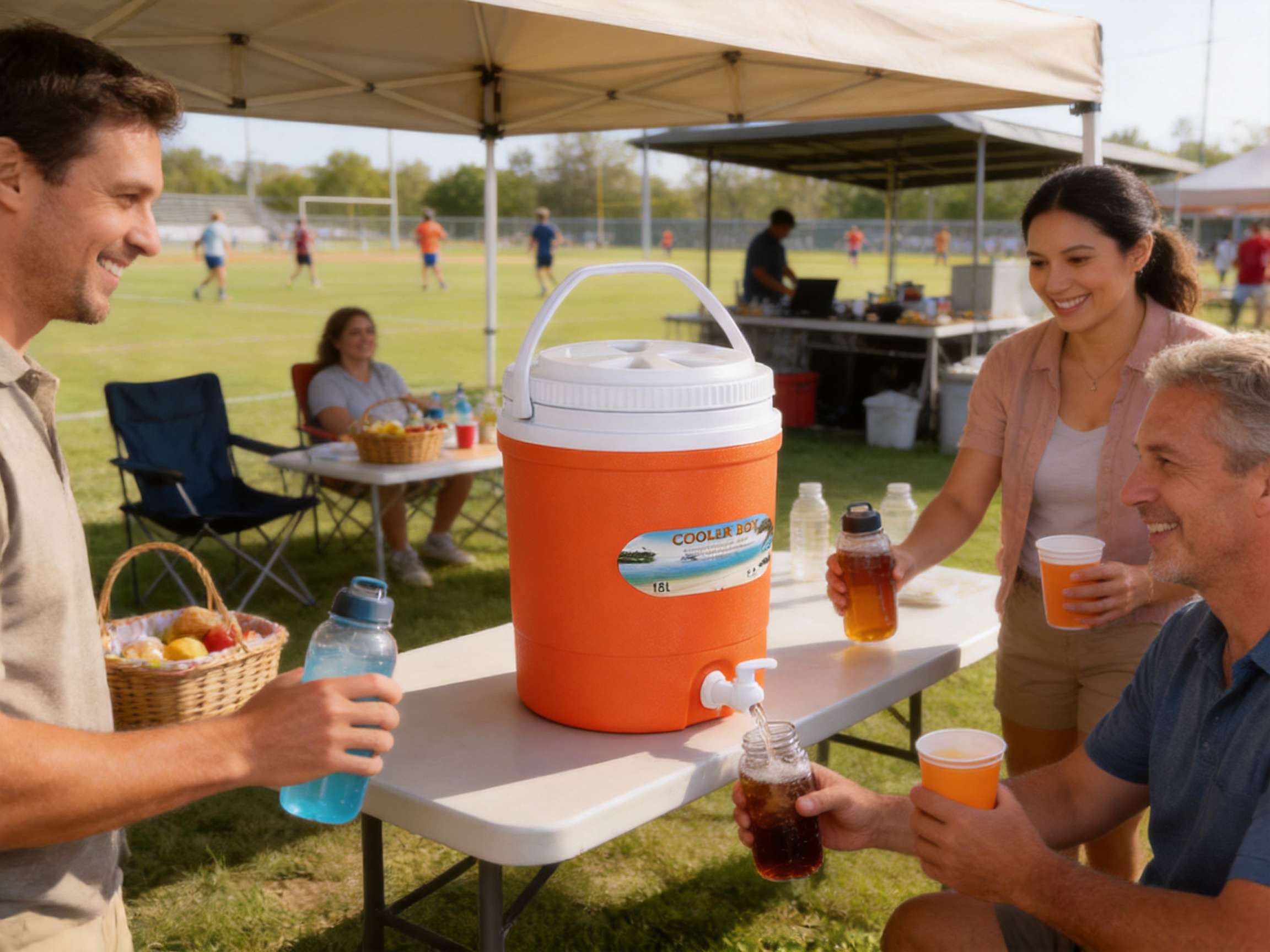
Sports teams need fast, reliable access to fluids during training and competition. An 18-liter dispenser can be used as a central hydration station for athletes, coaches, and support staff. The faucet helps users refill bottles efficiently, while the insulated body assists with maintaining a cooler beverage temperature when the container is properly pre-chilled.
Event organizers can use multiple units for different beverages or teams. Because the jug is suitable for branding customization, sports clubs, tournament organizers, and promotional agencies may request custom colors, logos, or packaging for specific events and campaigns.
Construction and Work Sites
Outdoor workers may spend long periods away from permanent kitchens or drinking fountains. A large-capacity insulated water jug can provide a practical hydration point at a work site. It can be placed in a break area, mobile office, maintenance station, or shaded rest zone.
The direct faucet is especially useful in this environment because workers can fill personal bottles without lifting the container. The textured exterior supports handling when gloves are worn, although users should follow site-specific hygiene and safety requirements.
Catering, Buffets, and Hospitality
Caterers and hospitality operators can use the jug for self-service beverage stations. It can hold lemonade, iced tea, fruit drinks, water, coffee, or other appropriate beverages. The insulated structure supports temperature management, while the faucet helps reduce service congestion.
For buffet operations, a product that looks organized and functions consistently can improve the overall customer experience. The container can be positioned beside cups, ice, napkins, and waste collection points to create a clearly arranged beverage station.
Markets, Community Events, and Exhibitions
Outdoor markets and exhibitions often require temporary beverage facilities that can be assembled quickly. The portable jug can support vendor operations, promotional sampling, or staff refreshments. Custom color and logo options may help businesses integrate the product into their event presentation.
Because the product can be supplied in bulk, distributors and event rental companies may use it as part of a broader equipment inventory. The same base design can serve different customer sectors with changes to branding, packaging, or color selection.
Advantages Compared with Conventional Alternatives
The cooler jug competes with several types of beverage containers, including ordinary plastic buckets, uninsulated water dispensers, metal beverage tanks, small insulated bottles, and electric cooling equipment. Its competitive position comes from combining multiple useful functions in one relatively simple product.
| Alternative | Typical Limitation | Advantage of the 18L Insulated Cooler Jug |
|---|---|---|
| Ordinary plastic bucket | No insulation and no controlled dispensing | Provides EPS insulation, a lid, and an integrated faucet |
| Small personal bottles | Limited capacity and frequent refilling | Offers 18 liters for group use and event service |
| Uninsulated beverage dispenser | Less effective at slowing temperature change | Uses an insulated body for hot or cold beverage service |
| Large metal tank | May be heavier and more difficult to move | Uses lightweight molded plastic construction |
| Open pitcher | Requires lifting and can spill during pouring | Dispenses from a stationary container through a faucet |
| Electric cooler | Requires power and may be less portable | Operates without electricity and is suitable for temporary locations |
Compared with a basic bucket, the product delivers better temperature management and more convenient dispensing. Compared with a small bottle, it is more efficient for group service. Compared with a heavy metal tank, it can offer easier handling and a lower-weight distribution model. Compared with an electric cooling appliance, it does not depend on a power source.
These advantages do not mean that one container is suitable for every purpose. Electric refrigeration may be more appropriate when beverages must be actively cooled for extended periods. A small bottle may be better for individual travel. A metal tank may be preferred for certain industrial or high-temperature applications. The strength of this cooler jug is its balance of capacity, portability, insulation, and uncomplicated operation.
Manufacturing Capabilities and Factory Strengths
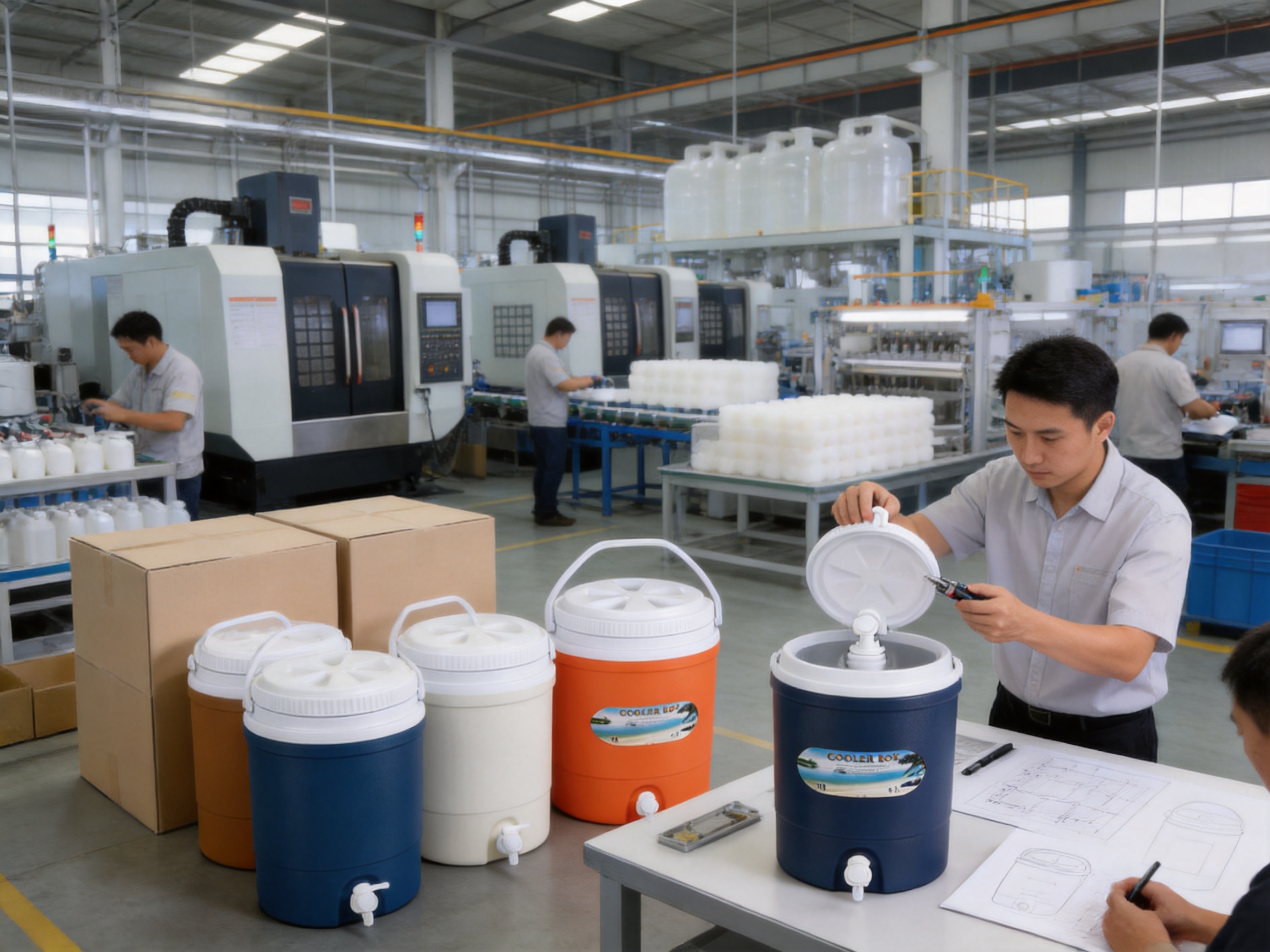
Ningbo Junlong Outdoor Products Co., Ltd. was founded in 2000 and operates in Cixi, Ningbo, Zhejiang Province, an important manufacturing region in the Yangtze River Delta. The company integrates product development, production, and sales, allowing design and manufacturing knowledge to be coordinated within one organization.
The company operates an independent factory covering approximately 12,000 square meters and employs more than 100 people. Its facilities include automatic injection molding machines, blow molding machines, and foaming equipment. This combination of capabilities is particularly relevant to cooler jugs, cooler boxes, ice buckets, and outdoor water containers because these products often require molded plastic components and insulated structures.
Automatic injection molding supports repeatable production of rigid components, lids, faucet parts, structural features, and other precision-molded elements. Stable molding conditions can contribute to more consistent dimensions, surface quality, and assembly compatibility across production batches.
Blow molding equipment expands the company’s ability to manufacture hollow plastic forms. Depending on product structure and project requirements, blow molding can be used for containers that require controlled wall distribution and efficient production. Having both injection molding and blow molding resources enables the factory to select suitable processes for different product designs rather than relying on one manufacturing method for every project.
Foaming equipment is essential for insulated product development. The insulation layer must be incorporated into the product structure in a controlled manner to provide useful thermal resistance while maintaining the intended appearance and dimensional stability. The company’s foaming capability supports production of cooler jugs and boxes in which insulation is a central performance feature.
Product Development and Engineering Support
Outdoor beverage products must balance capacity, weight, insulation, appearance, usability, and manufacturability. Product development therefore involves more than creating an attractive shape. It requires consideration of wall thickness, assembly interfaces, lid fit, faucet placement, center of gravity, cleaning access, mold design, packaging requirements, and expected user behavior.
Ningbo Junlong Outdoor Products Co., Ltd. maintains an R&D team focused on developing outdoor cooling and water storage products. The company can support product development based on customer drawings or physical samples. This is valuable for importers and brands that already have a concept but need a manufacturing partner capable of converting it into a production-ready item.
During development, customers may request changes to capacity, exterior dimensions, handle structure, lid style, faucet configuration, texture, color, or packaging. A manufacturer with in-house development knowledge can communicate more effectively about the relationship between these changes and tooling, material use, production time, and final cost.
OEM and ODM support also allows the product to be adapted for different market segments. A distributor may require a neutral private-label version. A camping brand may request outdoor-oriented colors and packaging. A sports organization may need a custom logo. A hospitality supplier may want a presentation that matches buffet equipment.
The company offers customization in product development, color, logo, and packaging. These options allow customers to create a more distinct market offering instead of competing only on a standard catalog image or generic product description.
Quality Management and Production Consistency
Quality management is especially important for molded plastic products because performance depends on repeated consistency. A cooler jug must maintain a reliable fit between its body, lid, insulation structure, and faucet. Variations in dimensions or assembly can affect usability, leakage resistance, appearance, and customer satisfaction.
A rigorous quality management system can help organize incoming material checks, process monitoring, assembly inspection, appearance review, and final product verification. The precise inspection plan may vary by customer project, but the general objective is to identify problems early and reduce the risk of inconsistent goods reaching the market.
For the 18-liter jug, key quality considerations may include dimensional accuracy, body integrity, lid engagement, faucet installation, surface finish, insulation assembly, color consistency, and packaging protection. Functional checks may be used to assess whether the faucet operates correctly and whether the assembled unit performs as intended under normal use conditions.
Quality is not limited to the finished product. It also includes production planning, mold maintenance, staff training, material control, packaging design, and communication between sales, engineering, and manufacturing teams. These factors influence whether a customer receives a stable supply over repeated orders.
For wholesale buyers, production consistency is often more valuable than a single successful sample. Retailers need products that look and function similarly across cartons. Brand owners need confidence that later replenishment orders will remain compatible with earlier products. A factory with integrated development and manufacturing can support this continuity more effectively.
Wholesale and Bulk Order Benefits
The product is suited to wholesale and bulk purchasing because it addresses several broad-use applications. Its 18-liter capacity is understandable to end users, while the combination of insulation and a faucet provides visible functional value. This makes it suitable for outdoor product catalogs, hospitality supply ranges, event equipment programs, and promotional merchandise collections.
For distributors, the product can be positioned under several categories, including cooler jug, insulated water container, outdoor beverage dispenser, camping water container, and large-capacity drink dispenser. Multiple positioning options can help retailers reach customers with different search habits and purchasing priorities.
For private-label customers, customization can strengthen product differentiation. Logos and packaging can make the product suitable for brand campaigns, corporate events, sports programs, resort operations, outdoor retailers, and promotional distribution. Color customization can also help distinguish different beverage types or customer groups.
Bulk orders benefit from factory-direct communication. Customers can discuss specifications, packaging requirements, production schedules, and quality expectations with a manufacturer that controls product development and production resources. This can reduce unnecessary communication gaps between a trading intermediary and the actual factory.
When planning a wholesale project, buyers should provide information about target markets, expected order quantity, preferred colors, logo requirements, packaging format, delivery destination, usage conditions, and any applicable market requirements. Clear specifications at the beginning help the factory evaluate tooling, materials, packaging, and production arrangements more efficiently.
Packaging, Storage, and Distribution Considerations
The product’s packaging should protect the faucet, lid, exterior surface, and other exposed components during transport. A suitable carton design can help reduce abrasion and impact while allowing efficient warehouse stacking. Retail packaging may also need to communicate capacity, insulation, applications, care instructions, and customization information.
Because the product is relatively large compared with small personal bottles, packaging efficiency is important for wholesale logistics. Buyers should consider carton dimensions, pallet arrangement, container loading, warehouse shelf height, and retail display space. Factory consultation can help optimize the balance between product protection and shipping efficiency.
During storage, the cooler jug should be kept in a clean, dry area away from sharp objects, excessive heat, and direct sunlight for extended periods. If units are stored before distribution, packaging should remain intact until products are prepared for sale or delivery. Retailers should avoid placing heavy objects on top of cartons if this could deform the lid or faucet components.
For international distribution, buyers may need to review labeling, packaging language, material declarations, and market-specific product documentation. Requirements differ by destination and application. Ningbo Junlong Outdoor Products Co., Ltd. can discuss project-specific documentation and packaging arrangements with customers during the quotation and order process.
Cleaning and Practical Maintenance
Regular cleaning is important whenever the jug is used for beverages. Before first use, the container, lid, and faucet should be cleaned according to appropriate food-contact procedures. After use, remaining liquid should be removed promptly, especially if the beverage contains sugar, dairy, pulp, or other ingredients that may support residue buildup.
The inside should be rinsed with clean water and washed using a suitable mild cleaning solution. Users should pay attention to the faucet because beverage residue can remain in or around the dispensing area. The lid and opening should also be cleaned thoroughly before the product is refilled.
After cleaning, the container should be allowed to drain and dry. Storing a sealed container while moisture remains inside may create an unpleasant odor or reduce hygiene. If the product is used for different beverage types, additional cleaning may be needed to prevent flavor transfer.
Harsh abrasives, unsuitable solvents, and tools that could scratch the plastic should be avoided unless specifically approved for the product. Scratches can make surfaces more difficult to clean. Users should also avoid modifying the faucet, drilling the body, or using replacement parts that are not compatible with the original design.
Proper maintenance extends service life and supports reliable operation. For commercial users, a simple cleaning schedule can be included in staff procedures. Event companies and rental businesses may benefit from inspecting each unit before and after every rental period.
Safe and Effective Use
The jug should be filled only with beverages appropriate for the product’s materials and dispensing system. Users should follow any temperature guidance supplied for the specific application and should avoid placing the container near flames, hot surfaces, or sharp equipment.
When the jug is full, it should be moved only when necessary. Whenever possible, transport the empty unit to its final location and fill it there. If movement is required, two trained people may be used for safer handling depending on the environment and local procedures.
The container should be placed on a stable, level surface with enough space below or in front of the faucet for cups and bottles. The faucet should be closed before filling and during transport. Users should check for leakage before serving and should stop using the product if the body, lid, or faucet is damaged.
For outdoor use, shade is recommended when practical. Direct sunlight can increase the temperature of the exterior and surrounding air, reducing the effectiveness of passive insulation. Keeping the lid closed between servings also helps maintain the temperature of the contents.
Why This Product Fits the Outdoor Equipment Market
The outdoor equipment market increasingly values products that provide multiple functions without excessive complexity. Consumers and professional users want equipment that is portable, durable, visually appealing, and easy to operate. The 18L Portable Insulated Water Jug meets these expectations through a straightforward design centered on group beverage service.
Its value is not based on a single feature. The 18-liter capacity provides volume. EPS insulation supports temperature retention. The faucet improves dispensing. Food-grade PP and PE support practical construction. The twist-open lid improves access and closure. The textured surface supports handling. Together, these elements create a product that is more useful than a basic container while remaining simpler than powered cooling equipment.
For retailers, the product can appeal to camping customers, families, sports participants, event organizers, workers, and hospitality operators. For wholesalers, it offers a versatile item that can be marketed through several channels. For brands, customization creates opportunities for private-label and promotional programs.
The product also benefits from manufacturing support that includes molding, foaming, product development, and customization. This helps customers address not only the immediate need for a cooler jug but also broader product planning requirements such as color families, packaging systems, logo placement, and future model development.
Customization Possibilities for OEM and ODM Projects
OEM and ODM customers may approach the factory with different levels of preparation. Some have complete technical drawings and only need production support. Others have a product idea, reference sample, or market concept but need assistance with structure and manufacturing feasibility. The company’s integrated development and production model can accommodate both types of projects.
Product customization may include adjustments to the overall shape, capacity, dimensions, lid design, dispensing arrangement, exterior texture, or component color. Any change should be reviewed for its effect on mold tooling, insulation, strength, filling access, packaging, and user handling.
Color customization is useful for brand identity and product segmentation. A distributor may use one color for retail products and another for commercial customers. A sports brand may select team colors. A hospitality company may request a neutral appearance that matches existing service equipment.
Logo customization can be applied according to the available production method and the customer’s artwork requirements. Customers should provide clear logo files, preferred placement, print colors, and durability expectations. Packaging customization may include carton artwork, labels, instruction sheets, barcode areas, and retail presentation.
ODM development may involve several sample stages. A concept review can confirm the intended use and target price. A structural proposal can evaluate capacity, dimensions, and major functions. A prototype or sample can then be reviewed for appearance and operation before tooling and mass production. Clear feedback at each stage helps reduce delays and unnecessary revisions.
Evaluation Guide for Importers and Distributors
When assessing this cooler jug for a wholesale program, buyers should consider both product performance and commercial fit. The following questions can help organize the evaluation:
- Does the 18-liter capacity match the target customer’s typical group-serving needs?
- Is the product size suitable for the intended tables, shelves, vehicles, and storage areas?
- Will the faucet location work with the cups, bottles, or dispensers used by the target market?
- Are the selected colors and packaging appropriate for retail or commercial presentation?
- Does the product’s insulation function match the intended hot or cold beverage applications?
- What order quantity and delivery schedule are required?
- Are logos, labels, and packaging materials needed for private-label sales?
- What cleaning and care information should be included with the product?
- Does the destination market require specific documentation or labeling?
- Would future variations, such as different sizes or colors, support the product range?
A structured evaluation helps buyers compare the cooler jug with competing products on more than price. Important factors include factory capacity, mold and development support, material selection, quality control, packaging, supply stability, and after-sales communication.
Q&A
What is the capacity of the cooler jug?
The cooler jug has an 18-liter capacity. This makes it suitable for group beverage service at outdoor activities, events, work sites, sports programs, buffets, and family gatherings.
What are the approximate dimensions?
The listed dimensions are approximately 305 millimeters in diameter and 390 millimeters in height. Buyers should confirm final production and packaging dimensions for logistics and display planning.
What materials are used?
The product uses food-grade PP and PE for its main plastic construction and EPS foam for insulation. These materials support a lightweight, durable, and practical structure for beverage storage.
Can it keep beverages cold?
The EPS insulation helps slow heat transfer and can assist in maintaining a cold beverage temperature for longer than a standard uninsulated container. Performance depends on the starting temperature, ice quantity, ambient conditions, sunlight exposure, lid opening frequency, and remaining volume.
Can it be used for hot beverages?
The insulated design is suitable for hot or cold beverage service when used within appropriate operating conditions. Users should confirm the suitability of the specific beverage and temperature for the product and dispensing components before commercial use.
Does the product require electricity?
No. It is a passive insulated container and does not require a power source. This makes it suitable for campsites, temporary event areas, sports fields, mobile work sites, and other locations without convenient electrical access.
How does the faucet improve usability?
The faucet allows users to dispense beverages without lifting or tilting the full jug. This reduces handling effort, helps limit spills, and supports convenient self-service operation.
Can the jug be customized?
Yes. OEM and ODM services are available, including product development based on drawings or samples, color customization, logo application, and packaging options. Specific customization details should be discussed according to the project requirements.
Who manufactures this cooler jug?
The product is manufactured by Ningbo Junlong Outdoor Products Co., Ltd., a China-based outdoor product manufacturer specializing in cooler jugs, cooler boxes, ice buckets, and outdoor water containers.
What manufacturing equipment does the company have?
The company operates a factory of approximately 12,000 square meters with automatic injection molding machines, blow molding machines, and foaming equipment. These capabilities support the development and production of molded and insulated outdoor products.
Is the product suitable for wholesale orders?
Yes. The product is intended for wholesale and bulk orders and can be supplied for distributors, retailers, hospitality companies, event suppliers, sports organizations, outdoor brands, and private-label programs.
How should the product be cleaned?
The container, lid, and faucet should be cleaned after use with suitable mild cleaning methods. Beverage residue should not be allowed to remain inside for extended periods. The product should be drained and dried before storage.
Is the filled jug easy to lift?
A full 18-liter jug is heavy because the liquid itself weighs approximately 18 kilograms, in addition to the empty product. The integrated faucet is intended to allow the jug to remain on a stable surface during service, reducing the need to lift it while full.
What businesses can use this product?
Potential users include outdoor retailers, camping suppliers, sports organizations, construction companies, catering businesses, hospitality operators, event rental companies, promotional agencies, schools, community groups, and distributors of food-service equipment.
Conclusion
The 18L Portable Insulated Water Jug with Faucet provides a practical balance of capacity, insulation, portability, and direct dispensing. Its 18-liter volume supports group use, while the faucet eliminates the need to tilt a full container. EPS foam insulation helps preserve hot or cold beverage temperatures, and the food-grade PP and PE construction supports durable everyday use.
The product’s competitive strength comes from combining functions that are often separated across several products. It offers more service convenience than a basic bucket, more capacity than a personal bottle, less handling difficulty than many heavy metal tanks, and greater location flexibility than electric cooling equipment.
For wholesale customers, the product is supported by the manufacturing capabilities of Ningbo Junlong Outdoor Products Co., Ltd. The company operates an independent factory with injection molding, blow molding, and foaming equipment, along with product development, quality management, OEM, and ODM support. Customers can request product, color, logo, and packaging customization for different sales channels and market requirements.
Whether used for camping, sports, work sites, buffets, catering, exhibitions, or community events, this insulated cooler jug offers an efficient way to organize beverage storage and service. Its straightforward design and flexible manufacturing support make it a strong option for businesses seeking a dependable large-capacity outdoor water container.
References
1. Product specification materials for the 18L Portable Insulated Water Jug with Faucet, including dimensions, capacity, materials, weight, and intended applications.
2. Company information supplied by Ningbo Junlong Outdoor Products Co., Ltd., including factory history, manufacturing equipment, product categories, and OEM/ODM capabilities.
3. General principles of passive thermal insulation in food and beverage containers.
4. General engineering references concerning injection molding, blow molding, plastic product development, and foam insulation processing.
5. General food-service guidance concerning reusable beverage container cleaning, storage, handling, and dispensing practices.
Product: 18L Portable Insulated Water Jug with Faucet

Product Recommendation
link
Office
- TEL: +86-574-63787606
- Phone: +86-13777994798
- E-mail: sales@nbjunlong.com
- WhatsApp: 13777967488
- Address: No. 1, Lane 3, Development Road, Longtouchang, Longshan Town, Cixi City, Zhejiang Province, China
Get In Touch
Copyright © Ningbo Junlong Outdoor Products Co., Ltd. All Rights Reserved.
China Plastic Insulated Cooler Box Manufacturer Custom Cooler Box Supplier
