- SMALL ORDERS FOR STANDARD ITEMS. Contact Now
- OUTDOOR COOLING SOLUTIONS, MADE IN‑HOUSE. Contact Now
- COOLER BOXES THAT FIT REAL OUTDOOR LIFE. Contact Now

 LANGUAGE
 日本語
 Español
 عربى

Content
- 1 Designed for the Demands of Commercial Outdoor Use
- 2 Insulation Performance for Temperature-Sensitive Goods
- 3 Food-Grade Materials and Hygienic Use
- 4 Structural Features That Support Long-Term Use
- 5 How It Compares with Common Cooler Alternatives
- 6 Applications Across Outdoor Business Sectors
- 7 Manufacturing Strengths Behind the Product
- 8 Quality Management and Custom Manufacturing
- 9 Using the Cooler Efficiently
- 10 Purchasing Considerations for Wholesale Buyers
- 11 Questions and Answers
- 11.1 What is the capacity of the cooler?
- 11.2 What are the product dimensions?
- 11.3 What materials are used?
- 11.4 How long can it preserve temperature?
- 11.5 Is the cooler suitable for commercial use?
- 11.6 Can the cooler be pulled like a suitcase?
- 11.7 Does it have a drain system?
- 11.8 Is there a locking feature?
- 11.9 Can it be customized?
- 11.10 Is the cooler BPA-free?
- 11.11 What kinds of products can it store?
- 11.12 How should it be cleaned?
- 11.13 Why is the factory's manufacturing capability important?
- 12 Conclusion
- 13 References
- 14 Product: 60L Wheeled Market Stall Foam Insulated Cooler
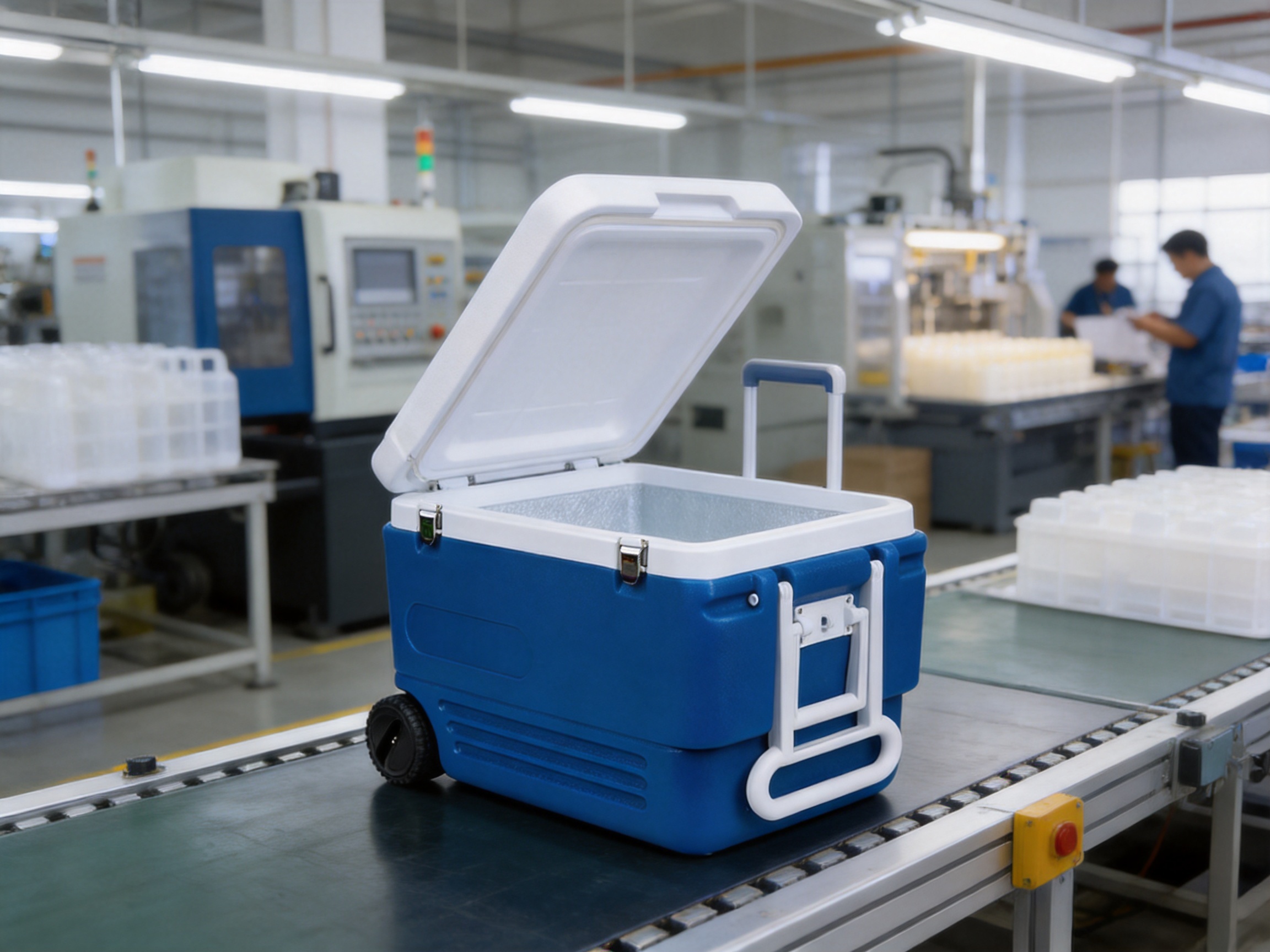
For market vendors, food-truck operators, event caterers, farmers-market sellers, and outdoor concession businesses, a cooler is much more than a container for ice. It is a mobile temperature-management system, a product display unit, a storage station, and a daily transport tool. The right cooler must protect temperature-sensitive goods, withstand repeated handling, support hygienic operation, and move efficiently from a vehicle to a selling point. It must also provide enough capacity for commercial use without becoming so difficult to transport that it slows down the working day.
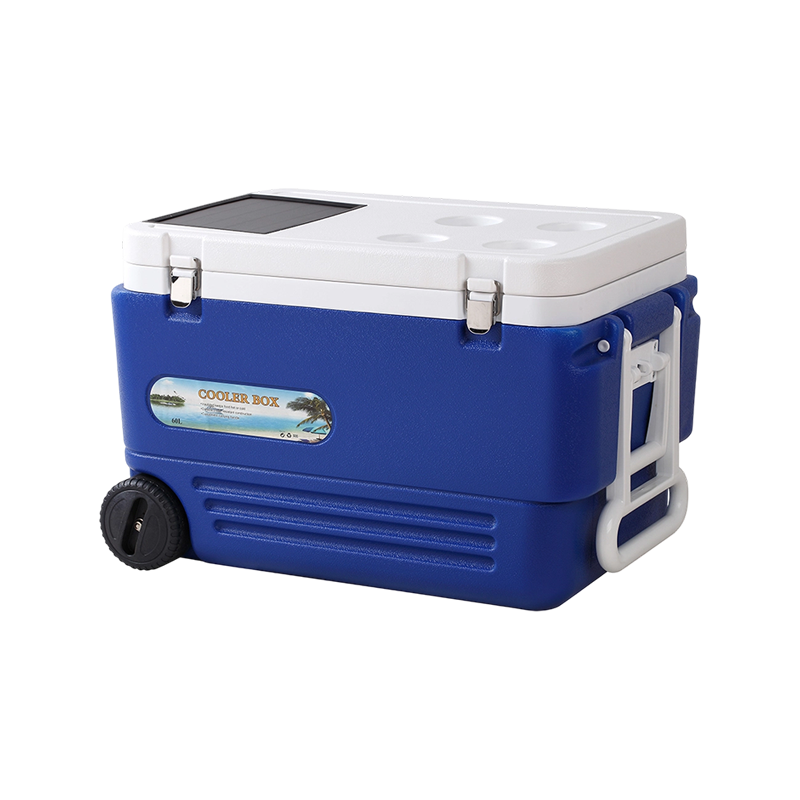
The 60-liter wheeled market stall foam insulated cooler has been developed around these practical demands. With a capacity of 60 liters, dimensions of 650 × 405 × 440 millimeters, a net weight of approximately 8.0 kilograms, and a construction made from food-grade PP, PE, and PU materials, it is designed for users who need dependable cooling and organized mobility. Its telescopic handle, integrated wheels, side grip grooves, drain valve, stainless steel lock buckle, and vacuum-lid-and-body insulation system work together to create a cooler suited to professional outdoor use.
Unlike many basic portable coolers that are intended mainly for occasional picnics, this large cooler box is designed for repeated commercial activity. It can support the daily routines of selling drinks, displaying frozen foods, transporting fresh produce, storing seafood, serving at outdoor events, or keeping ingredients ready for mobile catering. Its design balances capacity, insulation, durability, transportation, and ease of maintenance.
Designed for the Demands of Commercial Outdoor Use
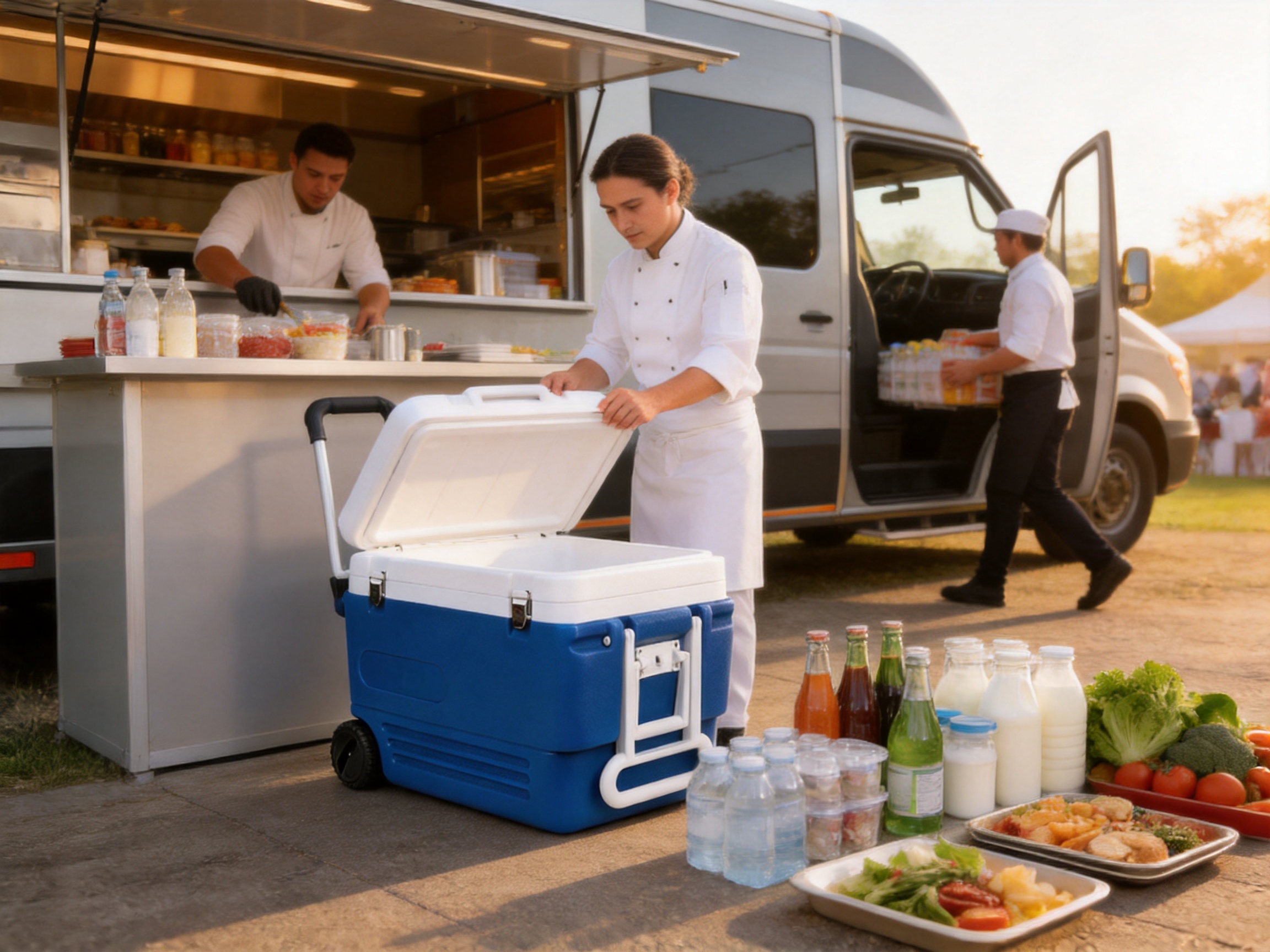
Commercial users face challenges that casual users may not notice. A market vendor may need to transport a full load over pavement, open and close the lid hundreds of times during a selling season, drain melted ice quickly, and maintain acceptable product temperatures through changing outdoor conditions. A food-truck operator may need a secondary cold-storage unit for ingredients, beverages, or prepared products. A catering company may move coolers between vehicles, kitchens, event venues, and temporary service counters.
These situations require a cooler that performs consistently rather than one that simply looks attractive when new. The 60-liter wheeled model is built as a practical working tool. Its relatively large capacity helps reduce the number of containers required for one selling session. Its wheels and large handle reduce lifting demands. Its reinforced closure components help secure the lid during transport. Its insulation system is designed to slow temperature change, helping users protect chilled or frozen contents for extended periods.
The cooler is especially suitable for applications where mobility and storage volume must be combined. A smaller cooler may be easy to carry but force a vendor to refill it frequently. A larger stationary chest may hold more goods but be difficult to move. This model occupies a useful middle position: it offers substantial commercial capacity while incorporating features intended to make movement more manageable.
Capacity That Supports Efficient Selling
A 60-liter interior gives operators room to carry a meaningful quantity of beverages, packaged food, ice cream, fresh ingredients, or produce. The actual loading capacity will depend on the size and shape of the products, the amount of ice or cooling medium used, and the need to leave space for air circulation and easy access. However, the volume is large enough to support a full market-day assortment in many applications.
For a beverage seller, the cooler can be used to organize bottled drinks, cans, juice containers, or sports beverages. For an ice-cream or frozen-food vendor, it can provide insulated holding capacity between cold storage and the point of sale. For a produce seller, it can help protect temperature-sensitive fruits, vegetables, dairy products, or prepared foods. For event service, it can be used as a back-of-house storage unit or a mobile service cooler.
Capacity also affects operational efficiency. When goods are stored in one well-organized container instead of several small boxes, employees can spend less time searching for products and more time serving customers. Fewer containers can simplify loading, unloading, inventory checks, and end-of-day cleaning. The 60-liter format therefore contributes not only to storage but also to workflow management.
Commercial Mobility in a Practical Format
A fully loaded cooler can become heavy, particularly when it contains ice, bottled drinks, or dense food products. Carrying such a load by hand may create unnecessary strain and increase the risk of drops or awkward lifting. The wheeled design addresses this issue by allowing the user to pull or guide the cooler across suitable surfaces.
The large handle and wheels are important for outdoor sellers who frequently move between a vehicle and a stall. The telescopic handle can be adjusted or retracted according to the transport situation, helping the cooler occupy less space when stored. Side grip grooves provide additional hand positions for lifting, repositioning, or loading the cooler into a vehicle when wheels cannot be used.
This combination is more versatile than a cooler with only a fixed carrying handle. A standard handle may work well for a small personal cooler, but it becomes less practical as volume increases. By offering both wheels and side grip areas, the design supports two-person lifting, short-distance pulling, and careful positioning at a booth or service counter.
Mobility also has a direct effect on business presentation. A vendor can bring chilled goods closer to customers without transferring them into another display container. The cooler can serve as a storage unit during transport and as a service point during operation. This can help reduce setup time and keep the selling area more organized.
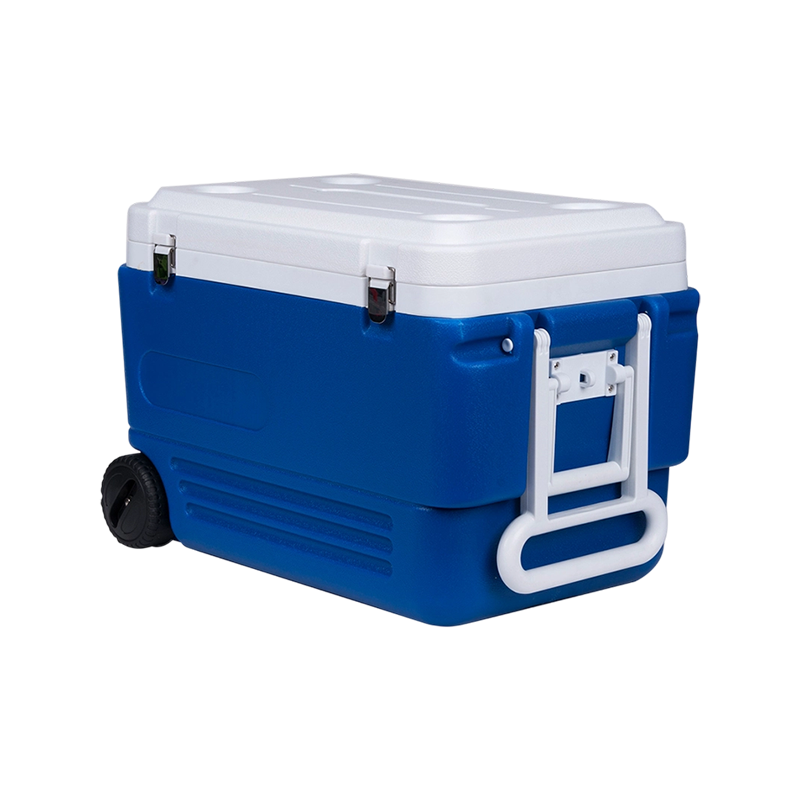
60L Wheeled Market Stall Foam Insulated Cooler
Insulation Performance for Temperature-Sensitive Goods
The main function of an insulated cooler is to slow the movement of heat between the outside environment and the contents inside. The performance of the cooler depends on several factors, including the insulation material, wall construction, lid fit, ambient temperature, frequency of opening, type of contents, and amount of ice or cooling medium used.
This model uses PU insulation in the lid and body. Polyurethane foam is widely used in insulated containers because it can provide a strong thermal barrier when properly formed within the cooler structure. The listed vacuum-lid-and-body insulation system is specified to provide insulation for up to 60 hours under suitable conditions. Actual holding time will vary according to operating conditions, but the specification demonstrates that the product is intended for extended use rather than short recreational trips only.
For commercial users, insulation duration is valuable because it gives greater flexibility during transportation and sales. A vendor may load the cooler before leaving a central cold-storage location, travel to an outdoor venue, operate through a busy service period, and return without needing constant replenishment. A caterer may prepare ingredients in advance and transport them to an event while reducing exposure to ambient heat. A market seller may protect products during early-morning setup and throughout the selling period.
Vacuum-Lid-and-Body Construction
The lid is one of the most important areas in any cooler because warm air can enter each time it is opened. A well-insulated lid helps reduce heat transfer through the upper surface, while a suitable seal and locking mechanism help keep the lid securely closed during transport and storage. The vacuum-lid-and-body construction described for this model is intended to improve thermal retention across both major sections of the container.
Reducing heat transfer through the body is equally important. Outdoor coolers may be exposed to direct sunlight, warm vehicle interiors, hot pavement, and changing weather conditions. A properly insulated body gives the contents a degree of protection against these external influences. The result is a more stable internal environment, especially when the cooler is pre-chilled and loaded correctly.
Users can improve performance by pre-cooling the cooler before loading, using an appropriate quantity of ice or cold packs, keeping the lid closed whenever possible, arranging products efficiently, and avoiding unnecessary exposure to direct sunlight. These practices complement the insulation system and help achieve better temperature retention.
Useful for Chilled, Frozen, and Fresh Products
The cooler is suitable for a broad range of outdoor applications. It can hold drinks for concession sales, chilled ingredients for catering, frozen products for temporary display, and fresh produce for market distribution. It can also be used for seafood, meat, dairy products, prepared foods, and other goods that require controlled low-temperature storage during transport or service.
Different products require different handling procedures. Frozen products may need more cooling medium and less frequent opening than beverages. Fresh produce may require careful packing to prevent crushing or excess moisture. Seafood and meat require strict sanitation and temperature-control routines. The cooler provides the insulated structure, but users remain responsible for selecting appropriate cooling methods, monitoring temperatures, and following relevant food-safety requirements.
Food-Grade Materials and Hygienic Use
The listed construction uses food-grade PP, PE, and PU. Polypropylene is commonly selected for durable molded components because it offers a useful combination of rigidity, impact resistance, and chemical tolerance. Polyethylene is widely used in products that require toughness and a practical surface for repeated handling. Polyurethane foam serves as the insulation layer inside the cooler body and lid.
Food-grade material selection is particularly important for commercial coolers. A container used for drinks, food, ice, or fresh produce must be designed with hygiene in mind. Smooth, durable interior surfaces are easier to inspect and clean than rough or damaged surfaces. The material system should also be suitable for repeated contact with ordinary cleaning procedures when used according to the manufacturer's care recommendations.
The cooler is described as BPA-free and made with food-grade PP construction. This gives buyers an important material-quality reference when evaluating products for professional use. Retailers, caterers, and distributors can use this information when developing purchasing specifications for food-contact equipment.
Cleaning and Daily Maintenance
A commercial cooler may be exposed to spilled drinks, food residue, melting ice, soil, dust, and outdoor debris. Daily cleaning is therefore essential. After use, the contents should be removed, melted water drained, and the interior washed with a suitable mild cleaning solution. The cooler should then be rinsed and dried thoroughly before the lid is closed for storage.
The drain valve helps simplify this process. Instead of lifting and tipping a full-size cooler to remove water, the operator can release accumulated liquid through the designated outlet. This is useful during long selling periods when ice melts gradually. It can also reduce the effort required at the end of the day, especially when the container is positioned in a vehicle or near a stall.
Users should inspect the drain valve regularly to confirm that it closes properly and remains free from debris. The lid, lock buckle, handle, and wheels should also be checked periodically. A simple maintenance routine can extend service life and help keep the cooler reliable during busy operating periods.
Structural Features That Support Long-Term Use
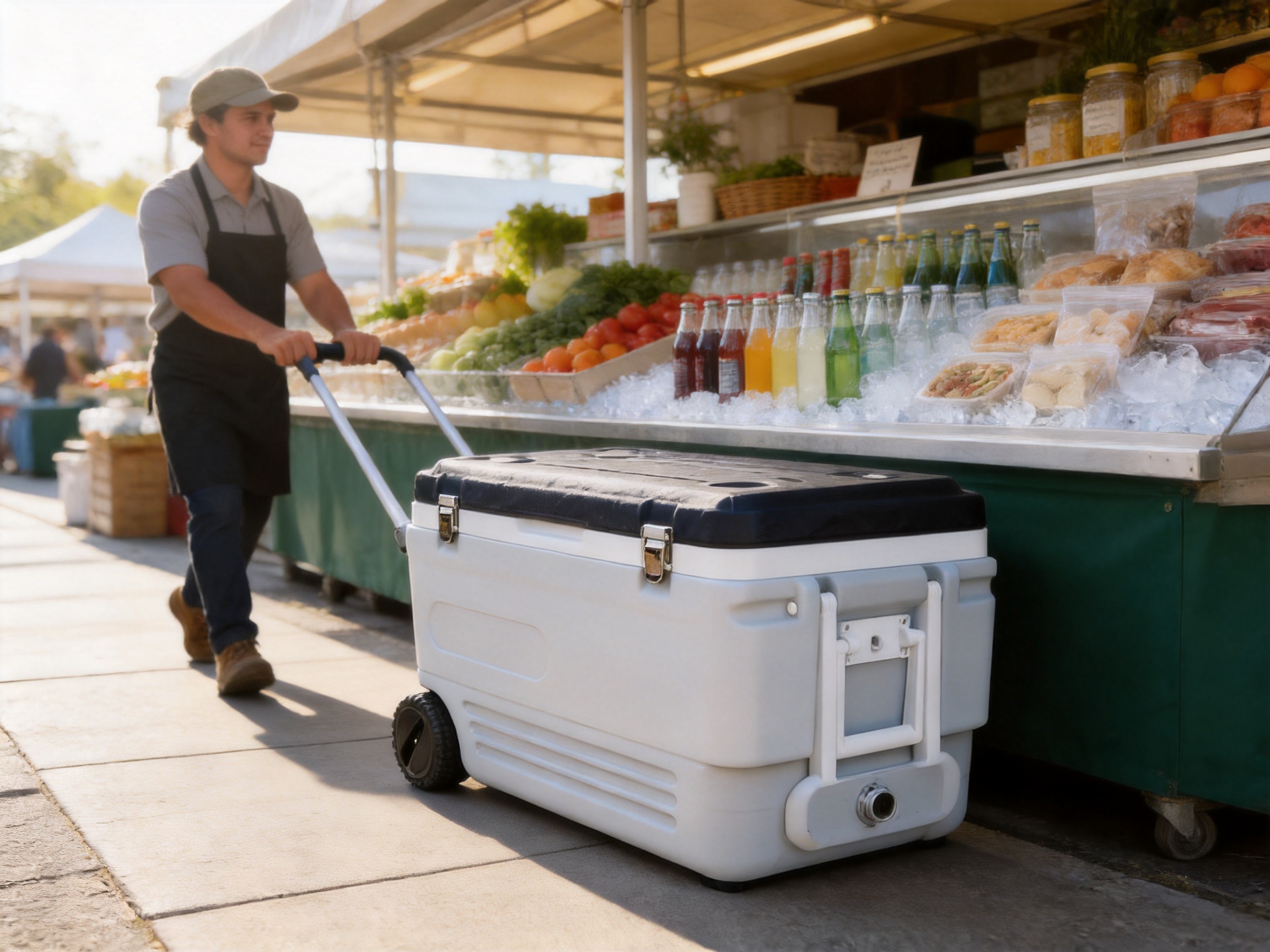
Commercial equipment must tolerate more demanding conditions than products used occasionally at home. It may be loaded into delivery vehicles, moved over uneven surfaces, placed near other equipment, and handled by different employees. The cooler's PP and PE construction is intended to provide a durable outer structure for these repeated tasks.
Durability does not mean that the cooler is indestructible. Users should avoid dropping it from vehicles, exceeding reasonable load limits, dragging it over highly abrasive surfaces, or using sharp tools inside the container. Nevertheless, a robust molded structure can offer advantages over thin-walled portable boxes that may flex, crack, or lose their shape under heavy use.
Stainless Steel Lock Buckle
The stainless steel lock buckle provides a secure method of holding the lid closed. This is useful when the cooler is moved over uneven ground or transported in a vehicle. A secure closure can also help reduce accidental lid movement during handling and limit unnecessary exposure of the contents to warm air.
Stainless steel is valued for its resistance to corrosion in many ordinary environments. Outdoor products may be exposed to moisture, condensation, cleaning water, and humid conditions, so corrosion-resistant hardware can be a practical advantage. As with any metal component, the buckle should be kept reasonably clean and inspected for damage or deformation.
Side Grip Grooves for Controlled Handling
Side grip grooves give users a stable place to hold the cooler when wheels are not suitable. This may occur on stairs, soft ground, narrow paths, vehicle ramps, or crowded market areas. The grooves can also help two people lift or reposition the cooler more safely than attempting to grip a smooth side wall.
These grip areas reflect a thoughtful approach to real-world use. A cooler should not be designed only for ideal flat surfaces. Outdoor commerce often involves changing terrain, restricted access, and tight working spaces. Multiple handling options allow users to adapt the cooler to the location instead of relying on a single transport method.
How It Compares with Common Cooler Alternatives
Buyers evaluating commercial coolers often compare hard plastic chests, soft-sided insulated bags, basic picnic coolers, and specialized transport boxes. Each type has a place, but the 60-liter wheeled model offers a combination of features that can be difficult to find in simpler alternatives.
| Evaluation Factor | 60-Liter Wheeled Insulated Cooler | Basic Soft Cooler | Small Personal Cooler | Stationary Large Chest |
|---|---|---|---|---|
| Storage capacity | 60 liters for commercial and event use | Usually limited and flexible | Generally suitable for personal portions | Often high, but may be difficult to move |
| Transport method | Wheels, telescopic handle, and side grips | Shoulder straps or hand carrying | Usually hand carrying | Often requires lifting or multiple people |
| Insulation structure | PU-insulated lid and body | Flexible layered insulation | Basic molded or foam insulation | Varies by model and construction |
| Commercial suitability | Designed for markets, concessions, and catering | Better for light-duty use | Better for short trips | Useful when mobility is not important |
| Drainage | Integrated drain valve | May require manual emptying | Often limited or absent | May have a drain, but moving the unit can be difficult |
| Closure hardware | Stainless steel lock buckle | Usually zipper-based | Basic latch or zipper | Varies according to design |
Compared with a soft cooler, the rigid construction offers stronger protection for products and more stability when the container is used as a temporary service station. A soft bag may be lighter, but it can be less suitable for dense loads, repeated commercial handling, or products that need protection from compression.
Compared with a small personal cooler, the 60-liter model offers substantially greater capacity and more appropriate transport features for business operations. A personal cooler may be convenient for one person or a short outing, but frequent restocking becomes inefficient when sales volume increases.
Compared with a large stationary chest, the wheeled format offers better flexibility. A stationary chest may provide more volume, but it may require a vehicle lift, trolley, or several people to relocate. The 60-liter model is easier to integrate into mobile selling routines where equipment must move regularly.
A Balance Between Capacity and Mobility
One of the product's strongest competitive advantages is balance. Capacity alone does not guarantee usefulness, and mobility alone does not solve the needs of a commercial operator. A compact cooler is easy to carry but may not hold enough products. A very large container stores more but can create transportation and handling problems. The 60-liter format, supported by wheels and a telescopic handle, aims to provide a practical middle ground.
The dimensions of 650 × 405 × 440 millimeters are substantial enough for commercial storage while remaining compatible with many vehicle-loading and market-stall arrangements. Buyers should always confirm available space in their vehicles, storage rooms, and display areas before ordering, especially when purchasing multiple units.
Applications Across Outdoor Business Sectors
Farmers Markets and Street Vendors
Farmers-market sellers often work outdoors for several hours and need to protect products from heat, sunlight, and fluctuating weather. The cooler can hold fresh produce, chilled beverages, dairy items, prepared foods, or specialty products. Its wheels make it easier to move from a vehicle to a stall, while its rigid body can provide a stable base for organized storage.
For beverage vendors, the cooler can hold products in bulk and reduce the need for repeated trips to a larger vehicle. The drain valve can help remove melting ice between sales periods, and the lock buckle can help keep the lid closed while the cooler is being relocated.
Food Trucks and Mobile Kitchens
Food trucks often have limited internal storage. A wheeled cooler can serve as supplemental cold storage during preparation, service, or restocking. It can hold ingredients that are needed near the service window, helping staff reduce unnecessary movement inside a crowded vehicle.
Because food trucks may operate at festivals, sporting events, construction sites, and private functions, a mobile insulated container can extend the usable service area. It may also be used outside the truck for beverage storage or temporary ingredient management, provided that the operator follows appropriate food-safety procedures.
Outdoor Concessions and Sporting Events
Sports tournaments, school events, concerts, fairs, and community gatherings often require temporary food and beverage service. A 60-liter cooler can support concession teams that need to transport stock from a central supply point to a service booth. The wheels are especially useful across paved event grounds, while the durable body can withstand the repeated handling typical of temporary operations.
For event organizers, standardized coolers can improve logistics. Multiple units may be assigned to different product categories, such as bottled water, soft drinks, frozen treats, or fresh ingredients. Color and logo customization may also help businesses create a consistent visual identity when ordering through an OEM or ODM program.
Catering and Hospitality
Caterers need to transport food safely and present it professionally. The cooler can be used during the movement of chilled ingredients, prepared dishes, beverages, or desserts. Its insulated construction helps protect products during the period between preparation and service, while the large capacity reduces the number of separate containers required.
Hospitality businesses may also use the cooler for outdoor breakfast service, poolside refreshments, garden events, mobile bars, and temporary banquet areas. Its wheels support movement across suitable flooring, and its side grip grooves provide an alternative when the cooler needs to be lifted over thresholds or loaded into a vehicle.
Fishing, Camping, and Outdoor Recreation
Although designed with commercial applications in mind, the cooler is also suitable for serious outdoor recreation. Anglers can use it for fish, bait, drinks, and food. Campers can use it for multi-day trips where greater storage volume and extended insulation are important. Boat operators may use it for beverages, provisions, or catch storage, provided the unit is secured appropriately.
The rigid food-grade construction and drain valve are useful in environments where water, ice, and outdoor debris are common. Users should select suitable tie-down methods when transporting the cooler on boats, trailers, or open vehicle platforms.
Manufacturing Strengths Behind the Product
The performance of a cooler begins with product design but depends heavily on manufacturing capability. A manufacturer that can manage product development, tooling, injection molding, blow molding, foaming, assembly, inspection, and customer support within an integrated system is better positioned to deliver consistent results.
Ningbo Junlong Outdoor Products Co., Ltd. was founded in 2000 and operates from Cixi, Ningbo, a major manufacturing area in the Yangtze River Delta. The company has an independent factory covering approximately 12,000 square meters and employs more than 100 people. Its facilities include automatic injection molding machines, blow molding machines, and foaming equipment.
Integrated Product Development and Production
An integrated manufacturing structure can shorten communication paths between design, tooling, production, and quality teams. This is important for products such as insulated coolers, where the relationship between the outer shell, insulation layer, lid, hardware, drain system, and transport components affects overall performance.
When design and production teams work closely, they can address practical details earlier in the development cycle. These details may include wall thickness, component fit, handle placement, wheel alignment, buckle positioning, drainage access, and compatibility with production molds. Early problem solving can improve consistency and reduce avoidable modifications after mass production begins.
Automatic Injection Molding
Injection molding is well suited to producing repeatable plastic components with defined shapes and consistent dimensions. For a cooler, this process may be used for structural parts such as outer shells, lids, handles, brackets, and other molded components. Automatic equipment can support stable processing conditions and efficient production volumes.
Consistent molding is important because dimensional variation can affect lid fit, hardware installation, wheel alignment, and the appearance of the finished product. A well-controlled process helps ensure that components from different production batches remain compatible with the intended assembly specifications.
Blow Molding Capability
Blow molding is another important process for producing hollow plastic structures. The ability to use both injection molding and blow molding gives a manufacturer broader flexibility when developing outdoor containers and cooler-related products. Different product geometries, wall structures, and performance requirements may call for different molding methods.
This process diversity allows the factory to support a wider product range, including cooler boxes, cooler jugs, outdoor water containers, and related storage products. It also gives OEM and ODM customers more options when requesting a new shape or application-specific design.
Foaming Equipment and Insulation Production
Foaming equipment is essential for producing insulated cooler bodies and lids that use PU foam. Insulation performance depends not only on the material itself but also on how consistently the foam is introduced, distributed, and formed within the product structure. Controlled foaming helps support repeatable thermal characteristics across production batches.
For commercial buyers, manufacturing control over the insulation process is a significant advantage. It can help reduce variation between units and support more reliable performance for distributors, retailers, and end users. It also allows the manufacturer to coordinate insulation development with shell design, lid construction, and overall product dimensions.
Quality Management and Custom Manufacturing
The company describes its operations as being supported by a rigorous quality management system and a creative research and development team. Quality management in cooler production may involve incoming material checks, mold and process control, component inspection, assembly verification, leak inspection, hardware checks, and final appearance review.
Quality requirements can vary according to the target market and intended application. A cooler for household use may have different packaging and appearance priorities from one intended for food-service distributors or outdoor event companies. A professional supplier should therefore be able to communicate specifications clearly and coordinate quality expectations before production.
OEM and ODM Services
OEM and ODM services provide options for companies that want to sell coolers under their own business identity or develop a product for a specific market. The manufacturer offers product development based on drawings or samples, along with customization of color, logo, and packaging.
Drawing-based development is useful when a buyer already has a concept, dimensional requirement, or technical specification. Sample-based development is helpful when the buyer has an existing product or reference unit and wants to develop a related design. These services can support private-label programs, promotional merchandise, hospitality supply, retail distribution, and specialized outdoor equipment ranges.
Color customization can help distinguish product lines or coordinate with a brand's visual identity. Logo application can support promotional use or business recognition. Packaging customization can improve shelf presentation, provide multilingual information, or accommodate different distribution channels. The feasibility of each option should be confirmed during the quotation and sampling stage.
Why Factory Capability Matters to Buyers
Purchasing directly from an experienced manufacturer can offer several advantages. Buyers may receive clearer technical information, more direct communication about production requirements, and greater flexibility in discussing materials, colors, packaging, and order volumes. Factory-level cooperation can also help businesses plan product revisions based on customer feedback.
For importers and distributors, production capability is especially important because a successful product launch requires more than one shipment. Stable supply, repeatable quality, packaging consistency, and responsive after-sales communication all contribute to long-term commercial success. A manufacturer with an established factory and multiple production processes may be better equipped to support continuing orders than a trading source with limited control over production.
Using the Cooler Efficiently
Correct operation can significantly influence insulation performance and service life. Before use, the interior should be clean and dry. Pre-cooling the cooler and its contents can reduce the initial thermal load. Cooling media should be distributed around the products rather than placed in one area only, and products should be packed in a way that permits convenient access without prolonged lid opening.
The lid should remain closed whenever possible. During busy sales periods, it may be helpful to organize products by type or size so that staff can retrieve them quickly. Frequently sold items can be positioned near the top, while reserve stock can remain lower in the cooler. This arrangement reduces the time required for each transaction and helps limit warm-air exchange.
Users should avoid placing the cooler directly on very hot surfaces for long periods. Shade or a suitable protective cover can help reduce exposure to direct sunlight. When transported in a vehicle, the cooler should be positioned securely so that it cannot roll, slide, or collide with other equipment.
Loading and Weight Management
Although the cooler has a 60-liter volume, users should consider the total loaded weight. Water, ice, cans, bottles, and dense foods can quickly create a heavy load. The wheels and handle are intended to support movement, but the operator should avoid pulling the cooler over surfaces that may damage the wheels or cause sudden tipping.
When lifting is necessary, two people should use the side grip grooves if the loaded weight is difficult for one person to manage. The cooler should not be lifted by the telescopic handle unless the product instructions specifically permit that method. Careful handling protects the handle assembly, wheel structure, and the people moving the unit.
Cleaning After Commercial Use
After each operating period, the cooler should be emptied and cleaned as soon as practical. Food residue should not be allowed to remain inside overnight. The drain valve can be opened to release melted water, after which the interior can be washed, rinsed, and dried.
Harsh abrasive tools and unsuitable chemicals may damage plastic surfaces or seals. Users should follow recommended cleaning procedures and test any unfamiliar cleaning product on a small area when appropriate. The cooler should be stored with the lid slightly open or in a ventilated condition if permitted, helping prevent trapped moisture and unpleasant odors.
Purchasing Considerations for Wholesale Buyers
Businesses planning to purchase this type of cooler should define their intended application before placing an order. Important considerations include expected capacity, product categories, operating temperature, transportation distance, terrain, vehicle space, number of units, color requirements, branding needs, packaging, and target market regulations.
Buyers should also clarify the exact product dimensions, net weight, insulation specification, available colors, hardware configuration, wheel design, handle operation, drain-valve structure, and carton details. If the cooler will be exported, packaging should be reviewed for protection during sea, rail, or road transportation.
Samples are valuable for checking practical details. A buyer can inspect the lid fit, buckle operation, wheel movement, handle extension, internal finish, drain performance, and overall appearance. Product testing under representative conditions can also help establish realistic expectations for holding time and loading capacity.
| Buyer Requirement | Recommended Discussion Point |
|---|---|
| Private-label sales | Confirm logo method, logo size, color options, and minimum order quantity. |
| Retail distribution | Review packaging design, barcode space, product information, and carton strength. |
| Food-service use | Confirm food-contact material information and cleaning guidance. |
| Outdoor events | Evaluate wheel performance, handle strength, drainage, and transport security. |
| International shipping | Confirm carton dimensions, loading quantity, export documents, and protection methods. |
| Custom development | Provide drawings, samples, target capacity, appearance requirements, and use conditions. |
Questions and Answers
What is the capacity of the cooler?
The cooler has a nominal capacity of 60 liters. The usable space will depend on the size of the products being stored and the amount of ice or cooling medium placed inside.
What are the product dimensions?
The listed dimensions are 650 × 405 × 440 millimeters. Buyers should confirm whether these measurements refer to the exterior dimensions and should allow additional space for packaging, handles, wheels, and vehicle loading.
What materials are used?
The cooler is made from food-grade PP, PE, and PU materials. The PP and PE components provide the molded structural elements, while PU is used for insulation in the lid and body.
How long can it preserve temperature?
The vacuum-lid-and-body PU insulation is specified for an insulation time of up to 60 hours under suitable conditions. Actual performance depends on the starting temperature, amount and type of cooling medium, ambient temperature, frequency of opening, loading arrangement, and exposure to sunlight.
Is the cooler suitable for commercial use?
Yes. Its 60-liter capacity, wheels, telescopic handle, side grip grooves, drain valve, stainless steel lock buckle, and durable food-grade construction make it suitable for market stalls, food trucks, outdoor concessions, farmers markets, catering, and related applications.
Can the cooler be pulled like a suitcase?
The cooler is equipped with a large handle and wheels for convenient transportation. Users should pull it on suitable surfaces and avoid excessive loads or rough terrain that could damage the wheels or handle.
Does it have a drain system?
Yes. The cooler includes a drain valve designed to help remove melted ice and water. The valve should be inspected and cleaned regularly to help maintain proper operation.
Is there a locking feature?
The cooler includes a stainless steel lock buckle that helps hold the lid closed during transport and storage. Buyers should confirm whether an additional security lock or accessory is required for their specific application.
Can it be customized?
OEM and ODM customization services are available. Options may include product development based on drawings or samples, color customization, logo application, and packaging customization. Specific requirements, tooling, order quantities, and production schedules should be discussed with the manufacturer.
Is the cooler BPA-free?
The product information identifies the construction as BPA-free food-grade PP. Buyers with specific regulatory or market requirements should request the relevant material documentation and compliance information for their target market.
What kinds of products can it store?
It can be used for drinks, ice cream, fresh produce, seafood, meat, dairy products, prepared foods, ingredients, and other temperature-sensitive goods. Users must apply suitable food-safety procedures and verify that products remain within their required temperature range.
How should it be cleaned?
Empty the cooler, release melted water through the drain valve, wash the interior with a suitable mild cleaning solution, rinse it, and dry it thoroughly. Regular inspection of the drain valve, lid, buckle, handle, and wheels is also recommended.
Why is the factory's manufacturing capability important?
The factory combines product development, injection molding, blow molding, foaming, production, and sales support. This integrated capability can help improve process coordination, maintain product consistency, and support customized projects for distributors and private-label buyers.
Conclusion
The 60-liter wheeled foam insulated cooler is designed for users who need more than basic short-term storage. Its large capacity supports commercial quantities of beverages, food, ingredients, and fresh products. Its PU-insulated lid and body are intended to provide extended temperature retention, with a listed insulation time of up to 60 hours under suitable conditions. Its food-grade PP and PE construction supports practical hygiene and durability, while the drain valve helps simplify maintenance.
The product's strongest advantage is the combination of capacity and mobility. Wheels, a telescopic handle, and side grip grooves make it easier to transport than a conventional large chest. The stainless steel lock buckle supports secure closure, and the rigid structure is appropriate for repeated outdoor handling. These features make the cooler useful for market stalls, food trucks, farmers markets, caterers, event concessions, outdoor recreation, and many other applications.
Behind the product is a manufacturing operation with experience dating back to 2000, a 12,000-square-meter factory, more than 100 employees, automatic injection molding equipment, blow molding machines, foaming equipment, research and development resources, and quality-management practices. The ability to provide OEM and ODM services, including development from drawings or samples and customization of color, logo, and packaging, gives commercial buyers additional flexibility.
For businesses seeking a dependable mobile cold-storage solution, this cooler offers a practical combination of insulation, structure, sanitation, capacity, and transport convenience. When matched with correct loading, cleaning, temperature monitoring, and handling procedures, it can become a valuable part of an outdoor sales or catering operation.
References
1. Product specification sheet for the 60-liter wheeled market stall foam insulated cooler, including dimensions, capacity, materials, weight, insulation, drainage, closure, and transportation features.
2. Company manufacturing profile for Ningbo Junlong Outdoor Products Co., Ltd., including factory history, facilities, product development, production capabilities, and OEM/ODM services.
3. General principles of insulated-container design, including the relationship between insulation materials, lid construction, ambient conditions, cooling media, and temperature retention.
4. General food-handling and cold-chain management guidance for chilled, frozen, and temperature-sensitive products used in outdoor commerce and catering.
5. General plastic product manufacturing references covering injection molding, blow molding, polyurethane foaming, component inspection, and quality-management procedures.
Product: 60L Wheeled Market Stall Foam Insulated Cooler

Product Recommendation
link
Office
- TEL: +86-574-63787606
- Phone: +86-13777994798
- E-mail: sales@nbjunlong.com
- WhatsApp: 13777967488
- Address: No. 1, Lane 3, Development Road, Longtouchang, Longshan Town, Cixi City, Zhejiang Province, China
Get In Touch
Copyright © Ningbo Junlong Outdoor Products Co., Ltd. All Rights Reserved.
China Plastic Insulated Cooler Box Manufacturer Custom Cooler Box Supplier
