- SMALL ORDERS FOR STANDARD ITEMS. Contact Now
- OUTDOOR COOLING SOLUTIONS, MADE IN‑HOUSE. Contact Now
- COOLER BOXES THAT FIT REAL OUTDOOR LIFE. Contact Now

 LANGUAGE
 日本語
 Español
 عربى

Content
- 1 Designed for Large-Scale Outdoor Storage
- 2 Three-Layer Material Construction
- 3 Mobility That Makes a Large Cooler More Practical
- 4 Thermal Retention for Extended Trips
- 5 Functional Lid Design
- 6 Bottom Drain Valve for Easier Maintenance
- 7 Advantages Over Basic and Competing Cooler Formats
- 8 Applications Across Outdoor and Commercial Settings
- 9 Manufacturing Capabilities Behind the Product
- 10 Product Development and Quality Management
- 11 OEM and ODM Customization Options
- 12 Responsible Use and Maintenance
- 13 Why the Product Fits Professional Purchasing Programs
- 14 Q&A
- 14.1 What is the capacity of the cooler?
- 14.2 What materials are used in its construction?
- 14.3 How long can the cooler retain cold temperatures?
- 14.4 Does the cooler have wheels?
- 14.5 Can the cooler be lifted?
- 14.6 What are the external and internal dimensions?
- 14.7 Does the cooler have a drain?
- 14.8 What is the purpose of the cup holes in the lid?
- 14.9 Can the product be customized?
- 14.10 Who can benefit from this cooler?
- 14.11 How should the cooler be cleaned?
- 14.12 Is the cooler suitable for use in a vehicle?
- 15 Conclusion
- 16 References
- 17 Product: 55L Heavy-Duty Wheeled Ice Cooler for Family Outdoor Use
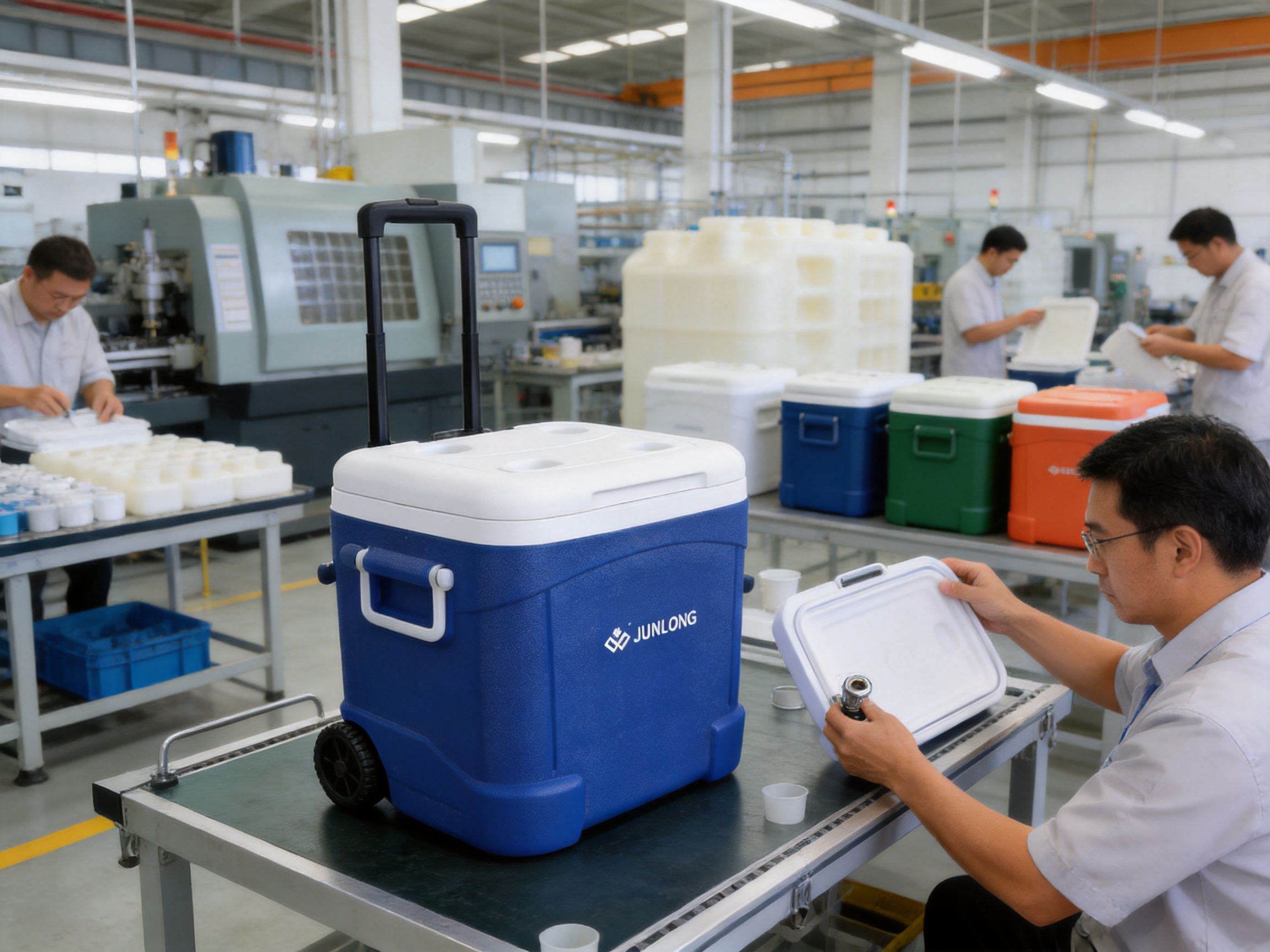
Outdoor activities become more comfortable when food, drinks, and fresh ingredients can be stored at a stable temperature. Whether the destination is a campsite, beach, fishing location, tailgate event, picnic area, or family road trip, a dependable cooler is more than a simple storage box. It must offer sufficient capacity, reliable insulation, convenient transportation, structural strength, easy cleaning, and practical details that support everyday use. The 55L Heavy-Duty Wheeled Ice Cooler is designed to combine these qualities in one large-capacity portable cooling solution.
With a 55-liter capacity, thick polyurethane insulation, a food-safe polypropylene inner lining, a durable polyethylene exterior, large rear wheels, a telescoping handle, reinforced side handles, a bottom drain valve, and lid cup holders, this cooler is built for demanding outdoor use. Its 490 × 440 × 520 mm outer dimensions provide substantial storage while its wheeled construction helps reduce the effort required to move a fully loaded box.
The cooler is suitable for users who need more space than a conventional personal cooler can provide but still want the flexibility of portable equipment. It can hold beverages, fresh food, meal ingredients, ice, fishing supplies, and other temperature-sensitive items for group activities. Its vacuum-insulated lid, PU-insulated body, and sealing strip are designed to support insulation performance for up to 60 hours under suitable conditions, depending on the amount of ice, ambient temperature, loading method, and frequency of opening.
Behind this product is Ningbo Junlong Outdoor Products Co., Ltd., a China-based manufacturer specializing in cooler boxes, insulated cooler jugs, ice buckets, and outdoor water containers. The company integrates product development, injection molding, blow molding, foaming, assembly, quality management, and sales within its manufacturing operation. This combination allows the product to be developed with attention to both user needs and production consistency.
Designed for Large-Scale Outdoor Storage
The principal advantage of this cooler is its generous 55-liter capacity. Small coolers are convenient for individual lunches or short outings, but they often become overcrowded when used by families or larger groups. A large cooler reduces the need for multiple containers and makes it easier to organize food and drinks in one location.
The 55L format is appropriate for extended outdoor use because it can accommodate a combination of bottled water, canned beverages, fresh produce, prepared meals, meat, seafood, dairy products, and ice. The available space can also be divided with storage baskets, food containers, or reusable ice packs according to the user’s needs. For commercial buyers, retailers, rental operators, event organizers, and hospitality businesses, the capacity provides a practical middle point between compact portable coolers and much larger stationary ice chests.
The inner dimensions are approximately 430 × 367 × 450 mm. This internal cavity is deep enough for upright bottles and tall food containers, while the broad structure helps users arrange multiple items. Proper organization is important because it limits unnecessary searching and reduces the time the lid remains open. When cold air is retained more effectively, cooling performance and ice life can be improved.
The outer dimensions measure approximately 490 × 440 × 520 mm. Although the cooler is large enough for family and group use, its footprint remains suitable for many vehicle trunks, recreational areas, campsites, and outdoor gathering spaces. Buyers should always confirm the available storage area of their vehicle or equipment before ordering, particularly when purchasing multiple units for commercial deployment.
Three-Layer Material Construction
A cooler’s performance depends heavily on the quality and compatibility of its materials. The product uses a food-safe PP inner material, a PE outer material, and a PU insulation layer. Each material performs a different function, creating a balanced structure for thermal retention, impact resistance, hygiene, and long-term usability.
Food-Safe Polypropylene Inner Lining
The inner lining is made from polypropylene, commonly identified as PP. This material is widely used in food-contact applications because it is lightweight, chemically stable, and relatively easy to clean. The smooth inner surface helps users wipe away moisture, beverage residue, food particles, and melted ice after use.
For outdoor equipment, the inner lining must withstand repeated loading and unloading. Bottles, cans, ice bags, food containers, and fishing supplies can all place pressure on the internal walls. PP provides a practical balance of rigidity and weight, helping the cooler maintain its shape while remaining portable.
The food-safe inner construction is especially useful for users who store unpackaged food or ingredients in the cooler. As with any food storage product, users should follow applicable food-handling practices, clean the interior after use, and avoid placing sharp objects directly against the liner.
Durable Polyethylene Outer Shell
The exterior uses polyethylene, or PE, which is valued for its toughness, impact resistance, and suitability for molded outdoor products. A cooler used at a campsite or beach may be placed on rough ground, moved across gravel, exposed to splashes, or transported in a vehicle with other equipment. The PE outer shell helps protect the insulation and internal compartment during ordinary outdoor handling.
The exterior structure is also suitable for product customization. Depending on the project, manufacturers can discuss colors, surface treatments, labels, logos, packaging, and other visual details for OEM or ODM programs. These options allow distributors, retailers, hospitality companies, and outdoor brands to create a cooler that matches their market positioning.
Polyurethane Insulation Layer
The insulation layer is made from polyurethane, or PU. PU foam is commonly used in insulated containers because it offers effective thermal resistance while maintaining a relatively compact structure. The insulation layer is positioned between the inner and outer molded components, forming a protective barrier that slows the transfer of heat from the surrounding environment into the cooler.
Insulation performance is influenced by many variables. Ambient temperature, direct sunlight, the temperature of the contents, the ratio of ice to stored items, lid-opening frequency, and the condition of the seal all affect the results. The cooler’s vacuum lid, PU-insulated body, and sealing strip are designed to work together to support an insulation time of up to 60 hours under appropriate conditions.
This construction gives the cooler an advantage over thin-wall containers that rely mainly on a small amount of foam or a flexible fabric lining. A rigid insulated body generally provides stronger protection, more consistent shape retention, and greater resistance to compression during transport.
| Specification | Details | Practical Benefit |
|---|---|---|
| Capacity | 55 liters | Suitable for families, groups, extended trips, and large gatherings |
| Category | Large cooler box, 45L–80L | Provides more storage than personal and medium-size coolers |
| Inner material | Polypropylene (PP) | Food-safe, durable, and easy to clean |
| Outer material | Polyethylene (PE) | Supports impact resistance and outdoor durability |
| Insulation | Polyurethane (PU) | Helps slow heat transfer and retain cold temperatures |
| Outer dimensions | 490 × 440 × 520 mm | Large capacity within a practical portable footprint |
| Inner dimensions | 430 × 367 × 450 mm | Provides usable vertical and horizontal storage space |
| Unit weight | Approximately 6,500 g | Robust construction while remaining movable |
| Transport system | Rear wheels and telescoping handle | Reduces lifting and carrying effort when loaded |
| Drainage | Bottom drain valve | Allows melted ice and wash water to be released conveniently |
| Lid design | Vacuum lid, sealing strip, and cup-hole design | Supports insulation and adds convenient beverage placement |
Mobility That Makes a Large Cooler More Practical
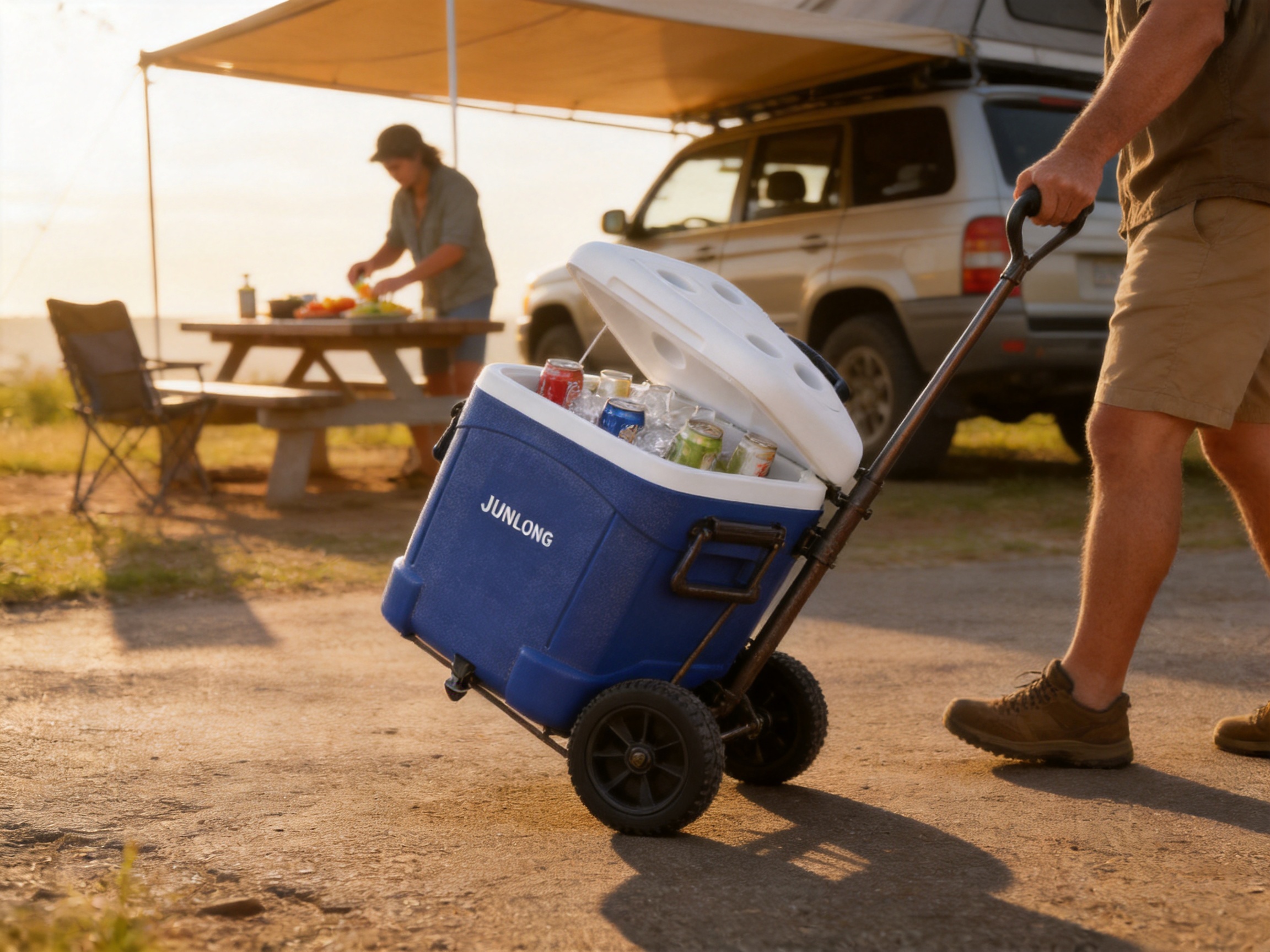
Capacity is valuable only when users can move the cooler without excessive effort. A fully loaded 55-liter cooler can become heavy because of ice, water, cans, bottles, fresh food, and cooking ingredients. Carrying such a container over a long distance can be uncomfortable and may require two people. The wheeled design addresses this challenge by transferring much of the load from the user’s arms to the ground.
The cooler includes large rear wheels and an iron rod wheel structure. The wheels help it travel across common outdoor surfaces such as paved paths, campsite roads, parking areas, patios, and compact soil. While no portable cooler wheel system should be treated as intended for every type of terrain, the design provides a substantial advantage over a stationary box when the cooler must be moved between a vehicle and an activity area.
The telescoping handle gives users a pulling point that can be adjusted for transport. When the cooler is not being moved, the handle can be returned toward the body to reduce obstruction. The design is useful for family users, older customers, event staff, and anyone who wants to reduce repeated lifting.
Reinforced side handles provide an alternative method of movement. Two people can use the side handles to lift the cooler into a vehicle or carry it over steps and uneven ground where wheels may not be appropriate. This combination of wheels, a telescoping handle, and side handles gives the product greater flexibility than a cooler that depends on one carrying method.
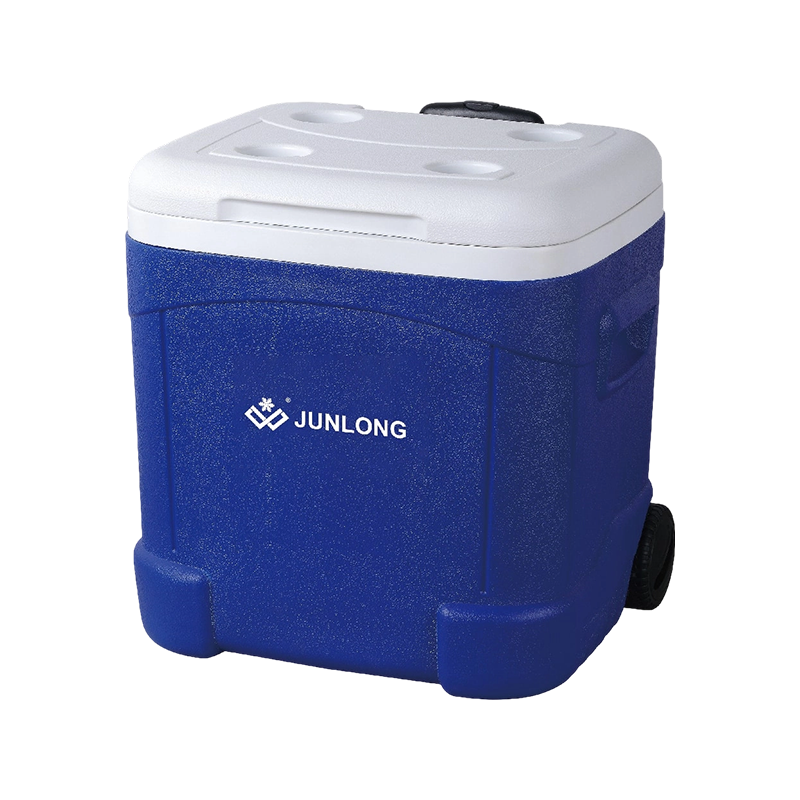
55L Heavy-Duty Wheeled Ice Cooler for Family Outdoor Use
Thermal Retention for Extended Trips
Long outdoor activities place more demanding requirements on a cooler than short lunches or day trips. A short outing may only require a basic insulated container, but multi-day camping, fishing, hunting, travel, and event use require a structure capable of maintaining a colder internal environment for a longer period.
The product’s insulation system combines a vacuum lid, PU insulation in the body, and a sealing strip around the closure area. The lid is a particularly important component because warm air can enter through gaps around the opening. A well-fitted lid and sealing strip help reduce unwanted air exchange when the cooler is closed.
The stated insulation time is up to 60 hours. This figure should be understood as a performance reference rather than a guarantee for every environment. Users can help achieve stronger results by pre-chilling the cooler, using sufficient ice, loading cold food and beverages, keeping the cooler in shade, minimizing the number and duration of lid openings, and ensuring that the sealing surface remains clean.
Recommended Loading Practices
For best results, contents should be chilled before they are placed inside the cooler. Loading warm food directly into an insulated box requires the ice or cooling medium to absorb that initial heat, which can shorten the overall cooling period. Pre-cooling drinks and ingredients helps preserve the available thermal capacity.
Ice should be distributed around the stored items rather than placed only in one area. Empty spaces allow warm air to circulate more easily, so users may improve retention by filling unnecessary gaps with ice packs or additional ice. At the same time, food should be sealed in suitable containers to prevent direct contact with meltwater and to help maintain hygiene.
The lid should remain closed whenever possible. Every opening allows cold air to escape and warm air to enter. For group use, it may be helpful to organize beverages and frequently accessed items near the top, while less frequently needed food is placed lower in the compartment. This reduces the amount of time spent searching inside the cooler.
Functional Lid Design
The lid is designed to contribute to both insulation and convenience. Its vacuum construction works with the body insulation to create a barrier against external heat. The secure-fitting structure and sealing strip help support a stable closed position and reduce leakage of cold air.
Built-in cup holes on the lid add a useful surface for placing cans, bottles, cups, or other drink containers. This feature can be valuable during picnics, tailgate events, outdoor parties, and family gatherings because it provides a convenient resting area without requiring a separate table or tray.
The cup-hole design also supports more organized use of outdoor space. Users can place drinks on the lid while accessing food from inside the cooler, helping to separate beverage handling from the main storage compartment. However, the lid should not be treated as a seat, step, or platform unless the manufacturer specifically approves such use.
A secure lid also helps limit spills during transport. When the cooler is moved over short distances or placed in a vehicle, a properly closed top reduces the possibility of contents shifting out of the opening. Users should still keep liquids in sealed containers and position the cooler upright whenever practical.
Bottom Drain Valve for Easier Maintenance
Melted ice is an unavoidable part of many cooler applications. Without a drain, users must lift and tilt a heavy container to remove water, which can be difficult when the cooler is full or positioned in a vehicle. The bottom drain valve provides a more controlled method for releasing meltwater after the ice has melted.
The drain can also make cleaning more convenient. After outdoor use, the inner compartment can be washed with appropriate water and mild cleaning materials. The drain allows rinse water to leave the cooler without requiring the entire unit to be overturned. This is particularly useful for fishers, caterers, event operators, and families who use the cooler frequently.
For hygiene and service life, the drain valve should be checked periodically. The sealing area should be kept clear of food particles, sand, and debris. Users should confirm that the valve is closed securely before loading ice or liquid contents. If the cooler is stored for an extended period, the interior should be emptied, cleaned, dried, and ventilated before the lid is fully closed.
Advantages Over Basic and Competing Cooler Formats
The 55L Heavy-Duty Wheeled Ice Cooler offers several advantages when compared with small soft coolers, basic hard-shell boxes, and large containers without wheels.
Compared with Soft-Sided Coolers
Soft-sided coolers are often lightweight and easy to fold, but they generally provide less structural protection and less usable volume. Their insulation can compress over time, and the exterior may be more vulnerable to punctures, abrasion, or deformation. A rigid PP, PE, and PU construction provides a more stable storage chamber for heavy food, bottles, ice, and outdoor equipment.
The wheeled hard-shell format is also more suitable for long trips in which the cooler will be loaded and unloaded repeatedly. Soft bags can be convenient for short journeys, but they may not offer the same level of protection when placed among camping equipment or transported across rough surfaces.
Compared with Small Hard Coolers
Small hard coolers are easier to carry by hand, but their limited capacity can be inconvenient for families and groups. Users may need multiple containers, which increases the amount of equipment to organize and transport. A 55-liter cooler consolidates more supplies into one insulated compartment and can reduce the need for several smaller boxes.
The larger format is also useful for planned meal storage. Instead of placing ingredients in separate small coolers, a family can organize produce, meat, drinks, and prepared foods in one main unit while using sealed containers or baskets to maintain order.
Compared with Large Coolers Without Wheels
Large stationary coolers may offer comparable storage volume, but they can be difficult to move after loading. This is especially true when a container is filled with ice and beverages. The wheel-and-handle system gives this product an important practical advantage: it can be pulled instead of carried over appropriate surfaces.
The inclusion of side handles preserves the option of two-person lifting when required. As a result, the product is not limited to one transport method. Users can pull it across a campsite, lift it into a vehicle, or carry it over a short obstacle depending on the situation.
Compared with Thin-Wall Plastic Containers
Some plastic storage boxes are suitable for organization but are not designed for thermal retention. A cooler requires a dedicated insulation layer, a fitted lid, and a sealing system. The PU body insulation, vacuum lid, and sealing strip provide a more complete thermal solution than a standard plastic box with no specialized insulation.
Applications Across Outdoor and Commercial Settings
The product is designed for a wide range of users and operating conditions. Its large capacity and mobility make it appropriate for personal recreation as well as selected commercial and institutional applications.
Family Camping
For family camping, the cooler can hold drinks, breakfast foods, meat, vegetables, dairy products, condiments, and snacks. Its wheels reduce the effort of moving supplies from a vehicle to a campsite. The cup holders can also provide a convenient place for drinks when outdoor tables are limited.
Beach Trips
At a beach, users may need cold water, fruit, sandwiches, prepared meals, and refreshments for several people. The rigid body helps protect contents from pressure caused by other equipment, while the drain valve makes it easier to remove melted ice after the trip. Users should store the cooler on a stable surface and avoid leaving it exposed to unnecessary direct sunlight.
Fishing Expeditions
Fishing users can use the insulated compartment for beverages, food, bait, or selected catch-handling purposes, subject to local regulations and suitable hygiene procedures. The durable exterior is suited to outdoor environments, while the interior can be cleaned after use. The drain is particularly practical when melted ice and water must be removed at the end of a fishing session.
Tailgate Events and Outdoor Parties
Tailgate gatherings and outdoor parties often require a large quantity of beverages. A 55-liter cooler can serve as a central cold-storage station, reducing repeated trips to a vehicle or indoor refrigerator. The lid cup holes provide convenient drink placement, and the wheels allow staff or hosts to position the cooler where it is most useful.
Road Trips
During a family road trip, the cooler can store drinks and perishable snacks between stops. Its substantial insulation helps reduce reliance on roadside purchases, while its rigid construction protects contents from being compressed by luggage. The cooler should be secured upright in the vehicle to prevent movement during travel.
Picnics and Group Events
Large picnics often require more food than a standard lunch cooler can accommodate. This model provides room for meals, drinks, and ice in one unit. Event organizers may also use several coolers with different contents, such as beverages in one unit and food in another, to improve access control and organization.
Hospitality and Rental Use
Hotels, resorts, campgrounds, outdoor activity providers, and event rental companies may consider large wheeled coolers for guest services or equipment packages. The hard-shell structure, cleanable interior, and customizable exterior create opportunities for branded or program-specific supply solutions. Commercial users should establish cleaning, inspection, and storage procedures to maintain consistent service quality.
Manufacturing Capabilities Behind the Product
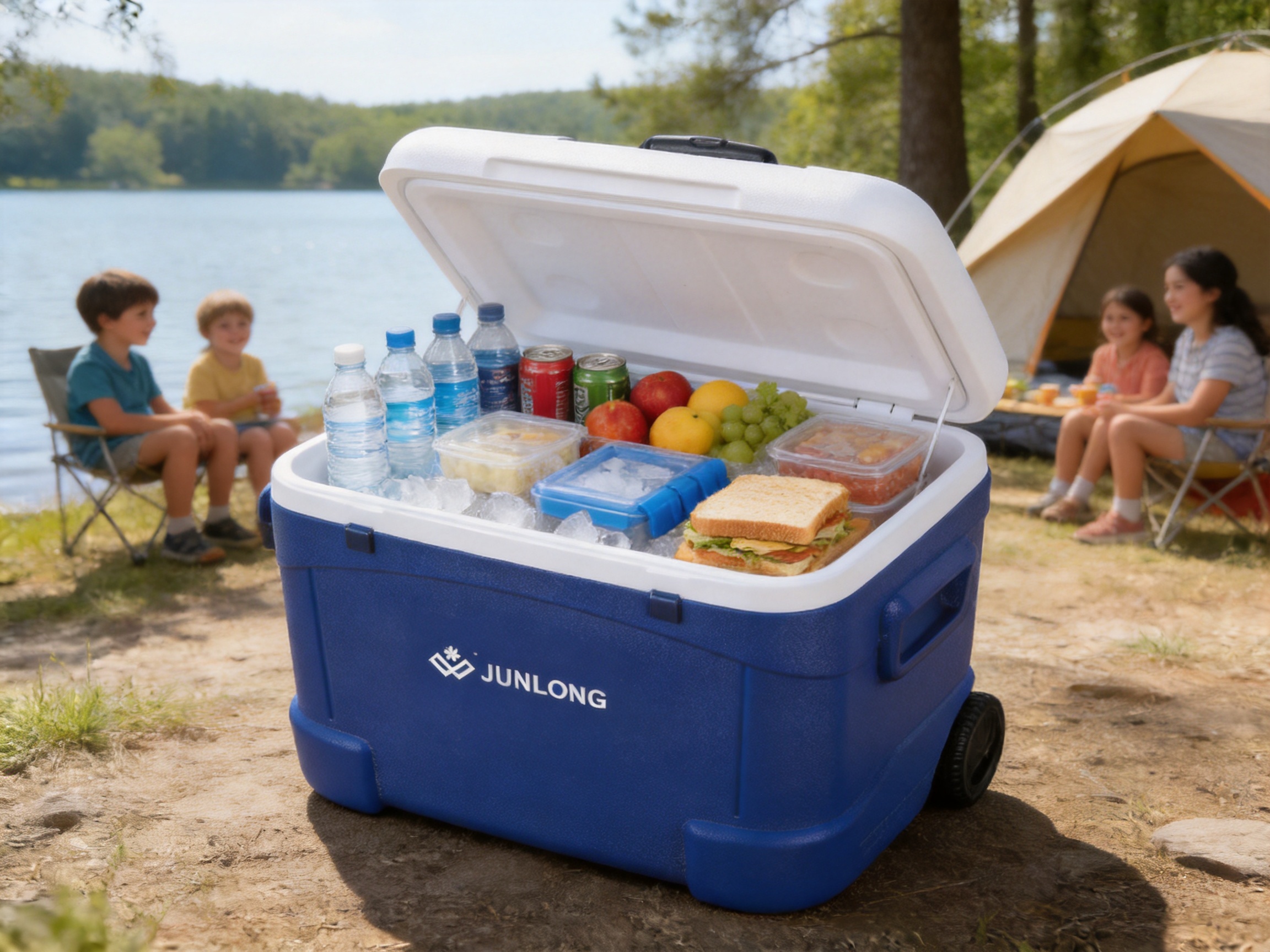
Ningbo Junlong Outdoor Products Co., Ltd. was founded in 2000 and is located in Cixi, Ningbo, Zhejiang Province, China. The region is recognized as an important manufacturing center within the Yangtze River Delta, with access to industrial supply chains, skilled production labor, tooling resources, logistics infrastructure, and supporting component suppliers.
The company operates an independent factory covering approximately 12,000 square meters and employs more than 100 people. Its facilities include automatic injection molding machines, blow molding machines, and foaming equipment. These capabilities are important for insulated cooler production because the product depends on the controlled formation and assembly of several molded components.
Automatic Injection Molding
Injection molding is used to produce plastic parts by injecting molten material into a prepared mold. Automated injection molding equipment can support repeatable production of inner liners, outer shells, lids, handles, and other components. Stable processing conditions help reduce variation in dimensions, wall thickness, surface finish, and assembly fit.
For a cooler, dimensional consistency is especially important around the lid, sealing interface, drain opening, wheel attachment points, and handle supports. If these areas vary excessively, the product may be more difficult to assemble or may not deliver the intended user experience. Automated equipment, process monitoring, and trained operators help the manufacturer maintain repeatability across production batches.
Blow Molding Capability
Blow molding is another plastic-processing technology used to form hollow products and components. Its availability gives the manufacturer broader production flexibility when developing outdoor water containers, cooler jugs, and related products. Different product structures may require different molding methods, and in-house capability can support more efficient product planning.
Blow molding expertise is also valuable for customers seeking a product family rather than a single item. A buyer may require an insulated cooler box, a matching water container, and a cooler jug with coordinated colors and packaging. A manufacturer familiar with multiple molding processes can better evaluate the most appropriate production method for each design.
Foaming and Insulation Production
Foaming equipment supports the creation of insulation layers used in cooler bodies. Controlled foaming is important because the density, distribution, and filling of the insulation influence thermal performance and structural consistency. The body must be designed and processed so that the insulation reaches the intended areas and works effectively between the inner and outer components.
Manufacturing experience in foaming enables the company to coordinate insulation design with shell geometry, lid construction, assembly requirements, and target performance. This integrated approach is preferable to treating insulation as an isolated step after the rest of the product has already been designed.
Product Development and Quality Management
Junlong describes itself as a manufacturing enterprise integrating product development, production, and sales. This integrated structure can benefit buyers because feedback from production and customers can be brought back into the design process. Practical improvements may involve handle strength, wheel placement, drainage, lid fit, color selection, packaging, or storage efficiency.
The company maintains an R&D team focused on developing products for outdoor cooling and water storage. Product development can begin with a concept, drawing, reference sample, required capacity, target market, or specific application. Engineers and production staff can then evaluate materials, dimensions, tooling, assembly, and packaging requirements.
A rigorous quality management approach is important for products that must perform under repeated outdoor use. Quality control may include inspection of incoming materials, monitoring of molding conditions, dimensional checks, visual inspection, assembly verification, drain and lid checks, and finished-product inspection. The exact inspection plan can be agreed upon with the buyer according to product design and order requirements.
For OEM and ODM customers, quality consistency is particularly significant. A retailer or distributor needs future production batches to match approved samples in appearance, function, dimensions, and packaging. Clear technical specifications, approved reference samples, documented processes, and communication between the customer and factory help reduce misunderstandings during mass production.
OEM and ODM Customization Options
The product can serve as a base design for customers requiring private-label or customized outdoor cooling equipment. Customization may include product colors, logo placement, packaging artwork, labels, instruction materials, and selected structural details, subject to tooling and order requirements.
Color Customization
Color is one of the most visible ways to adapt a cooler for a market or brand identity. Buyers may request standard colors, coordinated color combinations, or custom shades based on a reference. Color selection should consider the target market, outdoor visibility, dirt resistance, and the visual relationship between the inner liner, outer shell, lid, handle, and wheels.
Logo and Surface Branding
Logo customization can help retailers, sports organizations, hospitality companies, event operators, and outdoor brands create a distinctive product. Possible methods depend on the material, surface shape, logo complexity, order quantity, and desired durability. The manufacturer can discuss suitable branding methods during the product development stage.
Packaging Development
Packaging must protect the cooler during storage and transportation while presenting clear product information to end users. Buyers may request customized cartons, color boxes, labels, barcodes, manuals, protective materials, or pallet configurations. Packaging should account for the product’s 490 × 440 × 520 mm outer dimensions and its approximate 6,500 g unit weight.
Development from Drawings or Samples
Junlong offers product development based on drawings or samples. A customer may submit a concept for a new cooler, a competitor reference for market analysis, a physical sample, or technical drawings. The manufacturer can then evaluate manufacturability, material selection, tooling requirements, expected costs, and production feasibility.
Customers should provide as much information as possible at the beginning of a project. Useful information may include target capacity, dimensions, insulation expectations, wheel requirements, handle style, color, logo format, packaging, market regulations, estimated annual volume, and intended application. Clear requirements help shorten the process of quotation, sampling, testing, and approval.
Responsible Use and Maintenance
Proper care helps preserve the cooler’s performance and appearance. Before first use, the internal compartment should be cleaned according to the manufacturer’s recommendations. After each trip, users should remove remaining ice and food, open the drain valve, wash the interior, and allow the unit to dry thoroughly.
The sealing strip should be inspected for food particles, sand, or damage. A clean sealing surface supports better closure and helps prevent odors. The wheels and telescoping handle should be kept free from excessive mud and debris, particularly after use on unpaved ground.
Although the PE exterior is designed for outdoor durability, prolonged exposure to intense sunlight may affect the appearance of any plastic product over time. When possible, the cooler should be stored in a shaded, dry location. It should not be dragged unnecessarily over sharp rocks, and it should be lifted using the side handles when crossing stairs or obstacles.
The cooler should be loaded within its intended capacity and used on stable surfaces. Heavy objects should be distributed evenly rather than concentrated at one side. Users should avoid standing or sitting on the lid unless the manufacturer provides an explicit load rating for that purpose.
For commercial or rental use, operators should establish a standard inspection routine. The inspection can include checking the lid, sealing strip, drain valve, wheel assembly, telescoping handle, side handles, shell condition, and interior cleanliness. Damaged components should be addressed before the cooler is returned to service.
Why the Product Fits Professional Purchasing Programs
Professional buyers often evaluate more than the appearance of a cooler. They need to consider product consistency, supply stability, customization support, packaging, delivery coordination, and long-term cooperation. A manufacturer with product development, molding, foaming, assembly, and sales capabilities can provide a more coordinated purchasing experience than a trading source with limited control over production.
Junlong’s independent factory, automatic molding equipment, foaming capability, R&D resources, and quality management system provide a foundation for larger-scale supply. The company’s experience since 2000 also gives it a long operating history in the outdoor cooling and water storage category.
Its product range includes ice buckets, insulated cooler jugs, outdoor water containers, and cooler boxes. This broader portfolio can be useful for buyers seeking multiple related products from one supplier. Product families can be developed with matching colors, packaging, branding, and sales positioning.
The company’s location in Cixi, Ningbo, Zhejiang Province, places the factory within a major manufacturing and export region. For international customers, location within an established industrial area can support access to component suppliers, freight services, packaging resources, and other production partners.
Q&A
What is the capacity of the cooler?
The cooler has a nominal capacity of 55 liters. It belongs to the large cooler box category of approximately 45 to 80 liters and is designed for family outings, group events, long trips, and large-scale outdoor storage.
What materials are used in its construction?
The inner lining is made from polypropylene, the outer shell is made from polyethylene, and the insulation layer is made from polyurethane. This combination is intended to provide food-contact suitability, structural durability, and thermal resistance.
How long can the cooler retain cold temperatures?
The product specification states an insulation time of up to 60 hours. Actual performance depends on ambient temperature, sunlight, the temperature of the contents, the amount and type of ice, lid-opening frequency, loading method, and seal condition.
Does the cooler have wheels?
Yes. It includes large rear wheels, an iron rod wheel structure, and a telescoping handle. These features allow the cooler to be pulled across suitable surfaces instead of being carried continuously.
Can the cooler be lifted?
Yes. Reinforced side handles are provided for two-person lifting or for carrying the cooler over steps, uneven ground, or other surfaces where wheels are not suitable.
What are the external and internal dimensions?
The outer dimensions are approximately 490 × 440 × 520 mm. The inner dimensions are approximately 430 × 367 × 450 mm. Buyers should consider both sets of dimensions when planning vehicle storage, shipping, shelving, and use space.
Does the cooler have a drain?
Yes. A bottom drain valve allows users to release melted ice and cleaning water more conveniently than lifting and tilting the entire cooler.
What is the purpose of the cup holes in the lid?
The lid cup holes provide a convenient place for cans, bottles, or cups during outdoor activities. They are useful at picnics, tailgate events, parties, and campsites where a separate drink table may not be available.
Can the product be customized?
OEM and ODM services are available. Customization may include colors, logos, packaging, and product development based on drawings or samples. Specific options depend on the design, tooling, materials, order quantity, and technical requirements.
Who can benefit from this cooler?
Families, campers, fishers, travelers, outdoor event organizers, retailers, distributors, hospitality companies, rental businesses, and private-label brands can all consider this cooler for suitable applications.
How should the cooler be cleaned?
Remove all contents and meltwater, open the bottom drain, wash the inner compartment with suitable mild cleaning materials, and allow the unit to dry completely. The sealing strip, drain area, wheels, and handle should also be checked for debris.
Is the cooler suitable for use in a vehicle?
It can be used for vehicle travel when its dimensions fit the available storage area and it is secured upright. Buyers should measure the vehicle compartment before purchase and prevent the cooler from shifting during transport.
Conclusion
The 55L Heavy-Duty Wheeled Ice Cooler is designed for users who need substantial storage capacity without giving up portability. Its PP inner lining, PE outer shell, PU insulation, vacuum lid, sealing strip, bottom drain valve, cup-hole lid design, reinforced handles, rear wheels, and telescoping handle combine to create a practical solution for demanding outdoor use.
Its 55-liter capacity is suitable for families and groups, while the rigid insulated body provides greater protection and organization than many soft-sided alternatives. The wheel system reduces the physical effort of moving a fully loaded cooler, and the side handles preserve flexibility when lifting is necessary. The drain valve supports easier cleaning and maintenance, while the lid design adds both thermal and functional benefits.
For professional buyers, the product is supported by Ningbo Junlong Outdoor Products Co., Ltd.’s manufacturing infrastructure, including a 12,000-square-meter factory, automatic injection molding equipment, blow molding machines, foaming equipment, R&D resources, and quality management practices. The company’s OEM and ODM capabilities provide options for custom color, logo, packaging, and product development.
When used with proper loading, ice management, cleaning, and storage practices, this cooler can provide dependable support for camping, fishing, beach trips, road travel, picnics, tailgate events, hospitality services, and other outdoor applications. It is a strong choice for customers seeking a large, durable, customizable, and easier-to-move insulated cooler box.
References
1. Ningbo Junlong Outdoor Products Co., Ltd. Product specification information for the 55L Heavy-Duty Wheeled Ice Cooler.
2. Ningbo Junlong Outdoor Products Co., Ltd. Company information and manufacturing capability profile.
3. General technical reference materials concerning polypropylene, polyethylene, and polyurethane foam applications in insulated containers.
4. General outdoor food storage and cooler-use guidelines concerning pre-cooling, ice distribution, sealing, drainage, cleaning, and hygienic handling.
5. General plastic manufacturing references covering injection molding, blow molding, foaming processes, product development, and quality control.
Product: 55L Heavy-Duty Wheeled Ice Cooler for Family Outdoor Use

Product Recommendation
link
Office
- TEL: +86-574-63787606
- Phone: +86-13777994798
- E-mail: sales@nbjunlong.com
- WhatsApp: 13777967488
- Address: No. 1, Lane 3, Development Road, Longtouchang, Longshan Town, Cixi City, Zhejiang Province, China
Get In Touch
Copyright © Ningbo Junlong Outdoor Products Co., Ltd. All Rights Reserved.
China Plastic Insulated Cooler Box Manufacturer Custom Cooler Box Supplier
