- SMALL ORDERS FOR STANDARD ITEMS. Contact Now
- OUTDOOR COOLING SOLUTIONS, MADE IN‑HOUSE. Contact Now
- COOLER BOXES THAT FIT REAL OUTDOOR LIFE. Contact Now

 LANGUAGE
 日本語
 Español
 عربى

Content
- 1 1. The Role of a Personal Cooler Box in Daily Life
- 2 2. Product Specifications and Functional Overview
- 3 3. EPS Foam Insulation and Temperature Retention
- 4 4. Food-Grade Inner Liner and Easy Cleaning
- 5 5. Compact Capacity Without Unnecessary Bulk
- 6 6. Hidden Handle and Improved Portability
- 7 7. Integrated Cup Holder for Practical Convenience
- 8 8. Elevated Non-Slip Base
- 9 9. Advantages Compared with Common Alternatives
- 10 10. Manufacturing Materials and Product Construction
- 11 11. Factory Capabilities and Production Strengths
- 12 12. OEM and ODM Opportunities
- 13 13. Applications Across Different Markets
- 14 14. User Guidelines for Best Cooling Results
- 15 15. Quality, Durability, and Supply Considerations
- 16 16. Why Compact Insulation Is a Strong Product Category
- 17 17. Product Positioning for Distributors and Retailers
- 18 18. Frequently Asked Questions
- 18.1 Q1: What is the capacity of the cooler box?
- 18.2 Q2: What are the external dimensions?
- 18.3 Q3: How much does it weigh?
- 18.4 Q4: What materials are used?
- 18.5 Q5: Does the cooler actively refrigerate food?
- 18.6 Q6: Is the inner surface easy to clean?
- 18.7 Q7: What is the purpose of the cup holder in the lid?
- 18.8 Q8: Is the handle easy to store?
- 18.9 Q9: Is the cooler suitable for outdoor use?
- 18.10 Q10: Can the product be customized?
- 18.11 Q11: Who manufactures this cooler box?
- 18.12 Q12: Is this cooler suitable for long-term temperature-controlled transport?
- 19 19. Conclusion
- 20 References
- 21 Product: 5L Compact Foam Insulated Cooler Box with Cup Holder
A compact cooler box can make everyday food and beverage storage considerably easier. Whether it is used for an office lunch, a short picnic, a boat trip, a day at the beach, or a few drinks in the car, a small insulated container needs to balance cooling performance, portability, safety, durability, and convenience. The 5L Compact Foam Insulated Cooler Box with Cup Holder is designed specifically for this purpose. It provides a practical personal cooling solution without the bulk and unnecessary weight associated with larger hard coolers.
With external dimensions of 270 × 205 × 195 mm and a weight of approximately 850 g, this cooler box is small enough to carry comfortably while still offering useful capacity. It can hold up to six 330 ml cans of cola, making it suitable for individual meals, small refreshments, snacks, medicine, or other temperature-sensitive items that need short-term insulation. Its food-grade PP and PE construction, EPS foam insulation, integrated lid cup holder, hidden handle, and elevated non-slip base give it several advantages over simple lunch bags, thin-wall plastic containers, and larger coolers that are inconvenient for personal use.
The product is manufactured by Ningbo Junlong Outdoor Products Co., Ltd., an experienced outdoor products manufacturer with capabilities in product development, injection molding, blow molding, foaming, quality management, OEM production, ODM development, and packaging customization. The combination of compact design and established manufacturing resources makes this cooler box relevant not only to individual consumers but also to distributors, retailers, promotional product companies, hospitality suppliers, and private-label brands.
1. The Role of a Personal Cooler Box in Daily Life
Many cooling situations do not require a large camping cooler. A worker may need to carry lunch from home to the office. A parent may want to keep snacks and drinks cool during a short outing. A driver may need a small container for beverages in a vehicle. A boat owner may need a compact storage box that fits beside a seat or under a console. In these situations, a large cooler can be unnecessarily heavy, difficult to transport, and wasteful of space.
A personal cooler box addresses these needs by focusing on efficiency rather than maximum volume. Its smaller internal space is easier to organize, easier to carry, and generally faster to load with ice packs or chilled products. It can be placed on a car seat, in a backpack compartment, inside an office locker, or beside a picnic blanket without taking over the available space.
The 5L format is especially useful because it is larger than a basic lunch container but smaller than most family-size cooler boxes. This intermediate capacity accommodates a meal, several cans, fruit, small dairy products, sandwiches, or snacks while maintaining a highly portable profile. The capacity is also appropriate for people who want separate food storage for one person rather than a common cooler shared by an entire group.
Unlike a soft insulated bag, the rigid body helps the container retain its shape when loaded, stacked, or placed in a vehicle. The hard exterior also offers more protection against crushing than fabric-sided alternatives. At the same time, the use of EPS foam insulation keeps the weight low compared with many thick-wall rotomolded or heavily reinforced coolers.
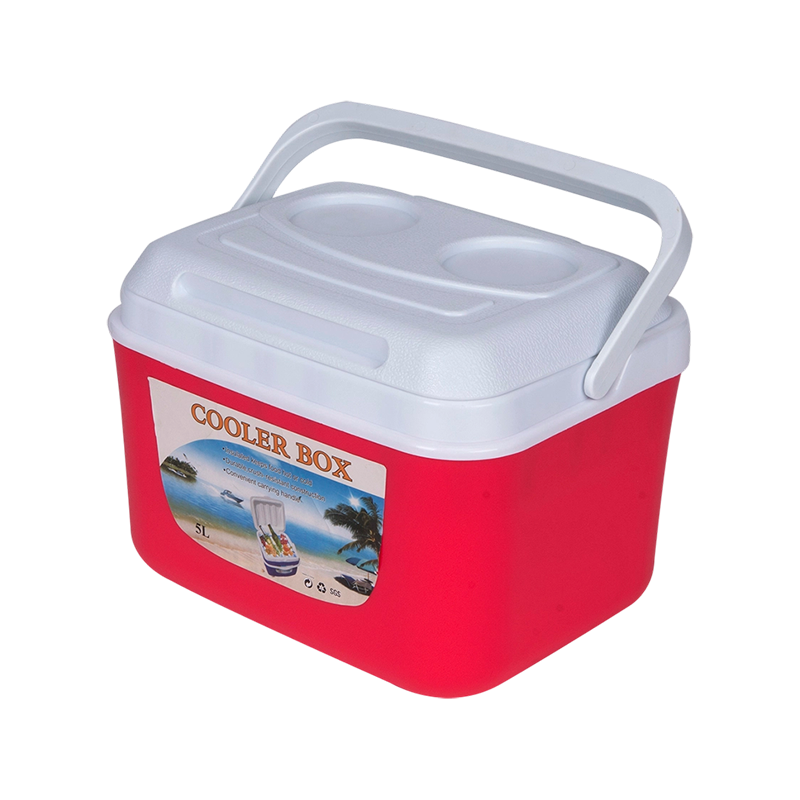
5L Compact Foam Insulated Cooler Box with Cup Holder
2. Product Specifications and Functional Overview
The cooler box has a compact rectangular design with dimensions of 270 × 205 × 195 mm. These proportions create a practical balance between footprint and capacity. The base is small enough to fit on a desk, car seat, boat bench, or narrow outdoor surface, while the height provides space for cans, food containers, and compact ice packs.
| Specification | Product Information |
|---|---|
| Product type | Compact insulated cooler box |
| Nominal volume | 5 litres |
| Dimensions | 270 × 205 × 195 mm |
| Approximate weight | 850 g |
| Main materials | Food-grade PP, PE, and EPS |
| Suggested beverage capacity | Up to six 330 ml cans |
| Handle design | Hidden handle |
| Lid feature | Integrated cup holder opening |
| Base feature | Elevated non-slip base |
| Typical applications | Lunches, picnics, beach trips, boating, vehicles, offices, and personal refreshment storage |
The combination of PP, PE, and EPS supports different functional requirements within the same product. The food-grade PP inner liner provides a smooth and cleanable surface for direct contact with packed food and beverages. PE components can contribute to structural performance and impact resistance, while EPS foam provides the insulation layer that slows heat transfer between the external environment and the contents.
The product is designed as a practical portable cooler rather than a high-volume expedition chest. Its purpose is to deliver convenient short-term cooling in a compact form. Users can place pre-chilled food, drinks, or cold packs inside the container to maintain a lower internal temperature for a period of time. Actual cooling duration depends on starting temperature, ambient conditions, the amount of ice or cold packs used, how frequently the lid is opened, and how fully the box is packed.
3. EPS Foam Insulation and Temperature Retention
Insulation works by reducing the rate at which heat moves into or out of the cooler. EPS, or expanded polystyrene, is a lightweight foam containing many small air-filled cells. Air is a relatively poor conductor of heat, and the cellular foam structure creates a barrier that slows thermal transfer through the walls.
For a compact cooler, EPS is valuable because it provides insulation without adding excessive mass. A thick, solid plastic wall would be heavier and would not necessarily provide the same thermal performance. A soft fabric bag may use foam or reflective film, but its insulation can be compressed or distorted over time. The rigid foam structure in this cooler box remains enclosed within the molded body, helping it preserve the intended wall thickness and shape.
The insulation is most effective when users begin with cold contents. Chilled cans, refrigerated food, and frozen gel packs place less thermal demand on the cooler than warm products. Filling empty spaces also helps reduce the amount of warm air trapped inside. Keeping the lid closed as much as possible further supports temperature retention.
The product is therefore suitable for short outings, daily transport, and personal cooling requirements. It should not be interpreted as a substitute for a powered refrigerator or a large heavy-duty ice chest designed for extended expedition use. Its advantage is the combination of adequate short-term insulation, small size, light weight, and easy handling.
How the insulation benefits different users
Office users can prepare lunch at home and transport it to work without carrying a large container. Drivers can keep drinks cool during a journey while preserving valuable cabin space. Outdoor users can carry a few beverages or snacks without the inconvenience of a full-size cooler. Boating customers can position the unit in a confined space where a large cooler would obstruct movement. For retailers, the product offers an accessible entry point for customers who need practical cooling but do not want to invest in an oversized product.
The insulated construction can also help protect contents from short-term temperature changes. For example, chocolate, fruit, sandwiches, dairy snacks, and bottled drinks can be separated from direct heat exposure during transportation. The cooler box is not intended to replace specialist medical shipping equipment, but the insulated format may be useful for certain everyday temperature-sensitive items when used within appropriate handling limits.
4. Food-Grade Inner Liner and Easy Cleaning
Food-contact safety is an important consideration in any cooler used for meals and beverages. The product uses a food-grade PP inner liner designed for contact with ordinary food and drink items. Polypropylene is widely used in food storage because it is lightweight, durable, and resistant to many common household conditions.
The smooth interior walls are especially useful for cleaning. Rough or fabric-lined interiors can trap crumbs, moisture, and food residue. A smooth molded liner can be wiped down more easily after use, and the absence of unnecessary seams reduces places where dirt can accumulate. Users should still follow sensible care practices, including removing leftover food promptly, drying the interior after cleaning, and avoiding harsh chemicals that may damage the surface.
The liner also provides a clear separation between the stored contents and the outer insulating structure. This layered construction supports hygiene and durability. The outer body protects the insulation, while the inner surface provides a practical storage cavity. By assigning a different function to each material layer, the product can achieve a better balance than a single-material container.
For commercial buyers, food-grade materials can be an important selling point. Retailers can present the cooler as suitable for lunches, snacks, and beverages, while hospitality and promotional customers can use the food-contact feature as part of their product specifications. Any market-specific food-contact claims, testing requirements, or certifications should be confirmed according to the destination country and intended application.
5. Compact Capacity Without Unnecessary Bulk
The 5-litre volume is one of the product’s most important design characteristics. Small coolers are often divided into two types: extremely small lunch boxes that hold only one meal, and larger portable chests that are difficult to carry for routine use. This product occupies a useful middle position. It has enough room for several drinks and snacks while remaining compact enough for individual transport.
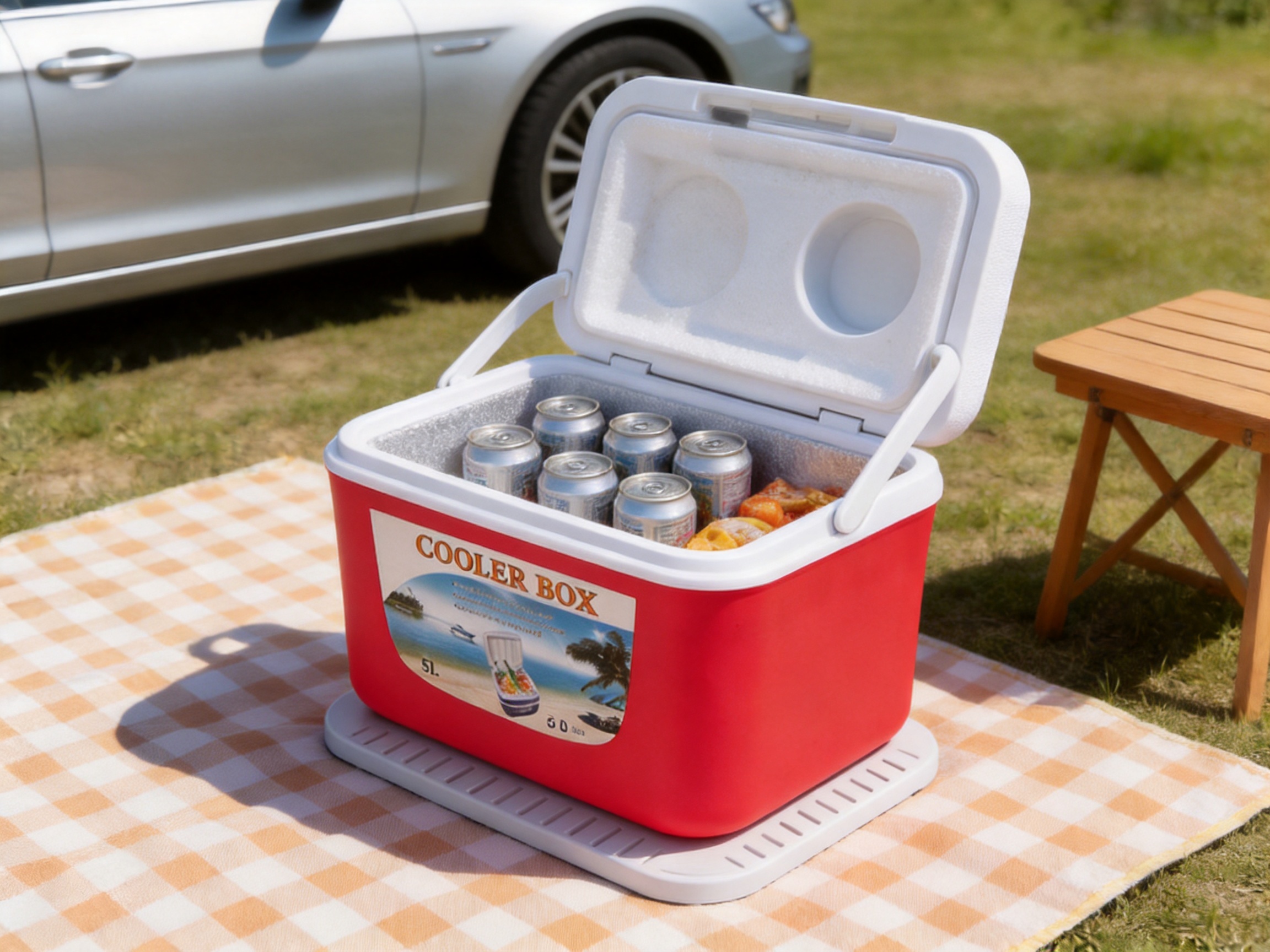
The stated capacity of up to six 330 ml cola cans demonstrates how the internal space can be used. Depending on the arrangement and whether ice packs are added, users may carry several cans, a lunch container, fruit, sandwiches, or a mixture of beverages and food. The exact usable arrangement will vary according to the shape of the items, the amount of insulation space, and the desired cooling method.
Compact dimensions can also reduce storage problems at home and in commercial environments. The cooler can be stored on a shelf, under a desk, in a cupboard, or in the trunk of a car. Retailers can display more units in a limited area, and distributors can benefit from more efficient carton utilization and container planning. The product information indicates an additional container-loading quantity of 5,440 pieces, which can be relevant to importers evaluating shipping efficiency and inventory planning.
Compared with larger coolers, the smaller footprint may also reduce the temptation to overpack. Users can carry only what they need, which makes the cooler easier to lift and less tiring during walking. A compact cooler is therefore not simply a reduced version of a large one; it is a different product category intended for convenience, mobility, and personal use.
6. Hidden Handle and Improved Portability
Portability is directly affected by the handle design. A large external handle can add width, interfere with storage, or catch on bags and vehicle interiors. The hidden handle used on this cooler box keeps the profile neat when the unit is not being carried. It can be pulled out or accessed when needed, then remain visually integrated with the body during storage.
This design is beneficial in crowded spaces. An office worker can place the cooler in a locker without an exposed handle taking up additional room. A traveler can fit it into a car compartment more easily. On a boat, a reduced external profile can help prevent snagging on equipment or clothing. For retailers, the concealed handle also gives the product a cleaner appearance on a shelf.
At approximately 850 g, the cooler is light enough for routine carrying. The low weight matters when the box is filled with drinks, food, or ice packs because the contents already add substantial mass. Starting with a lightweight container allows users to carry more useful contents without making the total load unnecessarily heavy.
A hidden handle should still be used according to its intended load limits. Users should lift the cooler by the handle rather than dragging it, and they should avoid swinging or dropping a loaded unit. Proper handling helps preserve the hinge, handle connection, and body structure over a longer service life.
7. Integrated Cup Holder for Practical Convenience
The lid includes a cup holder opening, adding a useful function without requiring a separate accessory. When the cooler is placed beside a chair, on a picnic blanket, near a desk, or inside a vehicle, the cup holder can help support a beverage. This keeps a drink within easy reach and reduces the need to place it on unstable or dirty surfaces.
The cup holder is particularly practical during short outdoor activities. A user can open the cooler to retrieve food, close it, and use the lid as a temporary beverage platform. The feature also makes the product more suitable for office environments, where the cooler can act as both a food storage container and a convenient drink holder.
In comparison with a basic insulated box that offers only internal storage, the cup holder adds an extra use to the lid. This is a good example of space-efficient product design: a surface that would otherwise serve only as a cover contributes to the overall user experience. It also gives retailers a clear product feature to communicate in packaging and sales materials.
The cup holder is intended for suitable cups or cans that fit its opening. Users should avoid placing unstable, overfilled, or very hot beverages in it. The cooler is primarily designed for chilled or room-temperature food and drinks, and the cup holder should be treated as a convenience feature rather than a sealed spill-proof system.
8. Elevated Non-Slip Base
The elevated non-slip base is another detail that supports daily usability. A cooler placed directly on a wet, rough, or uneven surface can slide, collect moisture underneath, or suffer unnecessary abrasion. Raising the main body slightly from the ground creates a small separation between the cooler and the supporting surface.
The non-slip design helps improve stability on tables, vehicle seats, boat decks, picnic surfaces, and other common locations. A stable base can reduce accidental movement when the cooler is opened or when a drink is placed in the lid cup holder. It may also help reduce direct contact with water and dirt during outdoor use.
This feature is especially relevant when the cooler is used in moving environments. A car may accelerate or turn, and a boat may experience rocking or vibration. Although the base cannot eliminate movement under all conditions, its elevated non-slip structure provides a better foundation than a completely flat smooth bottom.
Users should still position the cooler securely and avoid placing it where sudden movement could cause injury or damage. The base is a supportive feature, not a replacement for vehicle restraints or careful placement on unstable surfaces.
9. Advantages Compared with Common Alternatives
Compared with soft insulated bags
Soft cooler bags are lightweight and foldable, but they may lose their shape when loaded and can be more vulnerable to punctures, compression, and abrasion. Their fabric interiors may also require more effort to clean if food or liquid leaks. The rigid construction of this cooler box provides a defined cavity, greater crush protection, and a smooth molded inner surface.
The hard body also supports the integrated cup holder and elevated base more effectively than a flexible fabric structure. A soft bag may be useful when collapsibility is the main priority, while this product is better suited to buyers who want structure, easy cleaning, and a stable surface for daily use.
Compared with ordinary plastic storage boxes
A standard plastic storage box can protect food from crushing but generally does not provide meaningful thermal insulation. The EPS foam layer in this cooler box slows heat transfer and helps maintain cooler conditions when used with pre-chilled contents or cold packs.
The product also combines insulation with purpose-built details such as a hidden handle, cup holder, and non-slip base. These features make it more suitable for outdoor transport than an ordinary household storage box.
Compared with large hard coolers
Large coolers offer greater capacity, but they can be heavy even before loading. They may require two people to move when filled and can occupy substantial room in a vehicle or campsite. The 5L cooler box is designed for personal use, where low weight and small dimensions are more valuable than maximum volume.
Its smaller internal space can also be easier to organize. Users do not need to search through a deep chest for one drink or lunch item. This convenience is particularly important for quick daily trips and short outdoor activities.
Compared with powered portable refrigerators
Powered refrigerators provide active cooling but require electricity, a battery, or a vehicle connection. They are more complex, heavier, and typically more expensive. The compact insulated cooler requires no power source, no cables, and no control panel. It can be used immediately with chilled contents or ice packs.
For short-term personal cooling, this passive approach may be more practical and economical. It also avoids noise and electrical maintenance. Powered equipment remains preferable for extended trips or precise temperature control, but it is excessive for many everyday applications.
10. Manufacturing Materials and Product Construction
The cooler box uses a multi-material construction based on food-grade PP, PE, and EPS. Each material contributes to a different part of the product’s performance. Polypropylene is suited to molded food-contact surfaces and offers a useful combination of low weight, chemical resistance, and durability. Polyethylene can contribute to toughness and impact resistance in suitable structural components. EPS supplies lightweight thermal insulation.
The use of injection molding allows the manufacturer to produce repeatable plastic components with defined dimensions, consistent wall structures, and integrated design features. Molding is particularly suitable for products that require a clean appearance and reliable fit between the lid, body, liner, handle, and base.
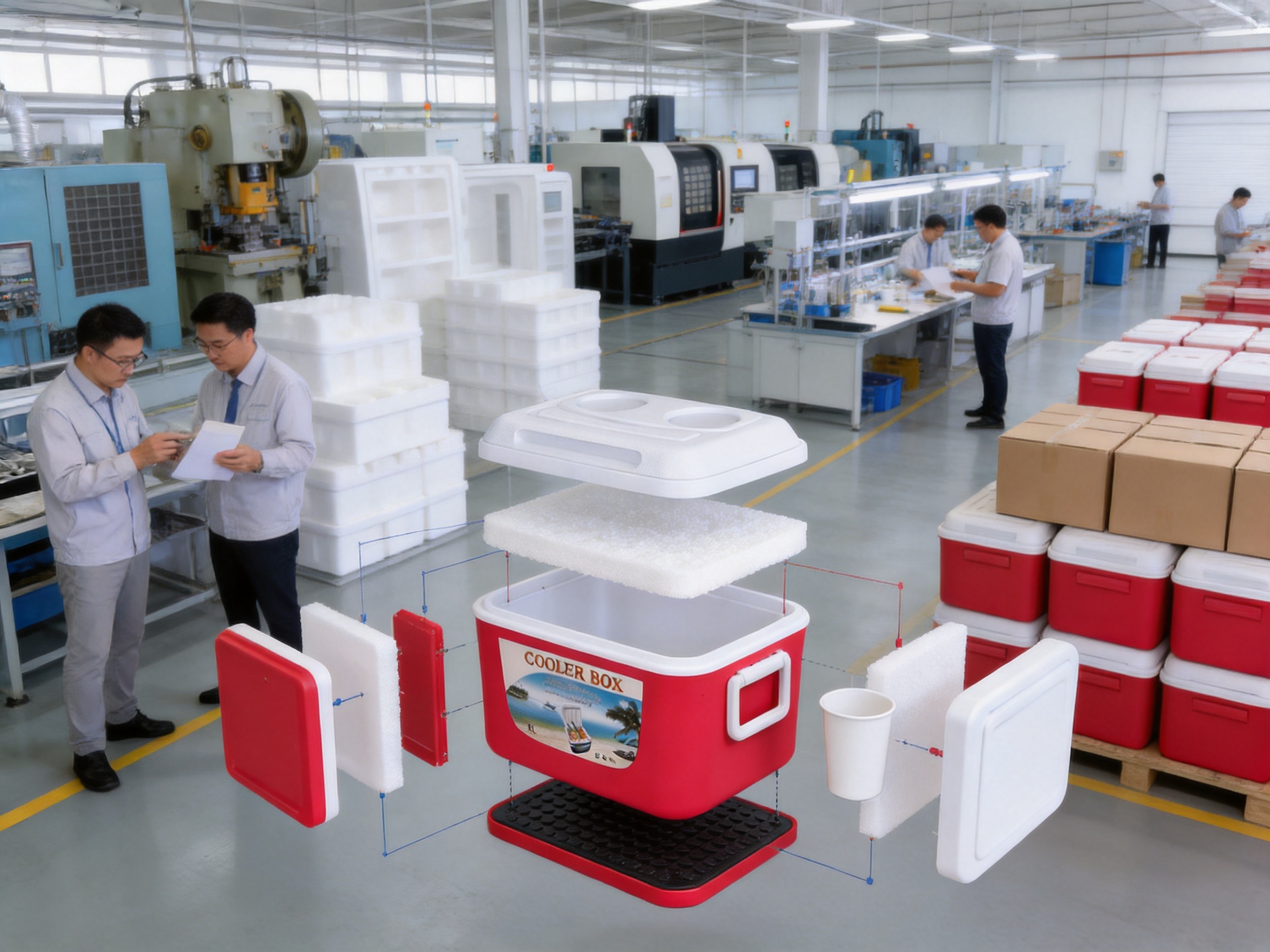
Foaming equipment is important for producing the EPS insulation layer. Controlled foaming helps create the cellular structure needed for thermal resistance while keeping the product lightweight. The relationship between foam density, thickness, molding accuracy, and assembly quality affects the final performance of the cooler.
Manufacturing a cooler box is not limited to shaping plastic. The process also requires attention to part alignment, surface finish, lid fit, handle operation, insulation continuity, and final assembly. Small gaps or inconsistent interfaces can reduce thermal performance and affect user satisfaction. An experienced manufacturer can establish process controls for each stage, from material preparation and molding to inspection and packing.
11. Factory Capabilities and Production Strengths
Ningbo Junlong Outdoor Products Co., Ltd. was founded in 2000 and operates in Cixi, Ningbo, Zhejiang Province, a major manufacturing area in the Yangtze River Delta. The company operates an independent factory of approximately 12,000 square metres and employs more than 100 people. Its equipment includes automatic injection molding machines, blow molding machines, and foaming equipment.
This combination of machinery is significant because the company can support several related outdoor product categories within its own manufacturing system. Its product range includes cooler boxes, insulated cooler jugs, ice buckets, and outdoor water containers. Experience across these categories can support the development of products that require thermal insulation, molded plastic parts, liquid storage, handles, lids, and outdoor durability.
Automatic injection molding machines can improve production consistency and help maintain stable cycle times for large orders. Blow molding equipment supports the production of hollow plastic products, while foaming equipment enables the manufacture of insulated structures. Having these capabilities within an integrated factory can simplify coordination between different production stages.
The company also maintains a product development and research and development team. This enables customers to request products based on drawings, samples, or specific market requirements. Development support may include adjustments to dimensions, colors, logos, packaging, structural details, and intended applications, subject to technical review and minimum order considerations.
A rigorous quality management approach is essential for maintaining consistent results across large production runs. Quality control may include incoming material checks, mold and process monitoring, dimensional inspection, appearance inspection, assembly checks, leakage or fit checks where applicable, and final packaging inspection. Specific testing procedures and certifications should be confirmed for each order and destination market.
12. OEM and ODM Opportunities
The cooler box is suitable for OEM and ODM programs because its compact shape and practical feature set can serve several market segments. A buyer may use the existing design with a private label, or request modifications to create a product adapted to a particular sales channel. Potential adjustments may include color selection, logo application, packaging artwork, instruction labels, carton design, and coordinated product assortments.
For an OEM project, the manufacturer can produce the cooler under the customer’s brand according to agreed specifications. This approach is useful for retailers, importers, outdoor brands, supermarket chains, beverage companies, promotional agencies, and hospitality suppliers. The customer can maintain a consistent visual identity while using an established production platform.
ODM development provides more flexibility when a customer wants a modified design or a new product based on a concept. The manufacturer’s product development team can review drawings, samples, intended capacity, target retail price, user requirements, and packaging needs. Engineering evaluation is important because changes to the lid, handle, insulation, body thickness, or cup holder may affect tooling, assembly, thermal performance, and shipping volume.
Customization should be planned early. Color matching, logo placement, printing method, packaging materials, and testing requirements can influence the production schedule. A clear technical specification should define dimensions, materials, acceptable color variation, surface finish, logo artwork, carton quantity, and inspection criteria before mass production begins.
13. Applications Across Different Markets
Office and workplace use
The cooler’s compact footprint allows it to fit into an office locker, under a desk, or beside a workstation. It can carry lunch, fruit, yogurt, drinks, and snacks from home. The smooth liner supports easy cleaning, while the cup holder can provide a convenient place for a beverage during the workday.
Short picnics and day trips
For a short picnic, a full-size cooler may be unnecessary. This 5L model can hold refreshments for one person or a small selection of snacks for two people. Its low weight makes it easy to carry from a vehicle to a park, beach, or picnic area.
Beach and boating activities
The rigid body protects contents better than a simple bag, while the elevated non-slip base helps keep the cooler stable on a deck, bench, or outdoor surface. Users should protect the product from prolonged exposure to extreme conditions and should secure it appropriately in moving boats or vehicles.
Automotive use
The compact dimensions are suitable for car backseats, footwells, trunks, and other limited areas. Drivers and passengers can store chilled drinks or food without occupying the space required by a large cooler. The hidden handle also reduces interference when the container is being stored in a tight area.
Retail and promotional programs
The product’s clear functional features make it suitable for promotional campaigns, seasonal outdoor displays, beverage promotions, and branded corporate gifts. A customer logo can be applied according to the selected production method and surface requirements. Customized packaging can further support retail presentation or campaign messaging.
14. User Guidelines for Best Cooling Results
Users should chill food and beverages before placing them inside the cooler. A passive insulated box is designed to slow warming, not to rapidly cool warm products. Starting with cold contents improves the practical result and reduces the thermal load on the insulation.
Cold packs or suitable ice products can be arranged around the contents when additional cooling is required. The cooler should not be overfilled to the point that the lid cannot close correctly. A secure lid fit reduces the exchange of warm air and helps the insulation perform as intended.
Opening the cooler frequently allows warm air to enter and cold air to escape. Organizing the contents before departure can reduce the time the lid remains open. If the cooler is used in direct sunlight, placing it in shade or inside a vehicle’s cooler area can help reduce external heat exposure.
After use, the contents should be removed and the interior cleaned with mild soap and water. The box should be dried before storage. Moisture left inside a closed container can create odors and reduce hygiene. The exterior can be wiped with a soft cloth, and abrasive cleaners should be avoided unless specifically approved for the surface.
The product is not a powered refrigeration device and should not be used as a substitute for equipment requiring controlled or continuously maintained temperatures. Users handling medicines, laboratory materials, or highly perishable products should follow the storage instructions associated with those items.
15. Quality, Durability, and Supply Considerations
For buyers evaluating a cooler box supplier, product design is only one part of the decision. Stable material sourcing, repeatable molding, dependable assembly, inspection procedures, packaging quality, and delivery coordination are equally important. A cooler may perform well in a sample but fail to meet expectations if mass production varies significantly in dimensions, color, insulation, or lid fit.
An established factory with injection molding, blow molding, and foaming capabilities can provide a stronger foundation for repeat orders. Internal coordination between development, production, quality, and sales teams helps reduce communication errors. This is particularly valuable when the buyer needs customized colors, branding, packaging, or shipment quantities.
Packaging should protect the cooler against scuffing, compression, and impact during domestic handling and international transportation. Carton design should consider the product’s dimensions, the desired units per carton, stacking requirements, and container utilization. The stated loading quantity provides a useful starting point for freight planning, although final quantities depend on packaging configuration and shipping conditions.
For international buyers, it is advisable to confirm the following before placing a production order: material specifications, sample approval, logo artwork, packaging design, carton markings, inspection standards, product testing, lead time, payment terms, shipping terms, and destination-market compliance. Written confirmation helps ensure that the delivered product matches the commercial agreement.
16. Why Compact Insulation Is a Strong Product Category
Consumers increasingly look for products that are practical, reusable, and easy to integrate into daily routines. A compact cooler box can serve multiple purposes without requiring electrical power or complicated operation. It can be reused for commuting, travel, outdoor recreation, and vehicle storage, making it more versatile than a single-purpose food container.
The modest size can also support more efficient logistics and storage. Retailers may display the product in seasonal outdoor sections, kitchen organization areas, travel departments, or beverage promotions. Distributors can offer it alongside larger cooler boxes and water containers to create a complete outdoor cooling range.
For private-label companies, a compact cooler provides an opportunity to enter the cooler market with a product that is accessible to a broad group of customers. Its selling points are straightforward: 5-litre capacity, lightweight construction, insulated walls, food-grade inner liner, hidden handle, integrated cup holder, and stable base. These benefits can be communicated easily through packaging, catalogues, online product listings, and in-store displays.
The product can also complement other outdoor products manufactured by the same supplier. A buyer sourcing cooler jugs, ice buckets, outdoor water containers, and cooler boxes from one manufacturing partner may simplify supplier management and develop coordinated product collections. Shared experience in molded plastic and insulated products can also support more consistent quality across a broader catalogue.
17. Product Positioning for Distributors and Retailers
When positioning the product in a catalogue, sellers should focus on its role as a personal and compact cooler rather than presenting it as a large-capacity camping chest. The most appropriate message is convenience: it is easy to carry, easy to store, easy to clean, and large enough for everyday refreshments.
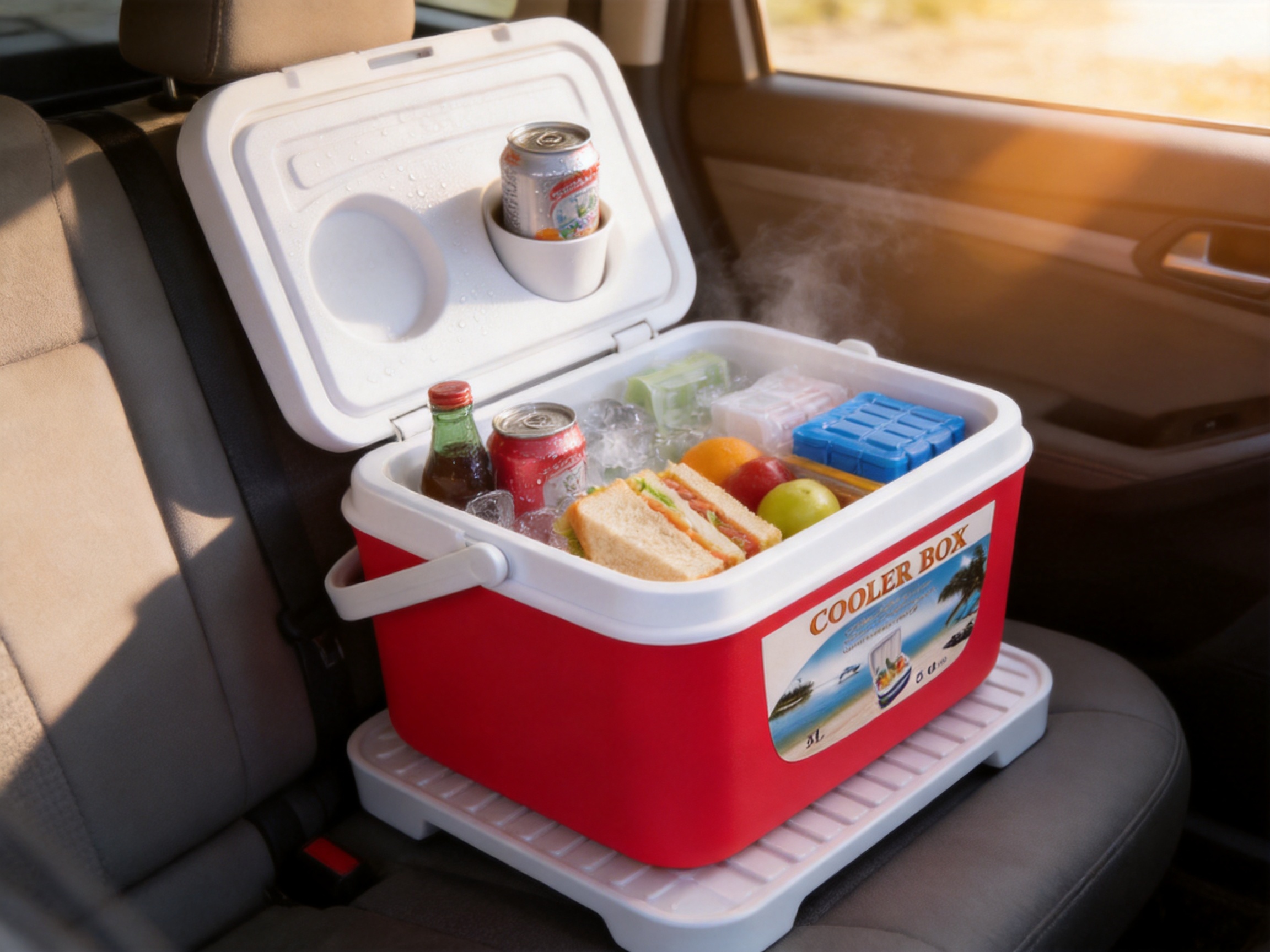
Recommended product descriptions can emphasize the 5-litre volume, six-can capacity, 850-gram approximate weight, food-grade PP inner surface, EPS foam insulation, cup holder lid, hidden handle, and non-slip base. Images and packaging should show the cooler in realistic environments such as an office, car, picnic area, beach, or boat.
Retailers should communicate that cooling performance depends on the use of pre-chilled contents and ice packs. Clear information helps customers form appropriate expectations and supports product satisfaction. The cooler should be marketed for short trips and personal use, while larger models can be recommended for families and extended outdoor activities.
18. Frequently Asked Questions
Q1: What is the capacity of the cooler box?
The nominal capacity is 5 litres. The cooler can hold up to six 330 ml cans of cola, although the exact usable arrangement will depend on the shape of the contents and whether ice packs or other cooling materials are included.
Q2: What are the external dimensions?
The listed external dimensions are 270 × 205 × 195 mm. These compact dimensions make the cooler suitable for backpacks, car interiors, office lockers, desks, picnic areas, and other locations where space is limited.
Q3: How much does it weigh?
The approximate weight is 850 g. The low empty weight helps keep the total load manageable after adding food, drinks, and cold packs.
Q4: What materials are used?
The product uses food-grade PP, PE, and EPS. The PP inner liner provides a smooth surface for food and beverage storage, while EPS foam supplies lightweight insulation. The specific role of PE depends on the molded construction and component design.
Q5: Does the cooler actively refrigerate food?
No. It is a passive insulated cooler and does not use electricity or a compressor. For best results, users should place pre-chilled contents and suitable cold packs inside the box and keep the lid closed as much as possible.
Q6: Is the inner surface easy to clean?
Yes. The food-grade PP inner liner has smooth walls designed to support easier cleaning. Users should remove food promptly, wash the interior with mild soap and water, and dry the box before storage.
Q7: What is the purpose of the cup holder in the lid?
The lid includes a cup holder opening that can support a suitable beverage container when the cooler is being used beside a desk, chair, picnic area, vehicle seat, or boat seat. It is a convenience feature and should not be treated as a completely spill-proof holder.
Q8: Is the handle easy to store?
Yes. The cooler uses a hidden handle design. This keeps the external profile neat and helps the box fit more easily into lockers, vehicles, shelves, and other compact storage spaces.
Q9: Is the cooler suitable for outdoor use?
It is designed for outdoor applications such as short picnics, beach outings, boating, and vehicle travel. Users should place it securely, protect it from unnecessary impact and prolonged extreme exposure, and clean it after outdoor use.
Q10: Can the product be customized?
The manufacturer provides OEM and ODM services. Customization may include color, logo, packaging, and product development based on drawings or samples. Final options depend on technical feasibility, order volume, tooling requirements, and destination-market specifications.
Q11: Who manufactures this cooler box?
The product is manufactured by Ningbo Junlong Outdoor Products Co., Ltd., a Chinese outdoor products manufacturer founded in 2000. The company operates a factory in Cixi, Ningbo, with injection molding, blow molding, foaming, product development, and quality management capabilities.
Q12: Is this cooler suitable for long-term temperature-controlled transport?
It is intended for everyday short-term cooling and transportation. It is not a powered refrigerator or specialist medical shipping container. Applications requiring strict temperature control should use equipment designed and validated for that purpose.
19. Conclusion
The 5L Compact Foam Insulated Cooler Box with Cup Holder is designed around a clear and useful purpose: providing portable cooling for individuals without the weight and bulk of a large cooler. Its 5-litre capacity is suitable for meals, snacks, and several drinks, while the 270 × 205 × 195 mm dimensions allow it to fit comfortably in cars, offices, backpacks, and outdoor spaces.
Its key advantages include EPS foam insulation, a food-grade PP inner liner, smooth cleaning surfaces, a hidden handle, an integrated cup holder, and an elevated non-slip base. Together, these features create a product that is more structured and functional than a simple lunch bag or ordinary plastic storage box, while remaining more convenient and economical for personal use than a large hard cooler or powered refrigerator.
From a sourcing perspective, the product benefits from the manufacturing resources of Ningbo Junlong Outdoor Products Co., Ltd. The company’s factory, product development team, injection molding machines, blow molding machines, foaming equipment, and quality management system support stable production and customization programs. OEM and ODM customers can explore private-label branding, color selection, packaging development, and design modifications for different markets.
For consumers, the product offers a dependable companion for office lunches, short picnics, beach trips, boating, road travel, and everyday beverage storage. For distributors and brands, it provides a practical compact cooler platform with broad application potential and straightforward selling points. Its value lies in combining portability, insulation, hygiene, convenience, and manufacturing flexibility in one compact outdoor product.
References
1. Product specification information supplied for the 5L Compact Foam Insulated Cooler Box with Cup Holder.
2. Product material and construction information supplied by the manufacturer, including food-grade PP, PE, and EPS components.
3. Manufacturer information concerning factory facilities, injection molding, blow molding, foaming equipment, product development, and quality management.
4. General principles of passive thermal insulation, molded polymer construction, and expanded polystyrene foam performance.
5. General food-contact storage, cleaning, handling, and consumer product care practices.
Product: 5L Compact Foam Insulated Cooler Box with Cup Holder

Product Recommendation
link
Office
- TEL: +86-574-63787606
- Phone: +86-13777994798
- E-mail: sales@nbjunlong.com
- WhatsApp: 13777967488
- Address: No. 1, Lane 3, Development Road, Longtouchang, Longshan Town, Cixi City, Zhejiang Province, China
Get In Touch
Copyright © Ningbo Junlong Outdoor Products Co., Ltd. All Rights Reserved.
China Plastic Insulated Cooler Box Manufacturer Custom Cooler Box Supplier
