- SMALL ORDERS FOR STANDARD ITEMS. Contact Now
- OUTDOOR COOLING SOLUTIONS, MADE IN‑HOUSE. Contact Now
- COOLER BOXES THAT FIT REAL OUTDOOR LIFE. Contact Now

 LANGUAGE
 日本語
 Español
 عربى

Content
- 1 Product Overview
- 2 Compact 10-Liter Capacity for Everyday Needs
- 3 Twist-to-Open Lid for Secure Handling
- 4 EPS Insulation and Temperature Retention
- 5 Food-Grade PP and PE Construction
- 6 Portable Form and User-Friendly Structure
- 7 Advantages Compared with Basic Cooler Designs
- 8 Applications for Outdoor Recreation
- 9 Home, School, and Grocery Uses
- 10 Promotional and Custom Branding Potential
- 11 Advanced Manufacturing Capabilities
- 12 Product Development and Engineering Support
- 13 Quality Management and Production Consistency
- 14 Factory Integration and Supply Advantages
- 15 Materials, Cleaning, and Daily Care
- 16 Guidance for Wholesale and Import Buyers
- 17 Why This Cooler Is a Practical Product Investment
- 18 Q&A
- 18.1 What is the capacity of the cooler?
- 18.2 What are the dimensions?
- 18.3 What materials are used?
- 18.4 How long can it retain insulation?
- 18.5 How does the lid work?
- 18.6 Can the cooler be used for frozen groceries?
- 18.7 Is the cooler suitable for school lunches?
- 18.8 Does it have a carrying handle?
- 18.9 What is the purpose of the elevated feet?
- 18.10 Can the product be customized?
- 18.11 Is the surface suitable for printing?
- 18.12 Who can purchase this product?
- 18.13 What manufacturing equipment supports production?
- 18.14 Can the manufacturer develop a product from a sample?
- 18.15 What should buyers confirm before placing an order?
- 19 Conclusion
- 20 References
- 21 Product: 10L Portable Twist-Lid Foam Insulated Cooler
10L Portable Twist-Lid Foam Insulated Cooler: Compact Performance for Outdoor Cooling
Choosing a compact cooler is not simply a matter of selecting the smallest available box. A practical portable cooler must balance capacity, insulation, durability, handling comfort, hygiene, appearance, and transportation. It must be large enough to carry essential drinks and food, yet compact enough for day trips, school lunches, grocery shopping, tailgate events, and outdoor recreation. The 10L Portable Twist-Lid Foam Insulated Cooler is designed around this balance, providing a dependable cooling solution in a compact format.
With a 10-liter internal capacity, food-grade PP and PE materials, EPS insulation, a secure twist-to-open lid, an integrated carrying handle, and elevated non-slip feet, this cooler is built for convenient everyday use. Its dimensions of 352 × 235 × 330 mm allow it to fit naturally into many transport and storage situations without becoming difficult to carry. Its listed net weight of approximately 1.65 kg also supports portability when the cooler is empty or partially loaded.
The product is suitable for a wide range of users, including families, outdoor enthusiasts, retailers, promotional buyers, food distributors, event organizers, and brands seeking an OEM or ODM cooler box. It can hold up to twelve 330 ml cola cans, making it a useful choice for short outings, personal refreshment storage, or compact food transportation.
Product Overview
The 10L Portable Twist-Lid Foam Insulated Cooler is a small cooler box developed for organized, secure, and convenient cold storage. Its most recognizable feature is the twist-to-open lid. Instead of relying only on a simple hinged cover or loose-fitting top, the twist mechanism is designed to help secure the lid during transport and reduce the risk of accidental opening.
The lid design is especially useful when the cooler is moved in a vehicle, carried by hand, or placed beside outdoor seating. A cooler used for beverages and chilled food should provide more than basic insulation. It should also help keep its contents contained, protect the interior from unnecessary exposure, and offer a user-friendly opening method. The twist-lid structure addresses these practical needs while adding a distinctive visual element.
The cooler is manufactured from food-grade PP and PE, with EPS insulation incorporated into the structure. Polypropylene is widely used in products that require a combination of durability, practical molding performance, and resistance to everyday handling. Polyethylene can contribute to a functional, resilient product structure, while EPS insulation helps reduce heat transfer between the outside environment and the cooler interior.
The result is a compact cooler designed for daily usability rather than occasional novelty. It can serve as a personal beverage cooler, a lunch and snack container, a grocery transport box for frozen items, or a promotional product with customized branding.
| Item | Specification |
|---|---|
| Product type | Portable foam insulated cooler |
| Capacity | 10 liters |
| Dimensions | 352 × 235 × 330 mm |
| Material | Food-grade PP + PE + EPS |
| Approximate net weight | 1.65 kg |
| Stated insulation time | Up to 24 hours, depending on use conditions |
| Stated beverage capacity | Up to 12 cans of 330 ml cola |
| Opening system | Twist-to-open lid |
| Carrying system | Integrated handle |
| Base design | Elevated non-slip feet |
| Customization | Color, logo, printing, packaging, and OEM/ODM development options |
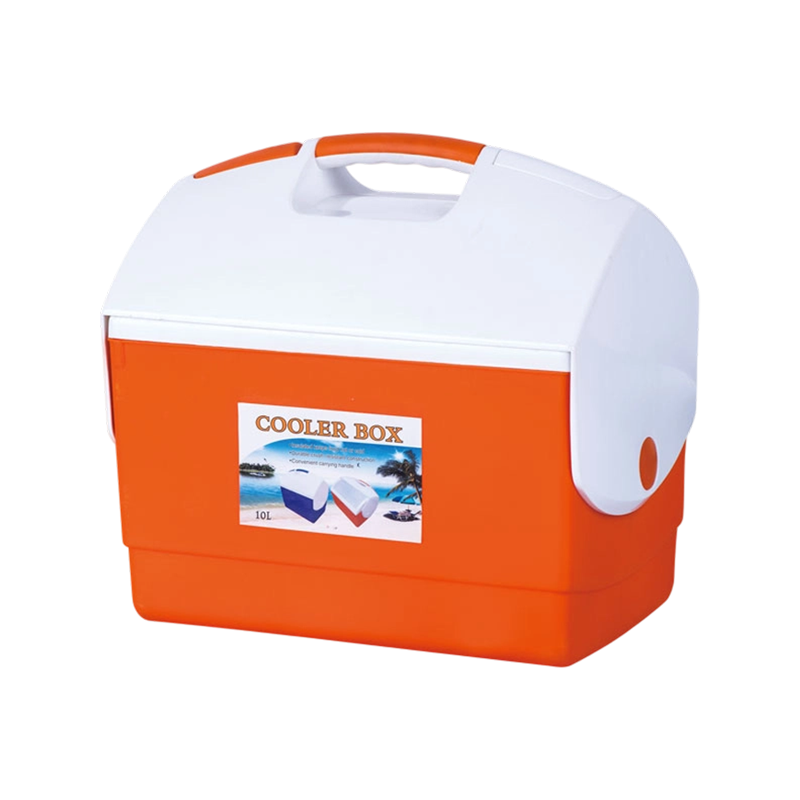
10L Portable Twist-Lid Foam Insulated Cooler
Compact 10-Liter Capacity for Everyday Needs
Capacity is one of the most important factors when choosing a small cooler. A cooler that is too small may fail to accommodate enough beverages or food, while a cooler that is too large can become difficult to carry and unnecessarily bulky. The 10-liter capacity provides a useful middle ground for individuals, couples, small families, and short-duration activities.
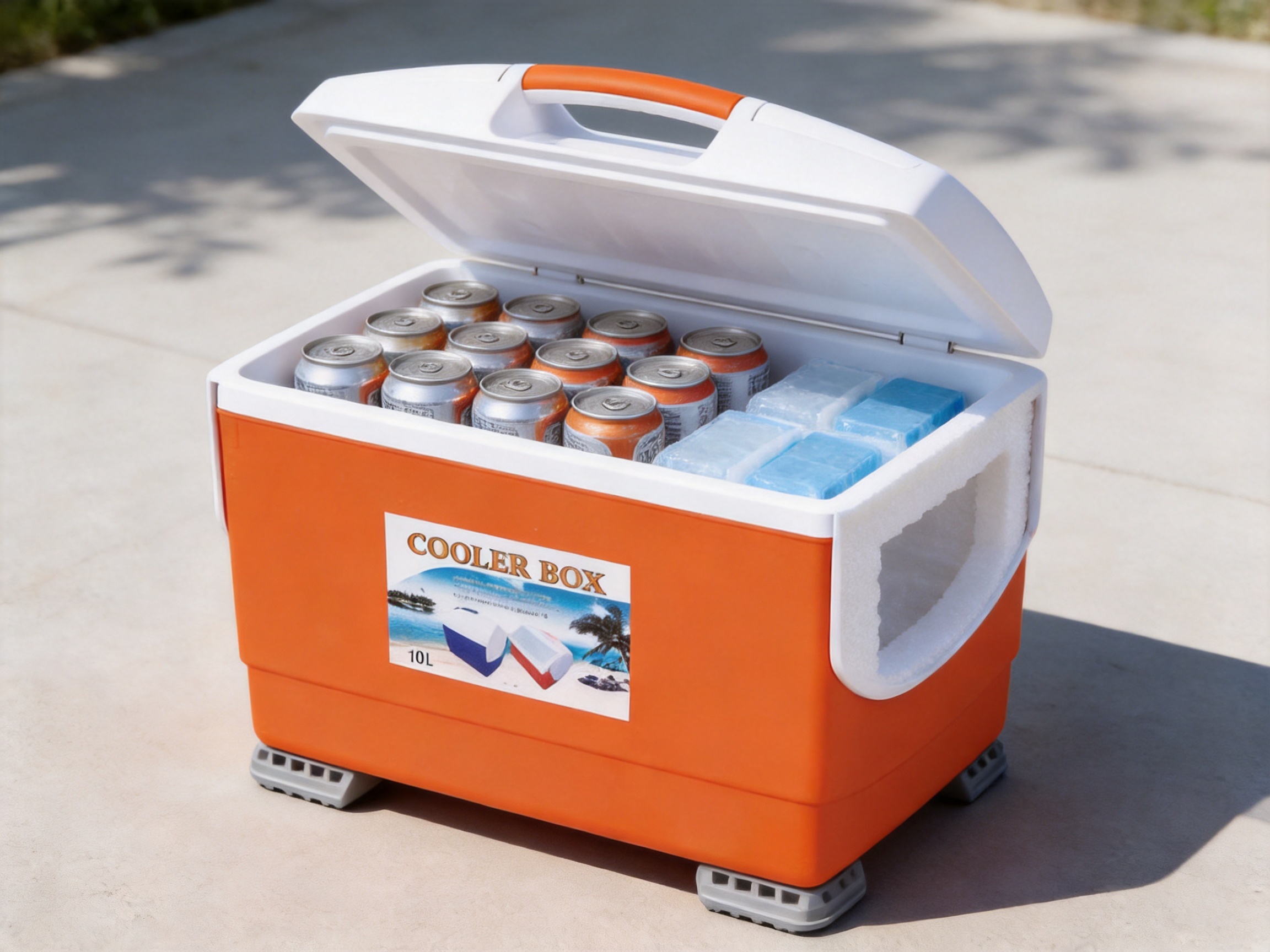
The cooler can hold up to twelve 330 ml cola cans according to the stated product specifications. Actual loading arrangements may vary depending on whether ice packs, food containers, bottles, or other items are included. Nevertheless, this capacity gives buyers a clear reference point for planning refreshments. It is large enough for a modest group while remaining considerably easier to transport than many large-capacity camping coolers.
For day hikes, a compact cooler can be used to carry chilled drinks, fruit, sandwiches, dairy products, and prepared meals. At a tailgate gathering, it can function as a dedicated beverage container or as a secondary cooler for frequently accessed items. During family outings, it can be used for children’s snacks and drinks without requiring the space of a full-size family cooler.
The 10-liter format is also useful for commercial and institutional applications. Retailers may offer it as an entry-level outdoor product. Promotional agencies can use it as a branded gift for customers, employees, or event participants. Food companies may select it for marketing campaigns connected with beverages, frozen foods, sports events, or seasonal promotions.
Compared with very large insulated boxes, this compact format is easier to place in a car, store in a closet, carry into a park, or move between locations. Compared with soft-sided bags, the molded cooler box provides a more structured enclosure that is less likely to collapse when loaded. These characteristics make it a versatile choice for buyers who need portability without sacrificing basic organization and protection.
Twist-to-Open Lid for Secure Handling
The twist-to-open lid is a central design advantage of this cooler. The lid is intended to lock into place through a simple rotational action, helping keep the cooler closed during routine handling. A secure cover is valuable because the cooler may be tilted, lifted, placed in a vehicle, or carried across uneven ground.
A loose lid can create several practical problems. It may shift while the cooler is being transported, expose the contents to warm air, or open unexpectedly if the box is moved quickly. The twist-lid concept helps address these concerns through a more deliberate opening and closing process. Users can twist the lid to access the contents and return it to the secured position after use.
The mechanism also gives the cooler a distinctive point of difference compared with basic boxes that use a simple removable cover. While different cooler designs may use hinges, latches, zippers, or snap closures, the twist-to-open approach combines a clean appearance with a straightforward user action. It can be particularly attractive to buyers seeking a cooler that looks more refined than a conventional utility container.
For promotional and retail products, the lid can also become part of the product identity. Its unusual opening method creates a memorable user experience, which may improve the perceived value of the cooler when it is used as a branded gift or campaign item.
EPS Insulation and Temperature Retention
Insulation is the main performance feature of any cooler. The purpose of insulation is to slow the transfer of heat from the surrounding environment into the cooler interior. The 10L model uses EPS insulation within a food-grade PP and PE structure. EPS is commonly selected for insulated containers because it is lightweight and provides useful thermal resistance without adding excessive weight.
The stated insulation time is up to 24 hours. Actual performance can depend on factors such as the starting temperature of the contents, the type and quantity of ice or ice packs, ambient temperature, frequency of opening, loading arrangement, and whether the cooler is exposed to direct sunlight. For best results, users should pre-chill beverages and food, use an adequate amount of ice or cold packs, minimize unnecessary opening, and keep the cooler in a shaded or relatively cool location.
The combination of insulation and a secure twist lid is important. Insulation works most effectively when the cooler is not frequently exposed to warm outside air. A lid that closes firmly helps maintain the intended internal environment and can support more consistent cooling performance during ordinary use.
This type of cooler is suitable for keeping beverages chilled and helping preserve the cool condition of packed food during short trips and daily transport. It is not intended to replace specialized refrigeration equipment or temperature-controlled logistics systems. Instead, it provides a practical passive cooling solution for outdoor and mobile situations where electrical refrigeration is unavailable or unnecessary.
Compared with uninsulated plastic containers, the EPS-insulated design offers a clear functional advantage. A standard plastic box may hold products but does not provide the same level of thermal protection. Compared with thin fabric bags, the molded insulated structure can provide a more stable shape and stronger physical separation between the contents and the external environment.
Food-Grade PP and PE Construction
Material selection affects safety, durability, appearance, and manufacturing consistency. This cooler uses food-grade PP and PE for the product structure. These materials are suitable for products intended to come into contact with packaged foods and beverages when manufactured and used according to applicable requirements.
Polypropylene is valued for its balance of toughness, low density, and molding suitability. It can help create a rigid yet relatively lightweight outer shell that withstands normal transportation and repeated handling. Polyethylene is also widely used in consumer and outdoor products because of its practical durability and resistance to everyday wear.
The food-grade material specification is important for distributors and buyers who want a cooler suitable for food and beverage applications. It provides a stronger basis for product positioning than a general-purpose storage box with no stated material grade. For commercial buyers, material information also supports product documentation, market communication, and quality review.
The molded surfaces are designed to be smooth and easy to print. A smooth surface can simplify cleaning and improve the visual quality of logos, graphics, and promotional messages. It also makes the cooler more suitable for organizations that want a consistent branded appearance across a large order.
Portable Form and User-Friendly Structure
Portability depends on more than product weight. A cooler must also be easy to grip, balanced when lifted, and manageable in confined spaces. The integrated handle provides a direct carrying point, allowing users to move the cooler without needing an additional strap or separate carrying accessory.
An integrated handle can also improve product durability because it is designed as part of the molded structure. While users should avoid exceeding the recommended load or lifting the cooler by the lid, a properly designed handle can offer a stable grip for normal transport. The handle is useful when carrying the cooler from a vehicle to a picnic area, from a store to a home, or between rooms during an event.
The elevated non-slip feet provide another practical detail. Raising the base slightly can reduce direct contact between the bottom of the cooler and wet, dirty, or uneven surfaces. The feet may also help improve stability and reduce sliding during vehicle transport or placement on smooth floors and tables.
Small structural details often distinguish a thoughtfully designed cooler from a basic container. The handle, twist lid, and raised feet work together to support a more convenient user experience. They do not add unnecessary complexity, but they address common problems related to carrying, opening, positioning, and protecting the product base.
Advantages Compared with Basic Cooler Designs
The market includes many types of portable cooling products, including soft insulated bags, simple plastic boxes, large hard coolers, and compact molded containers. The 10L Portable Twist-Lid Foam Insulated Cooler occupies a practical position between these categories.
Compared with a soft cooler bag, this product provides a more rigid form. The molded body is less likely to lose its shape when filled, and its structured lid can provide a more secure closure. A rigid cooler is also easier to stack or place in a vehicle without being compressed by nearby items.
Compared with a basic non-insulated plastic box, the EPS core adds thermal protection. This makes the product more suitable for chilled beverages, lunch items, frozen groceries, and outdoor refreshments. The insulation gives the product a clear performance purpose rather than making it simply a storage container.
Compared with a large hard cooler, the 10-liter format is easier to handle and more appropriate for short outings or smaller groups. A large cooler can offer substantial capacity, but it may be excessive when the user only needs a limited quantity of drinks or food. The compact format reduces the physical burden of transporting an empty or moderately loaded cooler.
Compared with a cooler using a plain removable lid, the twist-to-open system provides a more secure and distinctive closure concept. It can reduce accidental lid movement and improve the product’s visual appeal. This difference is particularly relevant to retailers and promotional buyers who want a product with a recognizable feature.
Compared with products that offer limited surface customization, the smooth outer surface of this model is suitable for printing and logo application. Buyers can use the cooler as a functional advertising product rather than a generic item. Custom colors, printed graphics, and packaging can further align the product with a brand identity or campaign theme.
| Comparison factor | 10L twist-lid insulated cooler | Basic plastic storage box | Soft cooler bag | Large hard cooler |
|---|---|---|---|---|
| Thermal protection | EPS insulation for passive cooling | Usually limited or absent | Flexible insulation layer | Insulated construction |
| Structure | Rigid molded body | Rigid molded body | Flexible body | Rigid molded body |
| Closure style | Twist-to-open lid | Often simple removable lid | Usually zipper or flap | May use latches or hinges |
| Portability | Compact with integrated handle | Depends on design | Usually lightweight | Can be bulky when loaded |
| Capacity positioning | Small and practical, 10 liters | Varies | Varies | Often medium to large |
| Promotional suitability | Smooth surface suitable for logo printing | Depends on surface | Printing depends on fabric | Depends on design and surface |
These comparisons do not mean that one cooler format is suitable for every situation. A large cooler may be preferable for extended group camping, while a soft bag may be convenient for very light travel. The advantage of this 10-liter model is its balanced combination of capacity, structure, insulation, carrying convenience, and customization potential.
Applications for Outdoor Recreation
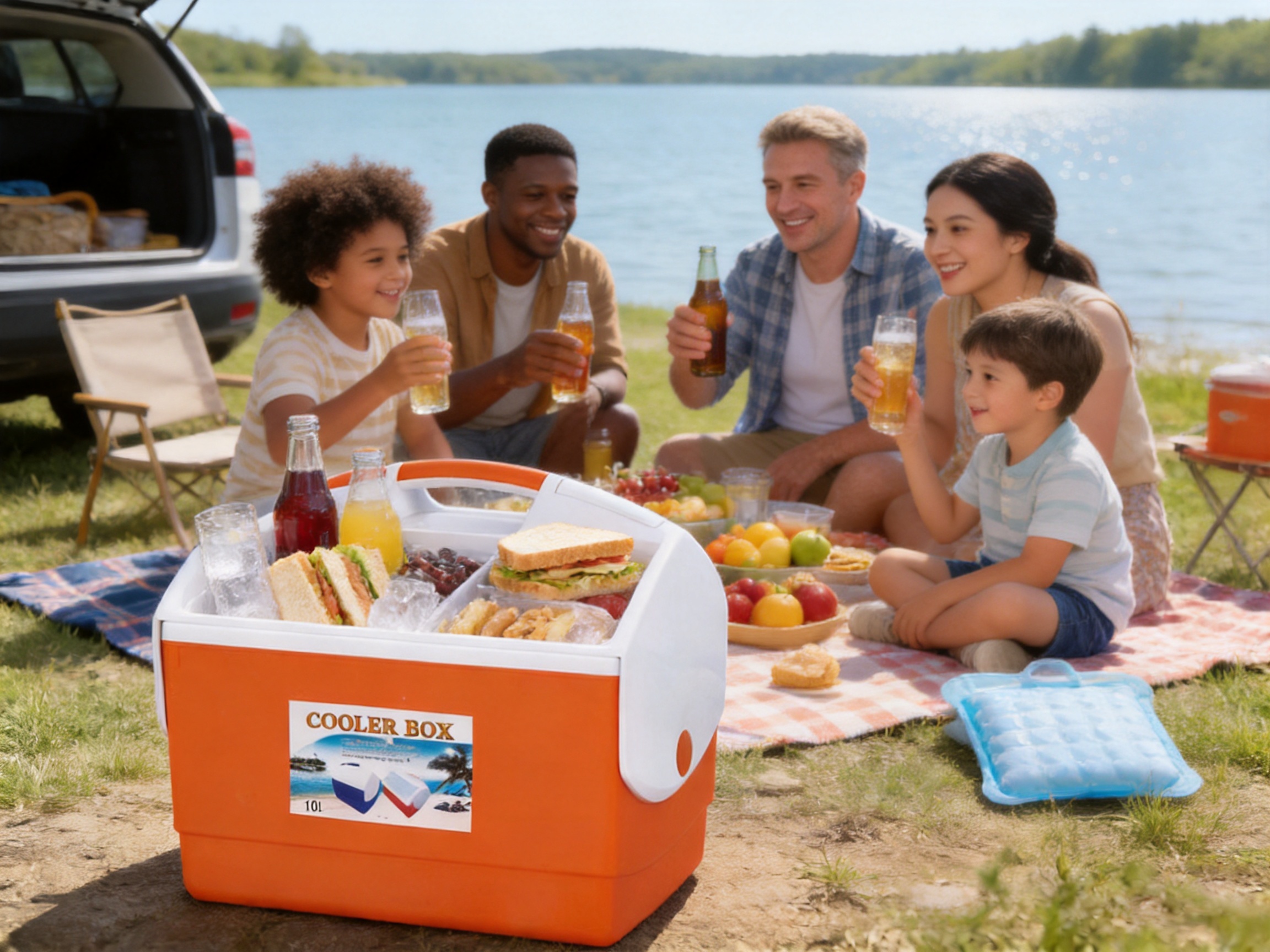
The cooler is designed for activities where users need cold storage without access to a powered refrigerator. Its compact size makes it suitable for day hikes, picnics, beach visits, fishing trips, camping, sports events, and tailgate gatherings.
For day hikes, the cooler can carry a controlled quantity of refreshments without adding the bulk associated with a large camping box. Users can pack water, juice, canned beverages, fruit, sandwiches, and cold snacks. The integrated handle supports short-distance carrying, while the rigid construction protects the contents better than an unstructured bag.
For picnics, the cooler can serve as a dedicated beverage or snack container. It can be packed separately from blankets, cooking equipment, and dry goods, making the overall arrangement easier to organize. The elevated feet help keep the base away from some contact with damp ground, although the cooler should still be placed on a suitable surface when possible.
At a tailgate or sports event, the cooler’s ability to hold up to twelve 330 ml cans provides a convenient reference for beverage planning. It can be used as a personal cooler or combined with multiple units for different beverages and foods. The twist lid allows repeated access while helping maintain a closed container between uses.
For fishing and outdoor work, the molded body offers a practical way to transport chilled drinks and packed food. Users should follow local food safety practices and clean the cooler after use, especially if condensation, spills, or raw food packaging is present.
Home, School, and Grocery Uses
A portable cooler is not limited to recreational settings. The 10L model can also support everyday household activities. It may be used when transporting frozen groceries from a store, carrying chilled food to a family gathering, or keeping refreshments available during a home event.
When purchasing frozen items, shoppers can place the products in the insulated cooler for the journey home. The cooler does not replace a freezer, and transport time should still be kept as short as practical, but its insulation can help reduce exposure to ambient heat compared with ordinary shopping bags.
The compact size is also appropriate for school lunches and workplace meals. Parents can use it to organize beverages and snacks for children’s outings, while employees can use it for packed meals during travel or outdoor work. Depending on the meal container design, the interior can accommodate individual portions, drink cans, and small cold packs.
For home entertaining, the cooler can be placed near an outdoor table or serving area to reduce repeated trips to the refrigerator. It can hold cans, bottled drinks, fruit, desserts, or other chilled items. The product’s appearance and customizable exterior also make it suitable for event themes and corporate hospitality.
Promotional and Custom Branding Potential
The cooler has strong potential as a promotional product because it combines practical daily use with a visible exterior surface. Promotional items are more effective when recipients can continue using them after an event. A portable cooler can remain relevant for picnics, sports, shopping, travel, and family activities, giving a printed logo repeated exposure.
The smooth surface is designed to be easy to print. Buyers can consider company logos, campaign slogans, event graphics, seasonal artwork, product illustrations, or retail branding. The product can also be customized with selected colors to match a corporate identity or promotional theme.
Customization may be especially suitable for beverage companies, food brands, supermarkets, outdoor retailers, travel organizations, sporting events, hospitality companies, and corporate gift programs. A branded cooler can be used as a product launch gift, an employee reward, a customer loyalty item, or a prize for an outdoor competition.
Packaging customization can further improve the presentation. A buyer may request packaging that includes product information, instructions, brand colors, retail barcodes, or campaign messaging. Packaging requirements should be confirmed during the quotation and sampling process because printing methods, color standards, carton specifications, and order quantities can affect production planning.
The lid itself also contributes to promotional value. The twist-to-open mechanism is more distinctive than a completely plain cover, giving the product an easy-to-remember functional feature. A promotional item is more likely to be discussed and reused when it has both attractive branding and a noticeable design advantage.
Advanced Manufacturing Capabilities
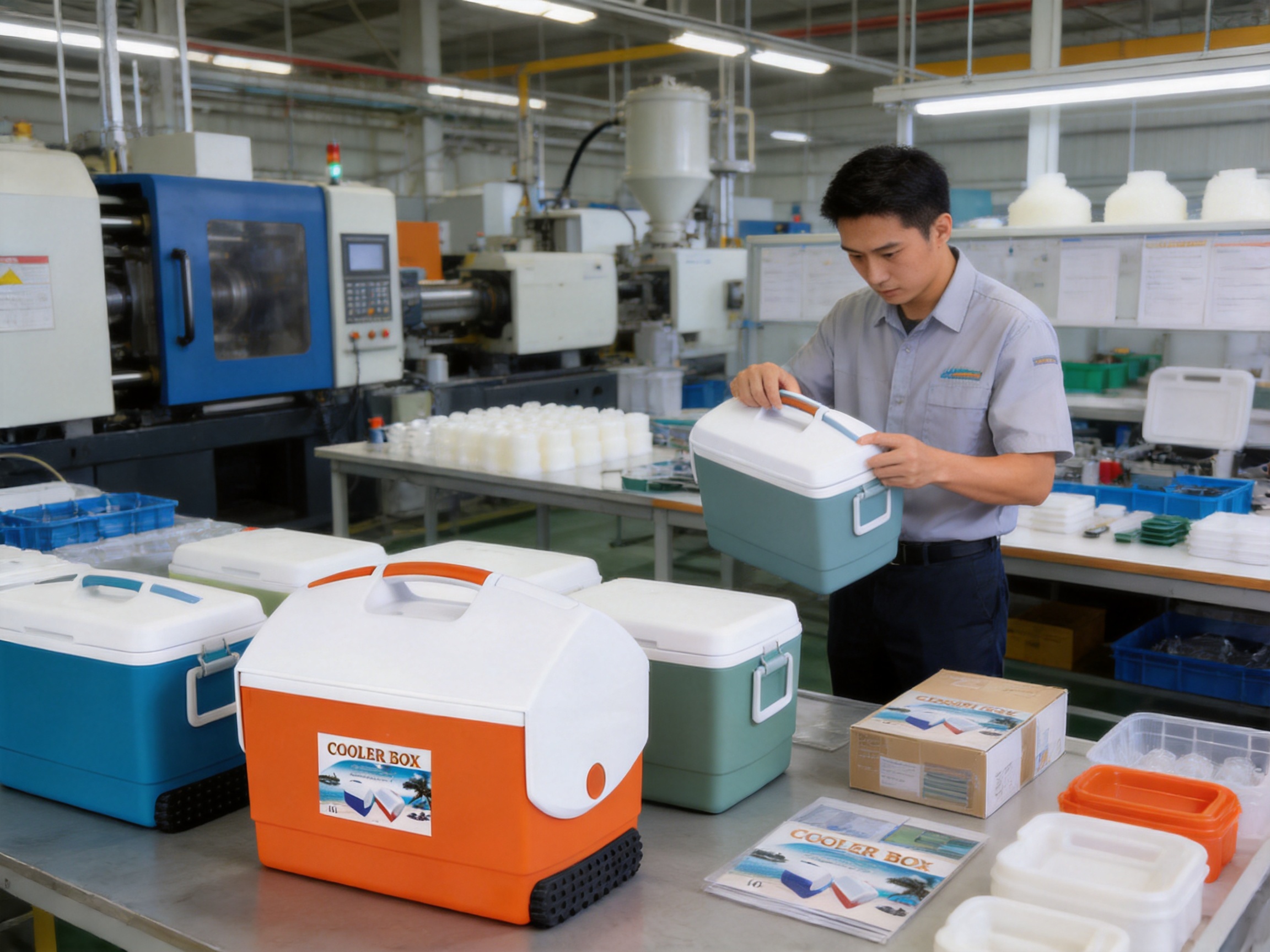
The manufacturer behind this product is Ningbo Junlong Outdoor Products Co., Ltd., a company founded in 2000 and located in Cixi, Ningbo, Zhejiang Province. The company focuses on outdoor cooling and water storage products and integrates product development, production, and sales.
The company operates an independent factory covering approximately 12,000 square meters and employs more than 100 people. Its production capabilities include automatic injection molding machines, blow molding machines, and foaming equipment. These facilities are relevant to the manufacture of insulated cooler boxes, cooler jugs, outdoor water containers, and related plastic products.
Automatic injection molding equipment supports the consistent production of molded plastic components. For a cooler box, molding quality can influence the appearance, dimensional accuracy, handle integration, lid fit, base structure, and repeatability of the outer shell. Stable production parameters help manufacturers maintain consistent results across larger orders.
Blow molding equipment expands the company’s ability to produce hollow plastic structures and related outdoor products. This capability is particularly valuable for a manufacturer serving several product categories, including water containers and cooler jugs. It demonstrates that the company’s manufacturing base is not limited to a single product format.
Foaming equipment supports the production of insulated structures. Combining molding and foaming capabilities within one manufacturing organization can simplify coordination between the outer shell, insulating layer, and final assembly. It also gives the manufacturer more direct control over production scheduling, process communication, and quality checks.
Product Development and Engineering Support
A cooler box must be designed as a complete system. The body, lid, closure mechanism, insulation, handle, feet, internal dimensions, and outer appearance all need to work together. The company’s product development and R&D capabilities support the creation of products based on practical user requirements and market opportunities.
The twist-lid design illustrates the value of product-focused engineering. A lid must be easy enough for ordinary users to open, but secure enough to remain closed during handling. It must also be compatible with the cooler’s dimensions, insulation structure, sealing interface, and molding process. Developing this type of feature requires more than simply changing the shape of a conventional cover.
OEM and ODM services allow buyers to participate in product development at different levels. A customer may provide a drawing, sample, functional specification, color reference, or general concept. The manufacturer can then evaluate the requirements, discuss mold and process considerations, prepare samples, and support further development.
OEM production is suitable for buyers who already have a defined product design or brand specification. ODM cooperation can be more appropriate for buyers seeking assistance with product structure, appearance, features, packaging, or market positioning. The exact scope of support should be agreed before production begins.
Customization can include product color, logo, printing, packaging, and development based on drawings or samples. These options allow importers, distributors, retailers, and promotional agencies to create a product that is better matched to their target market rather than selecting only a standard catalog item.
Quality Management and Production Consistency
Quality management is especially important for molded insulated products because performance depends on multiple components and process steps. A cooler may appear acceptable externally but still require careful control of lid fit, insulation distribution, material consistency, surface finish, handle strength, and assembly quality.
The manufacturer reports a rigorous quality management system supporting stable quality for diverse customer requirements. In practical terms, buyers should discuss the inspection points relevant to their order. These may include dimensions, material specifications, color consistency, logo quality, lid operation, structural appearance, packaging condition, and random performance testing.
Sample approval is an important stage in customized production. A buyer should review the physical sample before mass production, checking the overall dimensions, colors, printed graphics, opening action, handle comfort, base stability, and packaging. Written approval helps establish a clear reference for later inspection.
Production consistency also matters when the product is distributed across different markets. Stable dimensions make packaging and shipping planning easier. Consistent surface quality improves the appearance of retail displays. Reliable lid operation reduces complaints and supports customer confidence. Consistent material and insulation construction help maintain the intended product positioning.
Buyers can improve the outcome by providing complete technical information at the beginning of the project. Relevant information may include target capacity, preferred colors, logo files, packaging design, order quantity, destination market, labeling requirements, delivery schedule, and required testing documentation.
Factory Integration and Supply Advantages
A manufacturer that integrates development, production, and sales can provide a more coordinated supply process. Communication between product designers, production teams, quality personnel, and sales representatives may be more direct than in a fragmented supply chain involving multiple unrelated factories.
The company’s factory resources cover several processes associated with outdoor plastic products. This can be useful for buyers who want to source cooler boxes, cooler jugs, ice buckets, or outdoor water containers from one experienced supplier. Consolidated sourcing may simplify product communication, sample management, quality coordination, and order planning.
Factory integration can also support product series development. A customer may begin with the 10-liter cooler and later request matching products in different capacities, colors, or formats. A supplier with broader manufacturing capabilities may be better positioned to maintain visual and functional consistency across a product range.
The manufacturer’s location in Cixi, Ningbo, places it within an important manufacturing area in the Yangtze River Delta. This region has a broad industrial base and established supply networks for plastics, packaging, components, logistics, and export manufacturing. These conditions can support efficient coordination of production materials and shipping arrangements.
Materials, Cleaning, and Daily Care
Proper use and maintenance help preserve cooler performance. Before loading the product, users should clean the interior with a mild detergent and suitable water. Strong chemicals, abrasive tools, and excessive force should be avoided because they may damage the surface or affect printed areas.
The cooler should be dried after cleaning, particularly around the lid interface and base. If water or condensation remains trapped in seams or corners, it may create unpleasant odors over time. Food spills should be removed as soon as possible, especially when dairy products, meat, sauces, or sweet beverages are involved.
Users should pre-chill drinks and food whenever possible. A cooler performs more efficiently when it is loaded with already cold contents rather than being used to cool warm products. Cold packs or ice can be arranged around the contents to improve temperature retention, while excessive empty space can be reduced by using suitable cooling media.
The twist lid should be closed fully after every opening. Users should not force the mechanism if it does not rotate smoothly. Instead, they should check whether an item is interfering with the lid or whether the closure area needs cleaning. The integrated handle should be used for normal carrying, and the cooler should not be dragged by the lid or lifted with an excessive load.
When storing the cooler, keep it clean, dry, and away from sharp objects or extreme heat sources. Avoid placing heavy items on top of it for extended periods if doing so could deform the lid or affect the closure system.
Guidance for Wholesale and Import Buyers
Wholesale buyers should evaluate the product from both a user perspective and a supply perspective. The 10-liter capacity should be compared with the target market’s preferred beverage sizes, food containers, ice packs, and transportation habits. Buyers should also consider whether the compact format complements existing cooler products in their catalog.
For private-label programs, the buyer should confirm the desired logo position, printing method, artwork format, color references, and packaging requirements. The product’s smooth surface offers a useful foundation for branding, but the final appearance depends on the selected printing process, ink, artwork, and surface preparation.
Order planning should include sample development, approval, production lead time, inspection, packing, and transportation. Customized products may require additional preparation for color matching, logo setup, packaging printing, or mold-related changes. Early confirmation of these details helps reduce delays.
Importers should also verify the documentation and compliance requirements applicable to their destination market. Food-contact claims, labeling, packaging marks, recycling information, and testing requirements can vary by region. The manufacturer and buyer should agree on the documentation needed for the intended market before mass production.
Because the product is intended for outdoor use, buyers may also want to review packaging durability. Cartons should protect the coolers from scratches, crushing, moisture, and handling damage during transportation. Retail packaging may require a different design from bulk export packaging, so the final packaging structure should reflect the distribution channel.
Why This Cooler Is a Practical Product Investment
The value of a portable cooler is determined by how frequently and flexibly it can be used. A product that serves only one narrow purpose may have limited appeal. This 10-liter cooler can support outdoor recreation, food transport, school lunches, grocery shopping, workplace meals, events, promotions, and retail sales.
Its compact capacity reduces the barrier to everyday use. Users do not need a large vehicle or a major outdoor trip to justify carrying it. The integrated handle supports short-distance movement, while the rigid insulated structure makes it more capable than a simple shopping bag.
The twist lid adds a functional feature that helps distinguish the cooler from generic alternatives. The EPS insulation supports cold retention, the food-grade PP and PE construction supports food and beverage applications, and the elevated feet contribute to stable placement and base protection.
For business buyers, the customization potential adds another layer of value. The cooler can function as a product, a promotional gift, a retail item, or part of a larger outdoor lifestyle collection. Its broad application range can help distributors address several customer segments with one compact model.
For manufacturers and sourcing teams, the company’s factory resources provide a foundation for product customization and scaled production. Automatic injection molding, blow molding, foaming equipment, an independent factory, an R&D team, and an established quality management system all contribute to the supplier’s ability to support outdoor product programs.
Q&A
What is the capacity of the cooler?
The cooler has a stated capacity of 10 liters. It can hold up to twelve 330 ml cola cans, although the exact arrangement will depend on whether ice, cold packs, food containers, or other items are included.
What are the dimensions?
The product dimensions are 352 × 235 × 330 mm. These compact measurements make it suitable for vehicle transport, day outings, household storage, and small retail displays.
What materials are used?
The cooler uses food-grade PP and PE for its main construction and EPS for insulation. These materials support a lightweight, molded, and insulated product suitable for chilled food and beverage applications.
How long can it retain insulation?
The stated insulation time is up to 24 hours. Actual results depend on ambient temperature, the temperature of the contents, the amount of ice or cold packs, how often the lid is opened, and exposure to direct sunlight.
How does the lid work?
The cooler uses a twist-to-open lid. The user twists the lid to open it and returns it to the secured position after loading or removing items. The design is intended to help prevent accidental opening during ordinary handling.
Can the cooler be used for frozen groceries?
Yes. It can be used to transport frozen groceries for a limited period. Users should minimize transport time, use suitable cold packs when necessary, and transfer the products to a freezer as soon as possible.
Is the cooler suitable for school lunches?
Its compact format makes it suitable for school lunches, snacks, drinks, and small cold meals. Buyers should confirm that the internal arrangement matches the size of the lunch containers and cold packs they plan to use.
Does it have a carrying handle?
Yes. The product includes an integrated handle designed to provide a comfortable grip for normal carrying.
What is the purpose of the elevated feet?
The elevated non-slip feet help keep the base slightly above the supporting surface and may improve stability. They can also reduce direct contact between the cooler base and wet or dirty surfaces.
Can the product be customized?
Customization options include product color, logo printing, packaging, and OEM or ODM development. Customers may also discuss development based on drawings or samples.
Is the surface suitable for printing?
The product has a smooth surface designed to be easy to print. The final printing result depends on the artwork, printing method, ink, surface preparation, and production specifications.
Who can purchase this product?
The cooler is suitable for outdoor retailers, wholesalers, importers, promotional agencies, food and beverage companies, supermarkets, event organizers, hospitality businesses, and brands seeking customized outdoor products.
What manufacturing equipment supports production?
The manufacturer operates automatic injection molding machines, blow molding machines, and foaming equipment. These capabilities support the production of molded plastic parts, hollow outdoor containers, and insulated products.
Can the manufacturer develop a product from a sample?
The company provides OEM and ODM services, including product development based on drawings or samples. Specific development feasibility, tooling, sample charges, and production requirements should be discussed during project evaluation.
What should buyers confirm before placing an order?
Buyers should confirm the capacity, dimensions, materials, colors, logo artwork, printing method, packaging, order quantity, sampling procedure, quality requirements, delivery schedule, and destination-market documentation.
Conclusion
The 10L Portable Twist-Lid Foam Insulated Cooler is designed to provide a balanced solution for compact cold storage. Its 10-liter capacity is suitable for personal use, small families, short outings, grocery transport, school lunches, and promotional programs. Its ability to hold up to twelve 330 ml cans gives buyers a practical capacity reference, while its 352 × 235 × 330 mm dimensions support convenient transport and storage.
The product combines a distinctive twist-to-open lid, EPS insulation, food-grade PP and PE construction, an integrated handle, elevated non-slip feet, and a smooth printable surface. These features give it advantages over basic uninsulated boxes, loose-lid containers, and some soft cooler bags. It offers a structured, portable, customizable format without the bulk of a large cooler.
Behind the product is a manufacturer with experience in outdoor cooling and water storage products, an independent 12,000-square-meter factory, more than 100 employees, automatic injection molding equipment, blow molding machines, foaming equipment, product development resources, and a quality management system. These capabilities support both standard production and customized OEM or ODM projects.
For consumers, the cooler offers convenient cold storage for everyday and outdoor activities. For commercial buyers, it offers a practical product platform with branding and packaging potential. With appropriate use, realistic expectations, and proper maintenance, it can serve as a reliable compact cooler for retail, promotional, household, and recreational applications.
References
1. Product specification sheet for the 10L Portable Twist-Lid Foam Insulated Cooler.
2. Manufacturer-provided information regarding product dimensions, materials, capacity, insulation time, and customization options.
3. Manufacturer-provided company profile covering factory facilities, production equipment, product development, and OEM/ODM services.
4. General technical principles of passive cooler design, including insulation, heat transfer reduction, pre-chilling, and cold-pack usage.
5. General food storage and outdoor handling practices for transporting chilled and frozen products.
Product: 10L Portable Twist-Lid Foam Insulated Cooler

Product Recommendation
link
Office
- TEL: +86-574-63787606
- Phone: +86-13777994798
- E-mail: sales@nbjunlong.com
- WhatsApp: 13777967488
- Address: No. 1, Lane 3, Development Road, Longtouchang, Longshan Town, Cixi City, Zhejiang Province, China
Get In Touch
Copyright © Ningbo Junlong Outdoor Products Co., Ltd. All Rights Reserved.
China Plastic Insulated Cooler Box Manufacturer Custom Cooler Box Supplier
