- SMALL ORDERS FOR STANDARD ITEMS. Contact Now
- OUTDOOR COOLING SOLUTIONS, MADE IN‑HOUSE. Contact Now
- COOLER BOXES THAT FIT REAL OUTDOOR LIFE. Contact Now

 LANGUAGE
 日本語
 Español
 عربى

Content
- 1 Why a Purpose-Built Insulated Water Jug Matters
- 2 Core Product Specifications
- 3 15-Liter Capacity for Group Hydration
- 4 Leak-Resistant Twist-Lock Lid Design
- 5 Integrated Faucet for Controlled Dispensing
- 6 Food-Grade PE Construction
- 7 Insulation for More Comfortable Beverage Service
- 8 Hidden Handle and Space-Saving Form
- 9 Comparison with Common Alternative Containers
- 10 Suitable Applications for Homes and Events
- 11 Office, Workplace, and Commercial Use
- 12 Manufacturing Capabilities Behind the Product
- 13 Product Development and Engineering Support
- 14 Quality Management and Production Consistency
- 15 OEM, ODM, and Customization Opportunities
- 16 Design Advantages for Distributors and Retailers
- 17 Responsible Use and Maintenance
- 18 Considerations for Outdoor Performance
- 19 Environmental and Operational Considerations
- 20 Why Manufacturing Location and Experience Matter
- 21 Buying Criteria for Wholesale and Project Customers
- 22 Frequently Asked Questions
- 22.1 What is the capacity of the water jug?
- 22.2 What are the approximate dimensions?
- 22.3 How much does the empty jug weigh?
- 22.4 What material is used?
- 22.5 Does the jug have a faucet?
- 22.6 Is the lid designed to reduce leakage?
- 22.7 Can the jug be used outdoors?
- 22.8 Is the product insulated?
- 22.9 Does the product require electricity?
- 22.10 Is the handle detachable?
- 22.11 Can the product be customized?
- 22.12 Can businesses order OEM or ODM products?
- 22.13 What industries may use this product?
- 22.14 How should the jug be cleaned?
- 22.15 What should buyers check before placing a large order?
- 23 Conclusion
- 24 References
- 25 Product: 15L Leak-Proof Insulated Water Jug with Integrated Handle & Faucet
A dependable water container can make a significant difference wherever people need convenient access to drinking water. At outdoor events, offices, picnics, campsites, workshops, sports grounds, and family gatherings, a container must do more than simply hold liquid. It should be easy to carry, stable during use, resistant to leakage, simple to dispense from, safe for beverages, and durable enough to support repeated use. The 15L leak-proof insulated water jug with an integrated handle and faucet is designed around these practical requirements.
With a 15-liter capacity, compact rectangular proportions, food-grade PE construction, insulated body, sealed lid, integrated faucet, and hidden carrying handle, this water jug combines the functions of a beverage dispenser and a portable outdoor hydration container. It is suitable for situations in which users need a larger quantity of water available in one place without relying on multiple small bottles or an exposed open bucket.
The product measures approximately 350 × 195 × 290 millimeters and has a net weight of about 720 grams. This balance between capacity and empty weight makes it suitable for both stationary and mobile use. Its body can hold enough water for group activities while remaining manageable for one person to transport when filled conditions are considered carefully. The design also emphasizes clean appearance and efficient use of space, making it suitable for environments where function and presentation are equally important.
Why a Purpose-Built Insulated Water Jug Matters
Many water-storage products are designed for only one basic purpose. A standard bottle may be easy to carry but offer limited capacity. An ordinary bucket may hold a large volume but provide poor sealing and inconvenient dispensing. A simple plastic container may be affordable but lack insulation, an integrated faucet, or a secure carrying system. A large cooler box may preserve temperature effectively but may not be designed for direct beverage service.
A purpose-built insulated water jug addresses these gaps by combining several functions in one product. The container stores water, helps protect its temperature, limits exposure to dust and outside contaminants, and provides controlled dispensing through a faucet. Its lid is designed with a sealing ring and twist-lock closure, while its handle is integrated into the body rather than attached as a fragile external accessory.
This combination is valuable in shared-use settings. During a party, for example, guests can obtain water without opening a large container repeatedly. At a campsite, users can place the jug on a stable table or platform and dispense water as required. In an office, the container can serve a team without occupying the space or creating the waste associated with numerous disposable bottles.
The design is also useful for businesses that need a practical private-label or customized beverage-storage product. A manufacturer with experience in injection molding, blow molding, and foaming can adapt product details, colors, branding, packaging, and other specifications for distributors, retailers, hospitality suppliers, and outdoor-product companies.
Core Product Specifications
The following specifications summarize the main configuration of the 15L insulated water jug.
| Specification | Details |
|---|---|
| Product type | Insulated outdoor water jug with faucet |
| Capacity | 15 liters |
| Approximate dimensions | 350 × 195 × 290 millimeters |
| Main material | Food-grade PE |
| Approximate net weight | 720 grams |
| Closure | Twist-lock lid with sealing ring |
| Dispensing system | Integrated faucet |
| Carrying system | Integrated or hidden handle |
| Typical applications | Parties, offices, picnics, camping, events, workshops, and outdoor activities |
| Customization potential | Color, logo, packaging, drawings, samples, and product-development options |
Dimensions and weight can be especially important for buyers planning packaging, shipping, retail display, storage, or transport. The relatively narrow body width helps the product fit on many tables, counters, shelves, and vehicle storage areas. Its vertical format allows users to keep a useful water supply available without occupying the footprint of a wide open container.
15-Liter Capacity for Group Hydration
The 15-liter volume is one of the product’s most practical characteristics. It is large enough to support group use, yet more compact than many heavy-duty beverage tanks. The capacity can reduce the need for repeated refilling during a short event or outdoor activity. It also makes the container suitable for planned hydration stations, where users can refill cups or bottles at a single controlled point.
Capacity should always be considered alongside the type of activity. A family picnic may require only a few liters, while a sports event, workplace, construction area, or camping group may need significantly more. The 15-liter format occupies a useful middle position. It provides more service volume than a personal bottle or small thermos while remaining easier to handle than a very large commercial dispenser.
For offices, the jug can be used as a supplementary water station during meetings, training sessions, or temporary work arrangements. For parties, it can hold drinking water, chilled beverages, or other suitable non-carbonated drinks, depending on cleaning and usage requirements. For outdoor activities, it can serve as a central water source for a group instead of requiring every participant to carry a separate large container.
A larger capacity also supports operational efficiency. Event organizers can prepare the container in advance, position it in an accessible area, and allow users to serve themselves. This reduces the need for a host or staff member to distribute individual drinks continuously. It can also help reduce the number of disposable containers used during an activity.
Leak-Resistant Twist-Lock Lid Design
Leak prevention is essential for any portable water container. A container that spills during transport can damage bags, vehicles, furniture, equipment, or merchandise. It can also create avoidable hygiene and safety problems. The twist-lock lid and sealing ring are therefore central to the product’s performance.
The lid is designed to close securely over the opening, while the sealing ring creates a tighter interface between the cover and the container. The twist-lock action helps prevent the lid from loosening easily during normal handling. This is particularly important when the jug is moved from a vehicle to a campsite, carried across a room, or temporarily stored at an angle.
A sealed cover offers advantages over an open bucket or loosely covered dispenser. It helps limit the entry of dust, insects, leaves, and other outdoor debris. It also makes the water jug more suitable for transport and temporary storage. When the container is not being filled or cleaned, the lid can help protect the interior from unnecessary exposure.
The leak-resistant structure should not be interpreted as permission to treat the jug as an unrestricted liquid container under every transport condition. Users should close the lid fully, inspect the sealing ring, position the product upright when possible, and avoid placing excessive pressure on the lid. Correct operation and regular inspection contribute to the best results.
Compared with many basic beverage dispensers, the secure closure provides a stronger emphasis on mobility. Compared with ordinary open containers, it offers a more hygienic and controlled storage experience. This makes the product especially appropriate for outdoor environments, where weather, dust, movement, and uneven surfaces can affect exposed containers.
Integrated Faucet for Controlled Dispensing
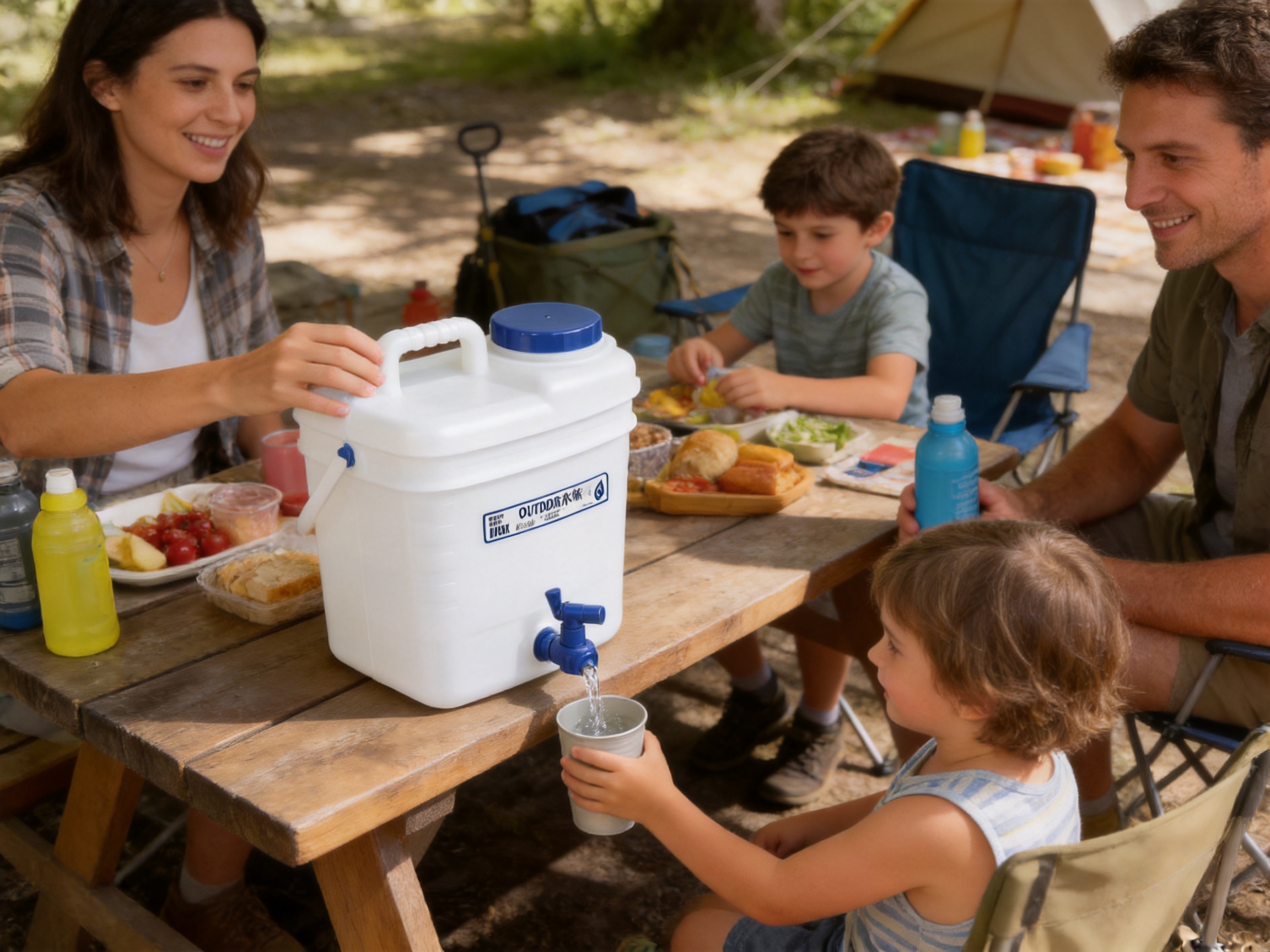
The integrated faucet transforms the jug from a simple storage vessel into a self-service beverage station. Users can place a cup, bottle, or other suitable drinking vessel under the outlet and dispense the required amount without lifting or tilting the entire container.
This arrangement improves convenience for children, older users, office workers, guests, and participants at outdoor events. A full 15-liter container can be heavy, even when the empty product itself is lightweight. The faucet reduces the need to lift the filled unit repeatedly and helps users control their serving size.
Controlled dispensing can also support cleaner shared use. Instead of removing a lid each time, users access the beverage through the faucet. This reduces the frequency with which the main opening is exposed. It can also help limit splashing and unnecessary waste, particularly when the product is positioned on a suitable elevated surface.
The faucet is integrated into the product configuration rather than being treated as an unrelated accessory. This allows the body, outlet location, and serving function to work as one system. A well-positioned faucet can make the jug easier to use in offices, refreshment areas, hospitality settings, temporary hydration stations, and outdoor gatherings.
Users should clean the faucet regularly and avoid allowing sugary beverages or pulpy liquids to remain inside the dispensing path for extended periods. Proper cleaning helps maintain smooth operation and supports good hygiene. For best results, the product should be used with beverages suitable for the materials and cleaning process.
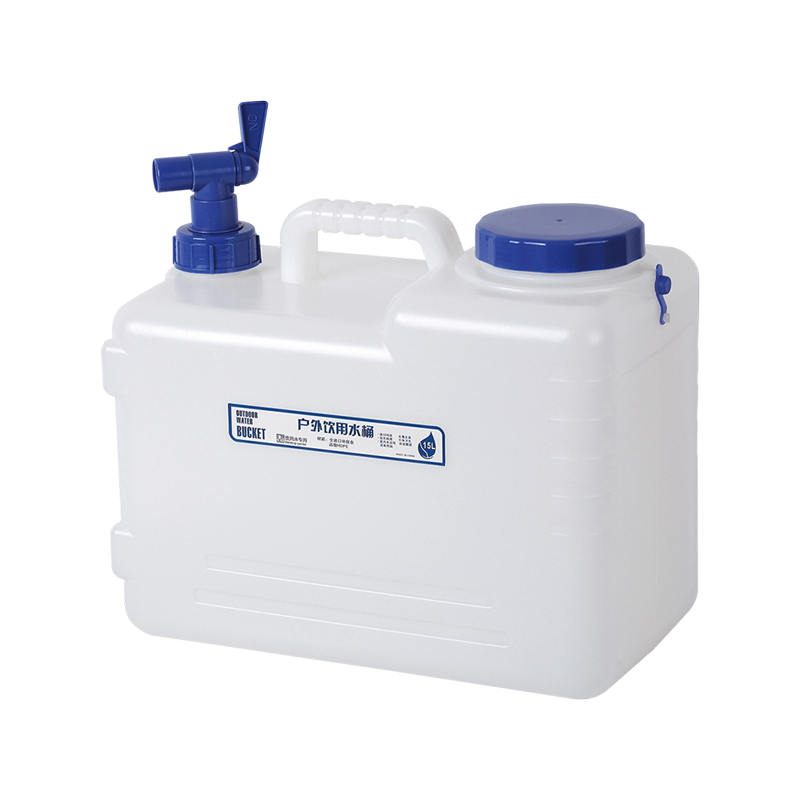
15L Leak-Proof Insulated Water Jug with Integrated Handle & Faucet
Food-Grade PE Construction
The water jug is made from food-grade polyethylene, commonly identified as PE. This material is widely used in products intended for storage and handling because it can provide a useful combination of toughness, relatively low weight, chemical resistance, and molding flexibility.
Food-grade material selection is important when a container is intended for drinking water or other beverages. It provides a suitable foundation for hygienic product design when combined with appropriate manufacturing controls, correct cleaning, and proper use. The BPA-free positioning of the product further supports buyer expectations for beverage-contact applications.
PE construction can offer practical durability in outdoor settings. A water jug may encounter transport vibration, repeated handling, mild impacts, and changing environmental conditions. Compared with some rigid but brittle materials, a properly designed PE body can be more forgiving during everyday use. It is also easier to produce in shapes that include recessed handles, curved surfaces, structural ribs, and integrated functional areas.
The material’s relatively low weight is another advantage. A 720-gram net weight for the empty product helps make storage, packaging, and handling more efficient. Weight savings can also be valuable for retailers and distributors managing freight, warehouse movement, and product presentation.
Material safety and durability do not remove the need for responsible maintenance. The container should be cleaned according to appropriate procedures, kept away from unsuitable high-temperature applications, and inspected for damage. Users should also confirm beverage compatibility before storing liquids other than water or standard non-carbonated drinks.
Insulation for More Comfortable Beverage Service
The insulated construction is intended to help beverages maintain a more desirable temperature for longer than they might in a simple single-wall container. Insulation can reduce the speed of heat transfer between the contents and the surrounding environment. This is especially useful during outdoor activities, warm-weather events, and extended periods of self-service.
Insulation performance depends on many factors, including starting temperature, ambient conditions, frequency of dispensing, exposure to direct sunlight, lid-opening frequency, and the volume remaining in the container. The jug should therefore be viewed as a practical insulated storage and dispensing product rather than a guarantee of a fixed temperature over a specific number of hours.
Compared with an ordinary plastic bucket or thin-wall bottle, an insulated water jug offers better support for temperature management. Compared with a powered refrigeration unit, it requires no electricity and creates no dependence on an electrical outlet. This makes it more flexible for camping, outdoor events, temporary work areas, and locations where powered cooling is unavailable.
The insulated format can also help improve user satisfaction. Water that remains pleasantly cool may encourage people to drink more regularly during outdoor work, travel, exercise, and social activities. For event hosts, temperature retention can help beverages remain more appealing between preparation and consumption.
For best results, users can pre-chill the beverage before filling the jug, minimize unnecessary lid opening, keep the unit away from direct heat, and use an appropriate amount of ice if compatible with the product. The faucet should remain closed when not in use, and the exterior should be kept dry and stable.
Hidden Handle and Space-Saving Form
The integrated or hidden handle is a notable design feature. Traditional external handles can increase the product’s overall profile and may become loose, cracked, or damaged after repeated use. A handle integrated into the body can provide a cleaner appearance and reduce the number of separate components exposed to impact.
The handle is positioned to support carrying while maintaining the product’s compact visual form. When the jug is placed on a table, the handle does not dominate the product’s appearance. This makes it suitable for visible service areas where buyers may prefer a cleaner and more organized presentation.
The compact dimensions also support efficient storage. A body measuring approximately 350 × 195 × 290 millimeters can fit into many transport and storage arrangements more easily than a wide, irregular container. Retailers may benefit from more efficient shelf planning, while users can store the product in a vehicle, cupboard, pantry, or equipment area when it is not needed.
Space efficiency is particularly important in modern apartments, compact offices, recreational vehicles, and crowded event venues. The water jug can be positioned on a counter or table without requiring the large footprint associated with some commercial beverage dispensers. Its narrow profile can also make it easier to place beside other supplies.
The handle and body design work together to improve the overall user experience. The jug looks more like a coordinated product than a generic tank with accessories attached. This can be valuable for businesses that care about brand presentation, as well as consumers seeking a functional product that does not appear out of place in an organized environment.
Comparison with Common Alternative Containers
Product selection becomes clearer when the insulated jug is compared with common alternatives. Each alternative has a suitable use case, but not every option provides the same combination of capacity, portability, insulation, sealing, and dispensing.
| Alternative | Typical Strength | Potential Limitation | Advantage of the Insulated Jug |
|---|---|---|---|
| Disposable water bottles | Simple individual distribution | Small capacity and increased packaging waste | Provides shared 15-liter storage and self-service dispensing |
| Ordinary plastic bucket | Low-cost bulk storage | Usually lacks sealing, insulation, and controlled dispensing | Combines a covered body, insulation, faucet, and carrying system |
| Single-wall water container | Lightweight storage | Limited temperature protection | Offers insulated construction for improved temperature management |
| Large powered dispenser | High-volume service or cooling | Requires electricity and may be less portable | Works without power and is suitable for mobile use |
| Small personal thermos | Individual portability | Limited group capacity | Supports shared hydration with a 15-liter volume |
| Open beverage dispenser | Easy access | Greater exposure to dust and accidental contamination | Uses a sealed lid and faucet for more controlled service |
The product’s competitive advantage is not based on one feature alone. Its value comes from the combination of functions. A competitor may offer a cheaper open container, a larger powered cooler, or a more portable personal bottle. However, the insulated jug is designed for buyers who want balanced performance across several needs: group capacity, easy movement, protected storage, temperature support, and direct dispensing.
Suitable Applications for Homes and Events
At home, the water jug can be used during family gatherings, celebrations, garden activities, barbecues, and informal outdoor meals. Its larger capacity reduces the frequency of refilling, while the faucet allows family members or guests to serve themselves.
For parties, self-service is one of the most useful features. The host can prepare the jug in advance, place it on a stable table, and provide cups nearby. Guests can access water without entering the kitchen or repeatedly asking for assistance. The concealed handle and clean body design also help the product fit into a carefully arranged serving area.
At picnics, the sealed lid helps support transport from the preparation area to the destination. The container can be placed on a picnic table, folding stand, or other stable surface. Because the faucet controls the flow, users do not need to tip the jug over uneven ground.
During camping trips, the product can serve as a central water station. It can be used for drinking water or other suitable beverages, subject to responsible cleaning and storage practices. Its insulated construction is useful when campers want to slow temperature change without carrying a powered appliance.
For community events and recreational activities, the 15-liter format offers a practical way to organize shared hydration. Event managers can place several units at designated points, use different colors for different beverages, or apply customized labels and logos for organized service.
Office, Workplace, and Commercial Use
In offices, the water jug can support meetings, training sessions, employee refreshment areas, and temporary workspaces. Its relatively compact footprint allows it to fit on a counter or table, while the faucet provides convenient service without requiring a conventional water-cooler installation.
At workplaces and workshops, access to drinking water can support employee comfort, especially in warm conditions or during physically active tasks. The container should be placed in a clean and accessible location, away from hazardous materials and heavy equipment. A stable stand or elevated table can improve faucet access and reduce the risk of accidental tipping.
Construction sites, agricultural work areas, sports fields, and outdoor maintenance locations may also benefit from a portable, non-powered hydration container. The product is easier to deploy than a fixed water station and can be moved according to the activity schedule.
Hospitality businesses can use the jug for outdoor dining, temporary service areas, buffet-style events, catering operations, and guest refreshment stations. Its ability to carry a meaningful volume while maintaining a clean appearance makes it suitable for settings where customer experience matters.
Retailers, importers, wholesalers, and distributors may consider the product for outdoor living, camping, kitchen organization, emergency preparedness, sports, travel, and workplace-supply categories. Its multiple applications can make it easier to position across more than one product segment.
Manufacturing Capabilities Behind the Product
A well-designed water jug depends on more than an attractive shape. Consistent wall thickness, reliable fit between lid and body, accurate faucet installation, clean surfaces, and stable material quality all influence the user experience. These factors are supported by appropriate manufacturing processes and quality-management practices.
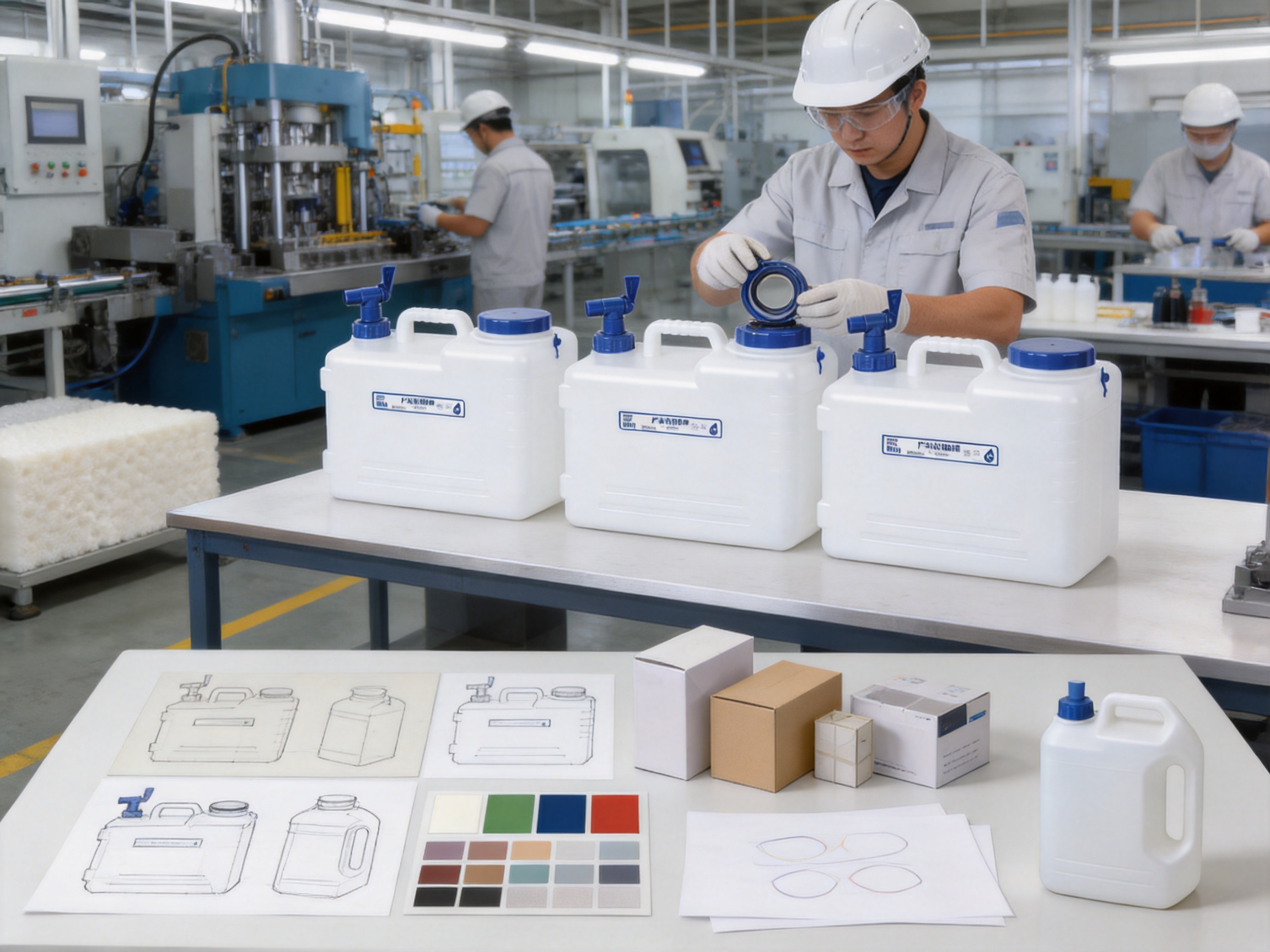
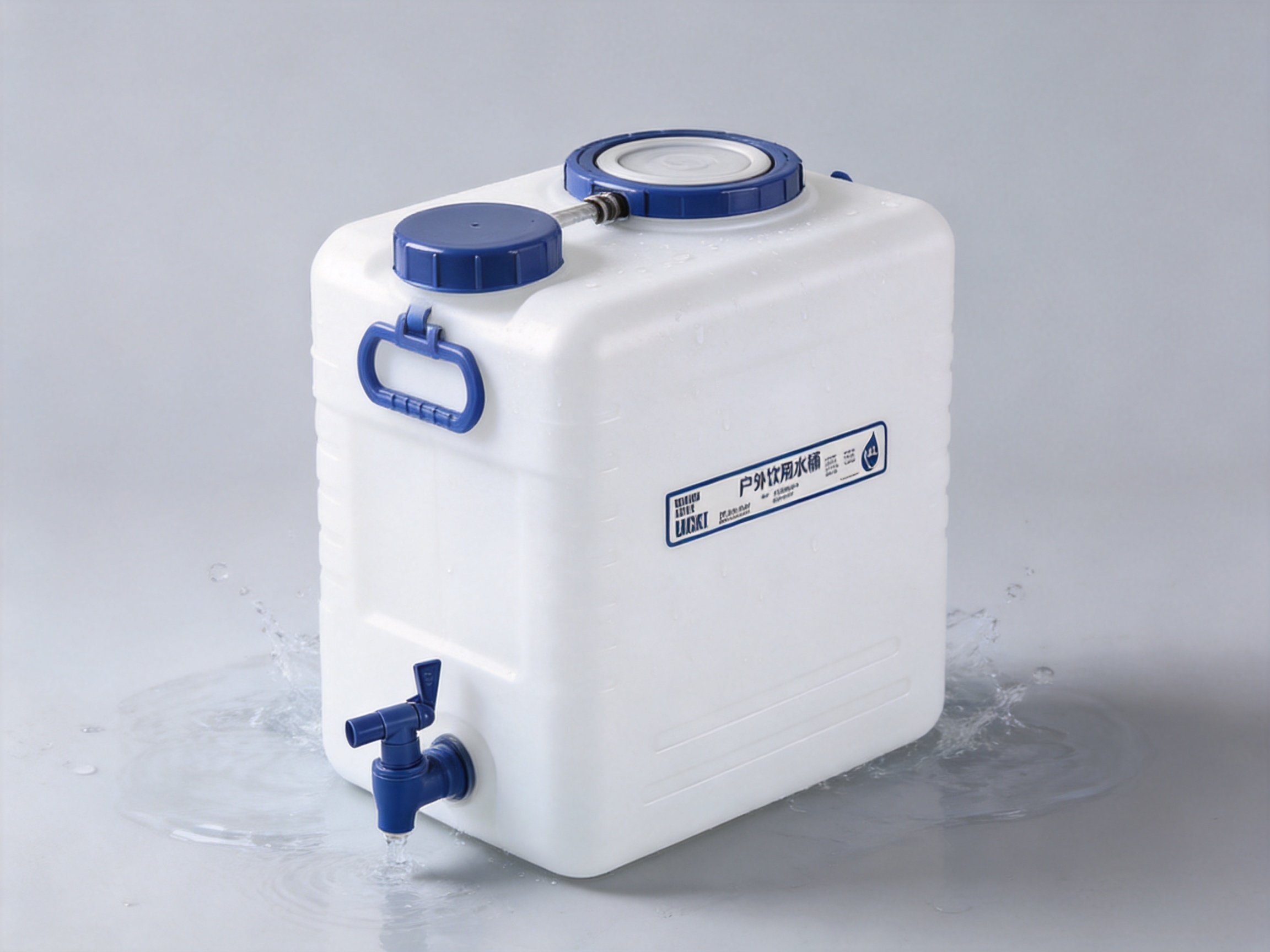
The manufacturer behind this product operates an independent factory covering approximately 12,000 square meters and employs more than 100 people. Its production capabilities include automatic injection molding machines, blow molding machines, and foaming equipment. This combination is relevant to outdoor cooling and water-storage products because different components and structures may require different forming technologies.
Injection molding can be used to produce precise plastic components, including covers, handles, faucet parts, structural fittings, and other detailed elements. The process uses a mold to form material under controlled conditions. When properly managed, injection molding supports repeatability, dimensional consistency, and efficient production of medium- to large-volume orders.
Blow molding is suitable for producing hollow plastic bodies and containers. It can support the manufacture of shaped vessels with useful internal volume and controlled external geometry. For products such as water jugs and cooler bodies, blow molding can help create a strong, lightweight shell while allowing designers to incorporate curves, recesses, and ergonomic features.
Foaming equipment supports insulated structures by creating or processing materials designed to reduce heat transfer. In an insulated water jug, the quality of the insulation process can influence temperature-retention performance, body rigidity, and the overall balance between weight and function.
The ability to operate several related processes within one manufacturing organization can improve coordination. Product development, tooling, molding, assembly, inspection, packaging, and order management can be handled through a more integrated workflow. This may help reduce communication delays and support more consistent production for customized projects.
Product Development and Engineering Support
Product development is particularly important in the outdoor-products sector because buyers often require more than a standard catalog item. They may need a different capacity, a modified handle, a new faucet arrangement, a particular color, an adjusted lid, a special package, or a shape based on a drawing or sample.
The manufacturer provides product-development support based on customer drawings or physical samples. This creates a pathway for businesses that already have a market concept but need production engineering and tooling assistance. A buyer may provide dimensional requirements, reference products, sketches, or performance goals, after which the development team can evaluate structure and manufacturability.
Good development work considers more than exterior appearance. It must account for wall thickness, molding draft, material flow, assembly tolerances, sealing interfaces, faucet placement, handle strength, cleaning access, packaging dimensions, and shipping stability. These details help determine whether a product will perform reliably after repeated manufacturing and everyday use.
Design-for-manufacturing thinking can also help control production costs. A product that is attractive but difficult to mold or assemble may require excessive tooling complexity or manual labor. A product designed with appropriate part geometry and production methods can be more efficient to manufacture while maintaining the desired functionality.
For OEM and ODM buyers, engineering collaboration can be valuable throughout the project. It can support initial feasibility review, sample development, mold modification, pilot production, testing, final approval, and future improvements. This kind of cooperation is especially useful for companies entering the cooler, jug, beverage-dispenser, or outdoor-water-container market.
Quality Management and Production Consistency
Quality management is essential for products that must contain liquid, seal during transport, and support repeated contact with users. The manufacturer describes a rigorous quality-management approach intended to support stable quality for different customer requirements.
Quality control can include incoming-material checks, mold and machine monitoring, dimensional inspection, visual evaluation, assembly checks, leakage inspection, faucet-function testing, and packaging review. The precise inspection plan may vary according to the project, customer specification, and product configuration.
For a water jug, sealing quality deserves particular attention. The lid, sealing ring, body opening, and closure mechanism must work together. A small dimensional inconsistency can affect fit or increase the risk of leakage. Consistent production control helps reduce such variation.
Faucet installation also requires care. The outlet must be positioned correctly, the connection must be secure, and the operating mechanism should function smoothly. Inspection of these elements helps support convenient dispensing and reduces the likelihood of avoidable assembly defects.
Surface appearance can influence consumer perception, especially for products used in visible settings. Consistent color, clean molding lines, accurate logos, and careful packaging can help buyers present the product more effectively in retail and hospitality environments.
Continuous improvement is another important strength. Manufacturing feedback, customer comments, inspection results, and market observations can all inform future product updates. Improvements may involve material use, handle ergonomics, faucet structure, insulation, packaging efficiency, or visual design.
OEM, ODM, and Customization Opportunities
Businesses often need products that align with their own brand identity, sales channel, or regional market. The water jug can support customization in areas such as color, logo, packaging, and product development. This allows importers, distributors, retailers, hospitality suppliers, and outdoor brands to create a more differentiated offering.
Color customization can help a business match a corporate identity, create a coordinated product series, or distinguish different beverage types. A logo can improve brand visibility during events, outdoor activities, and commercial service. Packaging customization can support retail presentation, shipping requirements, instruction communication, and market-specific labeling.
OEM production is useful when a buyer has an established specification and wants a manufacturing partner to produce it. ODM cooperation is suitable when a buyer wants to select or adapt an existing design with support from the manufacturer’s development and production capabilities.
A structured custom project should begin with clear requirements. Buyers may need to define capacity, dimensions, intended beverage type, color, logo placement, packaging method, target order quantity, delivery expectations, and applicable market requirements. Providing drawings, samples, reference images, or written specifications can help accelerate evaluation.
Before mass production, sample approval is important. Buyers should review fit, appearance, dimensions, faucet operation, lid sealing, handling comfort, packaging, and overall suitability for the intended market. A documented approval process can reduce misunderstandings and establish a clear reference for production.
Design Advantages for Distributors and Retailers
Retail success often depends on whether a product can be understood quickly by shoppers. The main benefits of this water jug are easy to communicate: 15-liter capacity, insulated construction, leak-resistant lid, integrated faucet, food-grade PE material, and convenient carrying handle.
The product can appeal to several consumer groups at once. Campers may value its portability and insulation. Families may focus on its capacity and self-service faucet. Office buyers may appreciate its compact footprint. Event organizers may be interested in its controlled dispensing and customization potential.
Its multifunctional positioning can support different sales categories, including outdoor water containers, camping equipment, beverage dispensers, party supplies, workplace products, and cooler accessories. A distributor can therefore present it through more than one channel rather than limiting it to a single narrow category.
Packaging can further support market performance. A clear package may emphasize the faucet and handle, while a printed carton can explain capacity, dimensions, material, cleaning instructions, and application examples. Custom packaging can also include the buyer’s logo, product name, barcode, language requirements, and usage guidance.
Because the product is relatively lightweight when empty, it may be easier to handle in warehouses and retail operations than heavier rigid beverage containers. The compact form can also support more efficient carton design and shipment planning, subject to final packaging specifications.
Responsible Use and Maintenance
Proper care helps preserve product performance and hygiene. Before first use, the container, lid, faucet, and relevant contact surfaces should be cleaned according to suitable instructions. The product should be rinsed thoroughly after cleaning, and users should avoid leaving cleaning agents inside the container.
After use, the jug should be emptied and cleaned as soon as practical. Residual beverages, particularly sweetened drinks, can encourage odor or residue if left inside for extended periods. The faucet should receive special attention because liquid can remain in its internal passage.
The container should be dried thoroughly before long-term storage. Storing it with the lid slightly open, where appropriate and safe, may help air circulate and reduce trapped moisture. The product should be kept in a clean, dry location away from sharp objects, strong chemicals, and excessive heat.
Users should inspect the sealing ring regularly for dirt, deformation, or damage. A worn or incorrectly positioned seal can reduce leak resistance. The lid should be twisted into its fully closed position, and the faucet should be checked before transport or service.
The jug should be placed on a stable, level surface when full. Although the integrated handle supports carrying, users should remember that 15 liters of water weighs approximately 15 kilograms before the container and accessories are included. Safe lifting practices are important, especially for children, older users, and anyone with limited physical strength.
The container should not be used for unsuitable chemicals, fuels, corrosive liquids, or substances that may damage the PE body, seal, faucet, or other components. Buyers with specialized beverage or liquid requirements should confirm compatibility before use.
Considerations for Outdoor Performance
Outdoor conditions can be unpredictable, so placement and handling influence the product’s performance. The jug should be kept out of direct sunlight whenever possible. Shade can help reduce temperature increase and protect the exterior from unnecessary exposure.
During transport, the lid should be fully closed and the jug should be secured so that it does not slide or fall. Even a leak-resistant container can be damaged if it is struck by heavy objects or placed under excessive pressure. A dedicated storage position in a vehicle or equipment box can improve safety.
At a campsite or event, the product should be positioned where users can access the faucet without crowding or accidental contact. A raised, stable table can make dispensing easier. The area around the faucet should be kept clean and free from standing water.
In hot climates, the jug can be pre-chilled and kept in shade to improve the user’s experience. In cold conditions, users should consider whether the liquid could freeze and expand. Extreme temperatures may affect seals, body materials, and dispensing components, so normal operating conditions should be observed.
For public or commercial events, organizers can establish a cleaning and refill schedule. Assigning responsibility for checking the lid, faucet, water level, and surrounding area can help maintain reliable service throughout the event.
Environmental and Operational Considerations
A reusable 15-liter container can reduce dependence on individual disposable bottles in suitable settings. Instead of distributing a separate bottle to every participant, an organizer can provide shared water access with reusable cups or personal refillable bottles. The environmental outcome depends on actual reuse, cleaning practices, product lifespan, and the broader event-management system.
Durable construction can support repeated use over time. Longer service life may help reduce the frequency with which containers are replaced. Buyers should care for the product properly, avoid unnecessary damage, and follow appropriate end-of-life procedures according to local recycling or waste-management systems.
The product can also improve operational efficiency. A single prepared jug may replace multiple small containers at a meeting, picnic, or temporary work area. This can reduce setup time, simplify transport, and make beverage management easier for organizers.
Businesses evaluating environmental claims should consider the complete product lifecycle rather than focusing on one feature. Material composition, packaging, shipping, cleaning, reuse frequency, and disposal all contribute to overall impact. The most practical benefit comes when the jug is used repeatedly and maintained properly.
Why Manufacturing Location and Experience Matter
The manufacturer is located in Cixi, Ningbo, Zhejiang Province, within the Yangtze River Delta manufacturing region. This location provides access to a broad industrial network, supply-chain resources, logistics services, and technical labor related to plastic products and outdoor equipment.
The company was founded in 2000 and has developed experience in product development, production, and sales. Its focus on outdoor cooling and water-storage products provides a more specialized foundation than a factory that produces unrelated plastic goods only occasionally.
Its product range includes ice buckets, insulated cooler jugs, outdoor water containers, and cooler boxes. This category experience can support design decisions involving insulation, lids, handles, faucets, body structures, and outdoor usability.
A specialized manufacturer can also understand the commercial requirements of international buyers. These may include stable repeat production, packaging coordination, sample approval, custom color management, logo application, communication across time zones, and long-term product updates.
For buyers seeking a supply partner rather than a one-time transaction, manufacturing continuity is important. A factory with product-development resources, molding equipment, quality systems, and experienced personnel may be better positioned to support future variations and related product lines.
Buying Criteria for Wholesale and Project Customers
Wholesale buyers should evaluate more than the basic product photograph. Capacity, dimensions, material, lid sealing, faucet performance, handle strength, insulation structure, packaging, and order quantity should all be discussed before purchase.
Buyers should request product samples when possible. A sample can help confirm how the jug feels when carried, how easily the faucet operates, how the lid closes, how much space it occupies, and how it fits the intended environment.
Customization projects should include a written specification. Details may include product color, logo method, logo size, logo position, packaging material, carton dimensions, instruction language, barcode requirements, and shipping marks. Clear specifications help reduce production ambiguity.
Commercial buyers should also plan for usage instructions. The end customer should understand how to fill the container, secure the lid, operate the faucet, clean the product, and store it. Simple and accurate instructions can reduce misuse and support customer satisfaction.
Order planning should account for development time, tooling if required, sample approval, production scheduling, inspection, packaging, and transportation. Early communication helps align expectations and reduce avoidable delays.
Frequently Asked Questions
What is the capacity of the water jug?
The water jug has a capacity of 15 liters. This volume is suitable for group hydration, office refreshment, parties, picnics, camping, and other shared-use situations.
What are the approximate dimensions?
The stated dimensions are approximately 350 × 195 × 290 millimeters. Buyers should confirm final packaged dimensions separately if they are planning retail cartons, shipping arrangements, or storage systems.
How much does the empty jug weigh?
The net weight is approximately 720 grams. The filled product will be substantially heavier because 15 liters of water weighs about 15 kilograms, excluding the container and accessories.
What material is used?
The body is made from food-grade PE. The product is also described as BPA-free, supporting its intended use for water and suitable beverages when handled and cleaned correctly.
Does the jug have a faucet?
Yes. The integrated faucet allows users to dispense water or other suitable beverages without lifting and tilting the full container.
Is the lid designed to reduce leakage?
Yes. The twist-lock lid and sealing ring are designed to create a more secure closure and reduce leakage during normal handling. The lid should be closed fully, and the container should be transported upright whenever practical.
Can the jug be used outdoors?
Yes. It is designed for outdoor water storage and is suitable for activities such as camping, picnics, parties, sports events, and temporary outdoor work areas. Shade, stable placement, and proper cleaning are recommended.
Is the product insulated?
Yes. The insulated construction helps slow temperature change compared with a basic single-wall plastic container. Actual temperature retention depends on the starting temperature, weather, lid opening frequency, remaining volume, and other conditions.
Does the product require electricity?
No. The jug is a non-powered container. Its insulation supports temperature management without requiring a power connection.
Is the handle detachable?
The product uses an integrated or hidden handle design. This creates a clean appearance and supports carrying without relying on a separate external handle assembly.
Can the product be customized?
Customization options may include color, logo, packaging, and product development based on drawings or samples. Buyers should discuss technical requirements, order quantities, and approval procedures with the manufacturer.
Can businesses order OEM or ODM products?
Yes. The manufacturer provides OEM and ODM services for customers requiring branded products, adapted designs, custom colors, packaging, or new product development.
What industries may use this product?
Potential users include outdoor retailers, camping suppliers, event organizers, hospitality businesses, offices, workplaces, distributors, wholesalers, sports organizations, and household consumers.
How should the jug be cleaned?
The container, lid, sealing ring, and faucet should be cleaned regularly using an appropriate method for food-contact products. Sweetened or flavored beverages should not be left inside for long periods, and the faucet should be rinsed carefully to remove residue.
What should buyers check before placing a large order?
Buyers should confirm capacity, dimensions, material, color, logo, faucet configuration, sealing performance, insulation expectations, packaging, sample approval, order quantity, production schedule, and shipping requirements.
Conclusion
The 15L leak-proof insulated water jug is designed to solve several everyday hydration challenges in one compact product. Its 15-liter capacity supports group use, while the integrated faucet provides controlled self-service dispensing. The twist-lock lid and sealing ring help protect against leakage, and the insulated construction supports more comfortable beverage temperatures without electricity.
Food-grade PE, BPA-free positioning, an integrated handle, compact dimensions, and a relatively low empty weight contribute to a practical user experience. Compared with disposable bottles, open buckets, basic single-wall containers, and powered dispensers, the jug offers a balanced combination of portability, capacity, sealing, insulation, and convenience.
Its commercial value is strengthened by the manufacturer’s production capabilities. With an independent 12,000-square-meter factory, more than 100 employees, automatic injection molding, blow molding, foaming equipment, product-development resources, and quality-management practices, the supplier is equipped to support both standard products and customized projects.
For distributors, retailers, event suppliers, hospitality businesses, offices, outdoor brands, and OEM customers, the product offers a flexible platform for reliable beverage storage and service. With appropriate cleaning, careful handling, and suitable placement, it can support repeated use across indoor and outdoor environments while contributing to more organized and efficient hydration management.
References
1. Product specification sheet for a 15-liter insulated water jug with integrated handle and faucet.
2. General technical information on polyethylene materials used in food-contact plastic containers.
3. General principles of injection molding, blow molding, and foam-insulation manufacturing for plastic products.
4. Outdoor beverage-storage and hydration-equipment design considerations.
5. General guidance on reusable container cleaning, maintenance, and responsible handling.
6. Manufacturing and customization information supplied for outdoor cooling and water-storage products.
Product: 15L Leak-Proof Insulated Water Jug with Integrated Handle & Faucet

Product Recommendation
link
Office
- TEL: +86-574-63787606
- Phone: +86-13777994798
- E-mail: sales@nbjunlong.com
- WhatsApp: 13777967488
- Address: No. 1, Lane 3, Development Road, Longtouchang, Longshan Town, Cixi City, Zhejiang Province, China
Get In Touch
Copyright © Ningbo Junlong Outdoor Products Co., Ltd. All Rights Reserved.
China Plastic Insulated Cooler Box Manufacturer Custom Cooler Box Supplier
