- SMALL ORDERS FOR STANDARD ITEMS. Contact Now
- OUTDOOR COOLING SOLUTIONS, MADE IN‑HOUSE. Contact Now
- COOLER BOXES THAT FIT REAL OUTDOOR LIFE. Contact Now

 LANGUAGE
 日本語
 Español
 عربى

3L PU Insulated Cooler Jug with Sealing Cover: Lightweight Outdoor Hydration for Wholesale and Custom Supply
Content
- 1 Product Overview
- 2 Why PU Insulation Is Important in a Cooler Jug
- 3 Food-Grade PP Inner Container
- 4 Large Opening for Ice, Refilling, and Cleaning
- 5 Rotating Sealing Cover and Leakage Control
- 6 Independent Drinking Port for Convenient Hydration
- 7 Lightweight Handle for Outdoor Mobility
- 8 Applications Across Outdoor and Commercial Markets
- 9 Advantages Over Conventional Outdoor Water Containers
- 10 Manufacturing Strengths and Production Capabilities
- 11 Quality Management for Wholesale Orders
- 12 OEM, ODM, and Custom Manufacturing Services
- 13 Wholesale Purchasing Considerations
- 14 Care and Use Guidance
- 15 Sustainability and Reusable Hydration
- 16 Recommended Product Positioning
- 17 Q&A
- 17.1 What is the capacity of the cooler jug?
- 17.2 What materials are used in the product?
- 17.3 Is the inner container BPA-free?
- 17.4 How long can the jug keep beverages cool?
- 17.5 Can users add ice cubes easily?
- 17.6 Is the cooler jug easy to clean?
- 17.7 Does the cover help prevent leakage?
- 17.8 How can users drink from the jug?
- 17.9 Does the product have a carrying handle?
- 17.10 What is the approximate weight?
- 17.11 What are the approximate dimensions?
- 17.12 Can the cooler jug be customized?
- 17.13 What manufacturing equipment supports production?
- 17.14 Who is the product suitable for?
- 17.15 What information should a wholesale buyer provide?
- 18 Conclusion
- 19 References
- 20 Product: 3L PU Insulation COOLER JUG with Sealing Cover
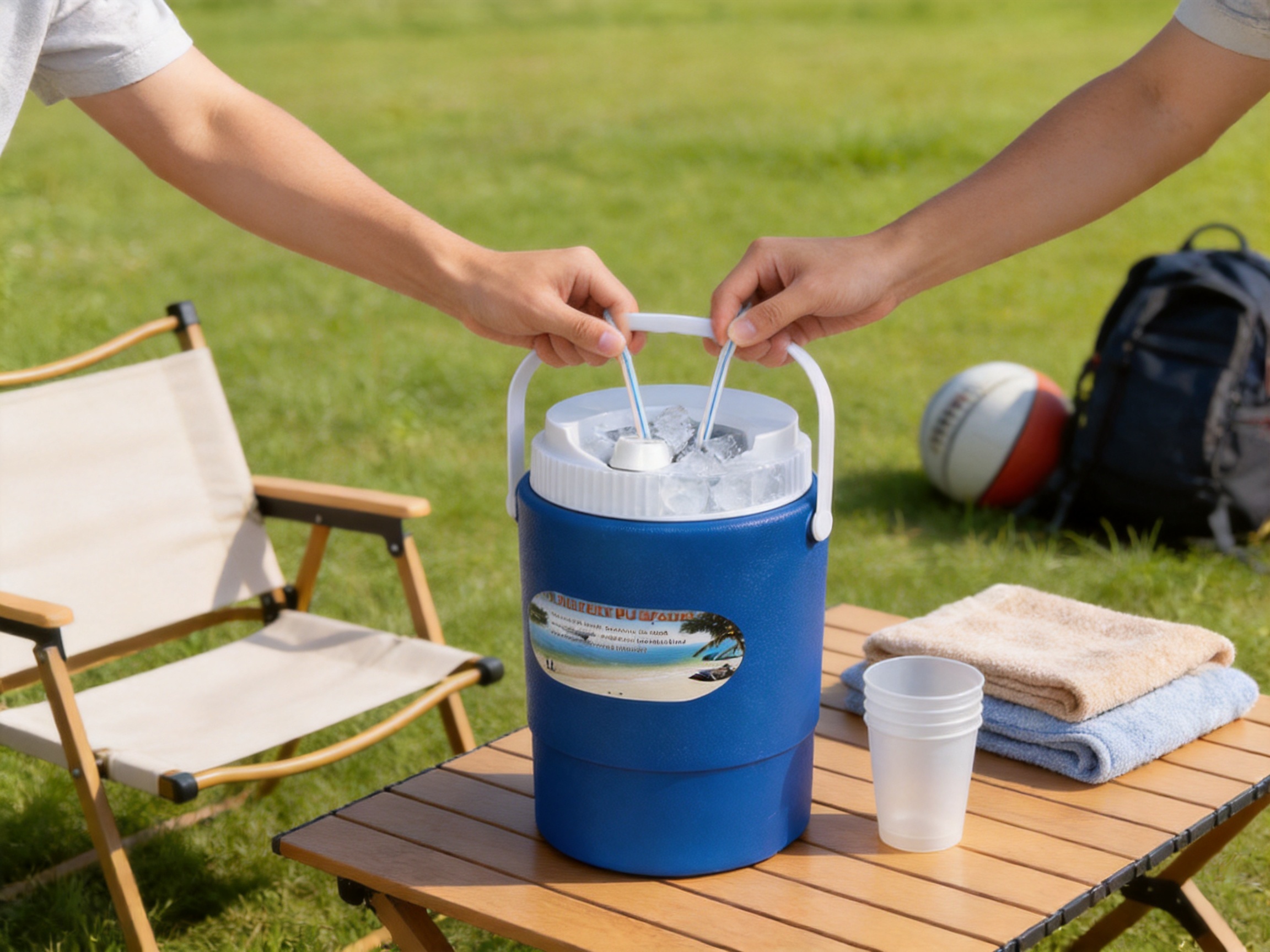
A dependable outdoor hydration product must do more than hold water. It should preserve temperature, resist leakage, remain easy to carry, support fast cleaning, and provide convenient access when users are moving, working, exercising, or relaxing outdoors. The 3L PU Insulated Cooler Jug with Sealing Cover is designed around these practical requirements. Combining a food-grade PP inner container, PE components, and a PU insulation layer, this cooler jug provides a balanced solution for outdoor water storage, sports events, camping, travel, work sites, picnics, and group activities.
With a 3-liter capacity, the jug is large enough for shared hydration while remaining compact enough for portable use. Its approximate dimensions are Φ167 × 270 mm, and its weight is about 470 g, or approximately 0.5 kg. This lightweight construction gives it an important advantage over many traditional metal insulated containers, especially when users need to carry a larger quantity of water without adding unnecessary weight.
The product is also designed for wholesale, OEM, ODM, and private-label purchasing. Its structure supports efficient production, practical customization, and reliable use across different outdoor product markets. As a cooler jug supplier and manufacturer, Ningbo Junlong Outdoor Products Co., Ltd. combines product development, injection molding, blow molding, foaming, assembly, and quality management within its own manufacturing operation.
Product Overview
The 3L PU Insulated Cooler Jug is a portable water container with a sealing cover, integrated carrying handle, and independent drinking outlet. The main body uses a PU insulation layer to help maintain the temperature of the liquid inside. The inner container is made from food-grade PP, while PP, PE, and PU work together to create a lightweight, durable, and functional construction.
The cooler jug is particularly suitable for users who need a larger volume than a personal bottle but want a more portable and convenient alternative to a large insulated beverage dispenser. Its 3-liter capacity is suitable for a small group, a training session, a family outing, a sports team, or a work crew. It can be used for cold water, chilled sports drinks, juice, tea, and other suitable beverages according to the buyer’s intended application and filling requirements.
The large opening is one of the product’s practical features. It makes it easier to add ice cubes, refill the container, and clean the interior by hand. The wide opening also simplifies inspection and routine maintenance, which is especially valuable for products used frequently in outdoor environments.
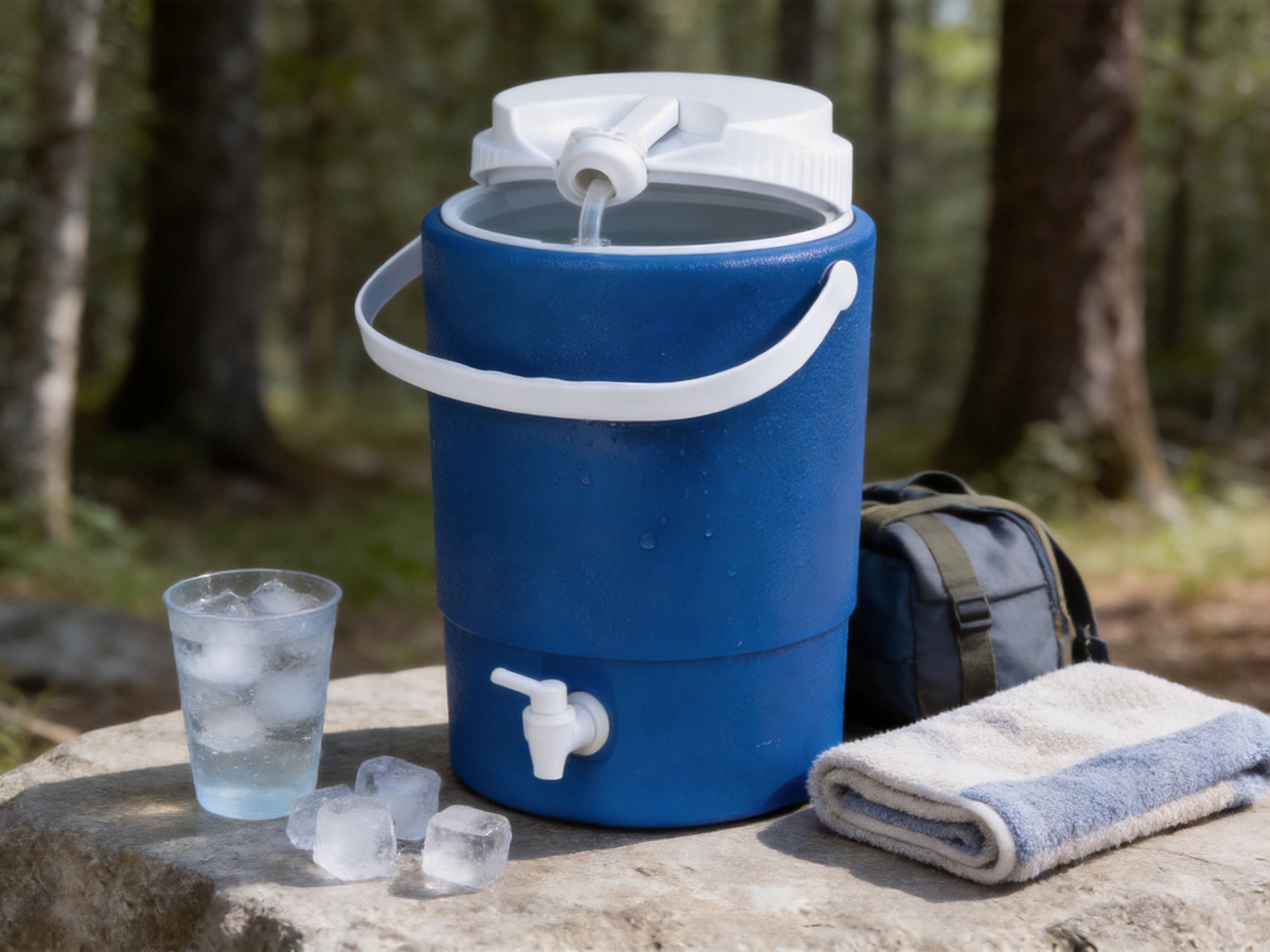
The rotating sealing cover is designed to reduce leakage at different angles. A sealing ring within the lid supports the closure and helps prevent liquid from escaping during transport. In addition, the jug includes a separate drinking port with a straw-style water outlet. This allows users to drink directly without removing the entire cover, helping reduce temperature loss and making hydration more convenient.
| Product Feature | Specification or Benefit |
|---|---|
| Product type | 3L PU insulated cooler jug |
| Approximate dimensions | Φ167 × 270 mm |
| Volume | 3 liters |
| Main materials | PP, PE, and PU |
| Approximate weight | 470 g, approximately 0.5 kg |
| Insulation structure | PU insulation layer |
| Cover design | Rotating sealing cover with sealing ring |
| Drinking method | Independent drinking port with straw-style outlet |
| Carrying method | Integrated handle |
| Opening design | Large diameter for ice filling and hand cleaning |
| Application areas | Sports, camping, travel, picnics, outdoor work, events, and family activities |
Why PU Insulation Is Important in a Cooler Jug
Insulation performance is a major factor when comparing outdoor water containers. A single-wall plastic container may be light, but it offers limited protection against ambient heat. A metal container may provide insulation when manufactured with a vacuum or foam structure, but it can be heavier, more expensive, and less convenient to handle in larger capacities.
PU, or polyurethane, insulation provides a practical middle ground. The insulation layer helps slow the transfer of heat between the beverage inside and the surrounding environment. When cold water or ice is added, the structure helps the contents remain cooler for longer than a conventional non-insulated container. The stated body insulation time for this model is up to 36 hours under appropriate test or use conditions. Actual performance may vary according to initial beverage temperature, ice quantity, ambient temperature, frequency of opening, and placement.
The use of PU insulation is particularly valuable for outdoor activities. A jug placed in direct sunlight, inside a vehicle, beside a sports field, or at a work site may be exposed to changing temperatures throughout the day. By slowing heat transfer, the cooler jug gives users a longer usable period between refills or ice additions.
PU insulation also supports a lightweight product structure. A 3-liter container should be easy to carry even when filled. Since water itself weighs approximately 3 kilograms at full capacity, reducing the empty weight is important. At about 470 grams, the cooler jug avoids adding excessive weight to the total load. This makes it more suitable for users who carry the container between locations or transport several units at one time.
Compared with some iron insulated cups or heavier metal beverage containers, this jug can offer a more favorable capacity-to-weight ratio. It is designed to hold more water while keeping the container itself relatively light. For wholesalers, this can also improve shipping and handling efficiency compared with heavier alternatives, although final logistics calculations depend on packaging configuration and order quantity.
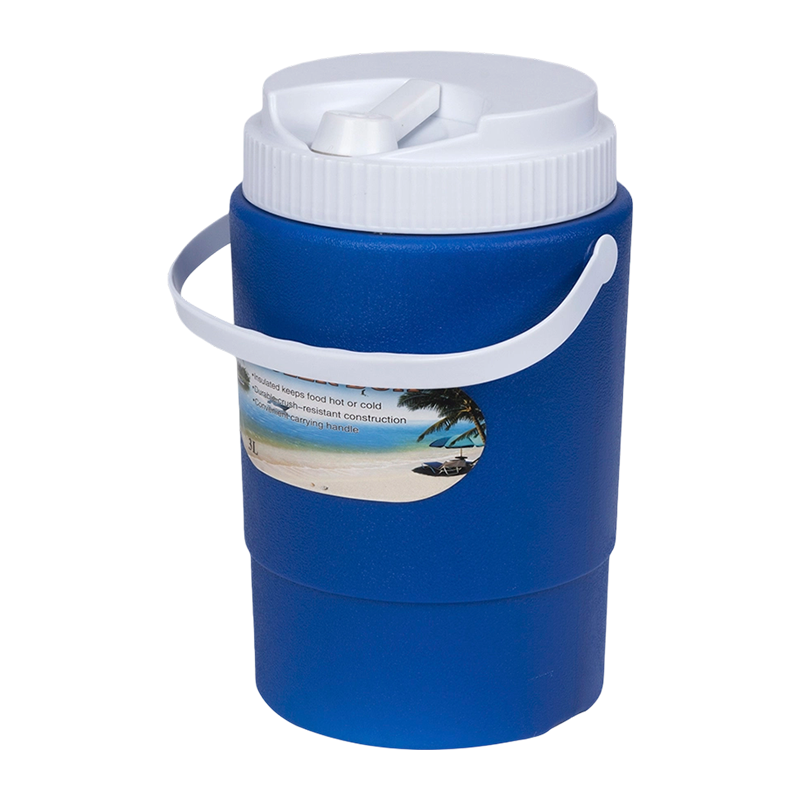
3L PU Insulation COOLER JUG with Sealing Cover
Food-Grade PP Inner Container
The inner container is made from food-grade PP. Polypropylene is widely used in food and beverage applications because it is lightweight, chemically resistant, and suitable for molded product structures. The material choice supports a clean interior surface and helps the product meet the practical requirements of repeated outdoor use.
The product description specifies that the inner container has no odor and does not contain BPA. These characteristics are important for buyers supplying drinking-water products, sports equipment, travel goods, and family-oriented outdoor accessories. A neutral-smelling inner container helps preserve the intended taste and drinking experience, while BPA-free construction is a key purchasing consideration in many markets.
Material selection also affects product durability. A cooler jug used outdoors may be exposed to handling, transportation, repeated filling, cleaning, and contact with equipment. PP provides a useful balance between rigidity and low weight. It can be formed into a large opening, internal container, drinking components, and other detailed structures while maintaining a practical production cost.
PE and PU contribute to the broader product construction. PE can be used in components requiring toughness and flexibility, while PU creates the insulation layer between the inner container and outer structure. The combination of these materials is intended to provide a stable, lightweight, and functional cooler jug rather than relying on a single material for every performance requirement.
Large Opening for Ice, Refilling, and Cleaning
The diameter of a cooler jug affects its daily usability. A narrow opening may reduce the ease of pouring or filling, but it can make adding ice difficult and make the interior challenging to clean. This model uses a large-diameter opening that allows users to add ice cubes more conveniently and reach into the container during cleaning.
For outdoor users, the ability to add ice quickly is valuable. Ice can be added before a sports match, a picnic, a camping trip, or a work shift. The large opening also helps users refill the container from different water sources or larger dispensers without excessive splashing.
Cleaning access is equally important. Outdoor water containers may be used with water, ice, sports drinks, flavored beverages, or other liquids. A hand-accessible opening makes it easier to rinse the interior, remove residue, inspect the bottom, and maintain hygienic use. Buyers should always follow appropriate cleaning instructions for the final application, including the recommended water temperature, detergent type, and drying method.
For commercial buyers, this design feature can also support customer satisfaction. A product that is easy to clean is more likely to be used repeatedly and maintained properly. It may also reduce complaints related to odor, residue, or difficulty reaching internal surfaces.
Rotating Sealing Cover and Leakage Control
Leakage is one of the most common problems associated with portable water containers. A lid that is difficult to close, lacks a proper seal, or becomes loose during movement can create inconvenience and damage nearby belongings. The 3L cooler jug addresses this concern with a rotating sealing cover and a sealing ring.
The rotating closure allows the user to secure the lid through a controlled twisting action. Once properly closed, the sealing ring helps create contact between the lid and the container opening. This design is intended to reduce leakage when the jug is tilted or transported at different angles.
The sealing cover also helps protect the liquid inside from dust and environmental exposure. This is useful at outdoor events, on construction or maintenance sites, during camping trips, and when the container is transported in a vehicle. A secure cover can help preserve the product’s cleanliness between drinking occasions.
Proper use remains important. Users should ensure that the lid is fully rotated into its closed position and that the sealing ring is correctly seated. The sealing components should be checked periodically for dirt, damage, or deformation. For wholesale customers, clear use and care instructions can be included in packaging or customized product documentation.
Independent Drinking Port for Convenient Hydration
Removing a large cover every time someone wants a drink is inconvenient, especially when the jug is shared among several users or placed in an active environment. The independent drinking port provides a more direct way to access the beverage. The straw-style water outlet allows users to drink without opening the main cover.
This feature is useful during sports training, outdoor work, cycling support, family trips, and group activities. Users can hold or place the jug while drinking from the outlet, reducing the need to lift and tilt the entire container. It may also help reduce exposure of the main opening to dust and air.
Direct drinking can support temperature retention because the main cover remains closed more often. Every time a large lid is removed, warm air can enter and cold air can escape. By using a separate outlet, the container can preserve its internal temperature more effectively during normal drinking routines.
The drinking port also gives buyers another opportunity for product differentiation. Depending on market requirements, customers may evaluate outlet shape, straw compatibility, color, packaging, instructions, or additional accessories. Customization options should be confirmed during product development, since changes to the drinking system can affect tooling, assembly, sealing, and testing.
Lightweight Handle for Outdoor Mobility
A filled 3-liter jug can weigh more than 3 kilograms, so a comfortable carrying method is essential. The integrated handle allows users to move the container from a vehicle to a campsite, from a storage area to a sports field, or from a work station to a break area.
The handle also supports organized transportation for distributors, event organizers, outdoor retailers, and institutional users. A handle can make it easier to place the jug in a cooler box, carry it with other equipment, or hang it temporarily in a convenient location. Its design must balance strength, comfort, and connection to the main body, which is why handle integration is an important part of product engineering.
Compared with carrying a heavy metal beverage container, the lightweight body can help reduce fatigue during repeated movement. This advantage is particularly relevant when several containers are used at an event or when the jug must be carried over uneven ground.
Applications Across Outdoor and Commercial Markets
Sports and Fitness Activities
Sports teams, training centers, gyms, coaches, and event organizers require accessible hydration for participants. A 3-liter cooler jug provides a shared supply of chilled water or sports beverages without the need to carry numerous small bottles. The direct drinking port allows convenient access during breaks, while the insulation layer helps the beverage remain cooler during extended sessions.
The product can be used at football fields, basketball courts, running events, cycling stations, tennis clubs, school activities, and recreational competitions. Buyers may choose custom colors or printed logos to coordinate the jug with team uniforms, event branding, or sponsor campaigns, subject to production feasibility.
Camping and Hiking Support
Camping requires products that are portable, durable, and easy to maintain. The cooler jug can serve as a central water container at a campsite, picnic area, or outdoor shelter. Its 3-liter capacity is large enough for shared use while remaining easier to transport than a much larger beverage dispenser.
The large opening is useful for adding ice and cleaning after use. The sealing cover helps reduce the possibility of leakage inside a vehicle or backpack compartment, although the product should be transported upright and protected from excessive impact. For hiking, suitability depends on the user’s carrying system and total load, since a full 3-liter container is naturally heavy even when the empty product is lightweight.
Picnics and Family Outings
Families and small groups can use the cooler jug to provide chilled water or beverages during picnics, beach visits, road trips, and outdoor gatherings. The independent drinking port helps children and adults access the beverage without repeatedly removing the main cover. The handle supports movement between the vehicle, picnic area, and storage location.
The neutral-smelling, BPA-free inner container is also relevant for family-oriented products. Retailers can position the cooler jug as a practical alternative to disposable beverage packaging, particularly for consumers who prefer reusable outdoor containers.
Outdoor Work and Service Operations
Workers in construction, landscaping, agriculture, transportation, maintenance, and field services often need accessible drinking water during the working day. A cooler jug can be placed at a work site, in a service vehicle, or in a break area. The insulation layer helps provide cooler water, and the larger capacity reduces the frequency of refilling.
For business buyers, durability, ease of cleaning, and simple transport are often more important than decorative features. The product’s PP, PE, and PU construction, integrated handle, sealing cover, and independent outlet address these practical requirements.
Promotional and Event Merchandise
Outdoor water containers can be used as promotional gifts for sporting events, travel campaigns, corporate activities, and seasonal marketing programs. The size of the cooler jug provides enough surface area for potential logo or color customization, while its practical usefulness can encourage repeated exposure to the printed identity.
For promotional orders, buyers should discuss artwork format, printing method, color matching, packaging, carton quantity, sample approval, and production lead time in advance. The final customization plan should be evaluated alongside product safety, durability, and cleaning requirements.
Advantages Over Conventional Outdoor Water Containers
The 3L PU Insulated Cooler Jug offers several advantages when compared with basic plastic water containers. A conventional single-wall container may be inexpensive and light, but it generally provides limited insulation. The PU layer in this cooler jug is intended to slow temperature change and support longer-lasting cool conditions.
Compared with large metal containers, the product can offer a lower empty weight and a more manageable handling experience. Metal may provide a strong and premium appearance, but it can increase carrying weight, production cost, and shipping weight. The PP, PE, and PU structure allows the cooler jug to maintain a practical balance between insulation, capacity, and portability.
Compared with narrow-neck bottles, the large opening improves access for ice filling and manual cleaning. It also provides a more suitable structure for group hydration rather than individual drinking only.
Compared with containers that use only a removable top, the independent drinking port offers quicker access and can help limit the loss of cold air. Users do not need to remove the complete cover each time they drink.
Compared with basic screw-top products without a sealing ring, the rotating sealing cover is designed to improve closure security and reduce leakage risk. A proper seal is particularly important for transport, outdoor movement, and vehicle storage.
| Comparison Point | Basic Single-Wall Plastic Container | 3L PU Insulated Cooler Jug |
|---|---|---|
| Temperature protection | Limited insulation | PU insulation layer designed to slow temperature change |
| Capacity suitability | Often designed for individual use | 3L capacity suitable for individuals or small groups |
| Ice filling | May be restricted by a narrow opening | Large opening makes adding ice easier |
| Cleaning access | May be difficult in narrow designs | Large diameter supports easier hand cleaning |
| Drinking convenience | Usually requires opening or pouring | Independent straw-style drinking outlet |
| Leakage control | Depends on basic cap design | Rotating sealing cover with sealing ring |
| Portability | Usually light but may lack a handle | Lightweight body with integrated carrying handle |
| Material structure | Often single-material construction | PP, PE, and PU multi-material structure |
Manufacturing Strengths and Production Capabilities
A successful cooler jug program requires more than a functional product concept. It requires stable tooling, controlled material processing, accurate assembly, consistent sealing, and dependable quality inspection. Ningbo Junlong Outdoor Products Co., Ltd. integrates product development, production, and sales within its own manufacturing operation.
The company was founded in 2000 and is located in Cixi, Ningbo, Zhejiang Province, an important manufacturing region in the Yangtze River Delta. Its independent factory covers approximately 12,000 square meters and employs more than 100 people. This scale provides a foundation for production coordination, engineering support, order management, and quality control.
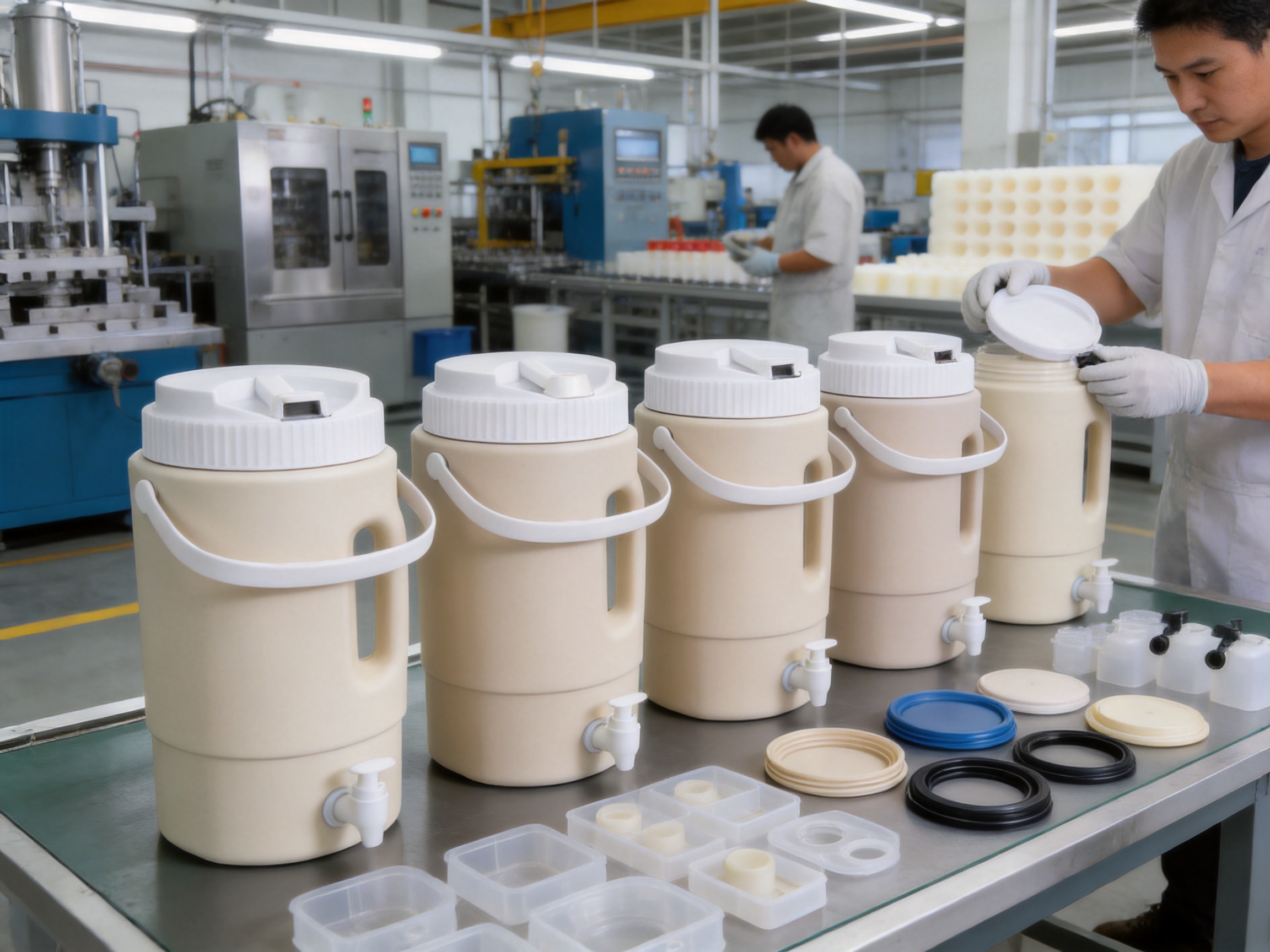
The factory includes automatic injection molding machines, blow molding machines, and foaming equipment. These capabilities are relevant to cooler jugs because the product requires multiple manufacturing processes. Plastic parts may be formed through injection molding, hollow or container structures may use blow molding techniques, and the PU insulation layer requires foaming equipment and process control.
In-house production capabilities can improve communication between design, tooling, manufacturing, and quality teams. When a customer requests a change to color, logo placement, handle configuration, packaging, or component details, an integrated factory can evaluate the effect across the complete production process more efficiently than a company relying entirely on external suppliers.
Automatic Injection Molding
Injection molding is suitable for producing repeatable plastic components with defined dimensions and detailed features. For the cooler jug, this type of process may be used for components such as covers, handles, drinking parts, sealsupport structures, and other molded elements, depending on the final design.
Automatic equipment supports production consistency by controlling important parameters such as material feeding, temperature, pressure, filling, cooling, and cycle time. Stable molding conditions help reduce variation between units and support efficient large-volume production.
For wholesale orders, repeatability is essential. Retailers and distributors expect units within the same order to have consistent color, fit, closure performance, appearance, and dimensions. Process control at the molding stage contributes to this consistency.
Blow Molding Capability
Blow molding is commonly used to create hollow plastic structures. Its application depends on the specific component design, but the capability is valuable for outdoor water containers and related products. Proper control of material distribution, wall thickness, cooling, and trimming helps create a stable container body.
Blow molding expertise also supports product development beyond the current 3-liter model. Customers may require different capacities, body shapes, or container formats for regional markets. A factory with relevant equipment and technical experience can evaluate these requirements as part of an OEM or ODM project.
Foaming Equipment for Insulation
The insulation layer is central to the performance of a cooler jug. Foaming equipment is used to support the formation of the PU insulation structure between relevant product layers. Process control is important because insulation performance can be affected by foam distribution, density, bonding, curing, and the completeness of the insulated area.
A stable foaming process helps the manufacturer pursue consistent insulation results across production batches. It also supports the structural connection between the inner container and outer body. Engineering review is required when changing dimensions, materials, wall structures, or capacity because modifications can influence foam flow and insulation behavior.
Product Development and R&D Support
The company has a creative R&D team focused on developing outdoor cooling and water storage products. Product development may begin with an internal concept, customer drawing, reference sample, or market requirement. The team can review product appearance, usability, material selection, mold construction, production feasibility, and assembly requirements.
For customers seeking OEM or ODM services, development support can reduce the distance between an idea and a manufacturable product. A drawing or sample may be used as a starting point, followed by technical evaluation, prototype development, mold preparation, sample approval, and mass production.
Development should consider the complete user experience. A cooler jug is not defined only by its capacity. Opening size, lid rotation, sealing ring position, handle strength, drinking outlet, cleaning access, insulation structure, surface appearance, packaging, and shipping protection all influence the final product.
Quality Management for Wholesale Orders
Quality management is essential when supplying cooler jugs to distributors, retailers, brands, event organizers, or institutional buyers. A product may look attractive in a sample but fail to meet expectations if production units vary in dimensions, color, sealing, insulation structure, or assembly quality.
A rigorous quality system should cover incoming materials, molding conditions, component inspection, assembly, appearance, sealing, packaging, and shipment preparation. Depending on the customer’s specification, inspection may include dimensional checks, visual inspection, closure tests, leakage checks, drinking-port function, handle evaluation, and insulation-related verification.
Material control is also important. The specified PP, PE, and PU materials should be managed according to the approved product requirements. For drinking-water applications, buyers may request relevant material documentation or testing according to the target market and applicable regulations.
Production samples and pre-production approvals help establish a clear standard before mass manufacturing begins. Customers should confirm the approved color, logo, packaging, accessories, carton marks, and product details before production. This reduces ambiguity and helps both parties evaluate final goods against the same reference.
Packaging quality protects the cooler jug during storage and transport. The handle, cover, drinking port, and outer surface should be protected from impact, compression, and scratching. Carton design, inner separators, polybags, labels, and palletization can be adapted according to the order quantity and logistics requirements.
OEM, ODM, and Custom Manufacturing Services
The product is suitable for customers that want to sell under their own brand or develop a customized outdoor hydration program. OEM production can include logo printing, color selection, packaging design, carton labeling, and other approved modifications. ODM services can extend to product development based on drawings, samples, performance targets, or market positioning.
Color customization allows buyers to match the cooler jug with a brand identity, sports team, retailer assortment, or promotional campaign. Logo customization can increase product recognition and create a more distinctive retail presentation. Packaging customization may include instruction sheets, barcode labels, retail boxes, color cartons, master-carton marks, and multilingual information.
Customization should be planned carefully because every change can affect cost, tooling, production time, testing, or minimum order quantity. For example, a new body shape may require a new mold, while a new drinking-port design may require additional sealing tests. A custom color may require material matching and sample approval before mass production.
Customers should provide as much information as possible during the inquiry stage. Useful details include target market, expected order quantity, preferred capacity, intended beverage type, color requirements, logo artwork, packaging format, delivery destination, required certifications, and expected delivery schedule.
Wholesale Purchasing Considerations
When evaluating a 3L cooler jug for wholesale, buyers should consider more than the unit price. Product performance, material quality, customization flexibility, production capacity, quality management, packaging, lead time, and after-sales communication all affect the total purchasing result.
Capacity should match the target consumer. A 3-liter jug is suitable for shared use and longer outdoor activities, but it may be too large for customers who want a personal bottle. Product positioning should therefore emphasize group hydration, sports support, family outings, work-site use, and outdoor convenience.
The market positioning should also reflect the product’s key advantages. These include PU insulation, a lightweight body, a large opening, a sealing cover, an independent drinking outlet, an integrated handle, and food-grade BPA-free PP inner construction. Clear communication of these features can help retailers distinguish the product from ordinary plastic water containers.
Buyers should also assess the supplier’s ability to support repeat orders. A successful product launch may lead to seasonal replenishment or expansion into different colors and related outdoor cooling products. Factory experience, equipment, workforce, and quality systems all influence whether a supplier can support long-term cooperation.
Care and Use Guidance
Before first use, the cooler jug should be washed according to the supplier’s instructions. The main cover, drinking port, sealing ring, and inner container should be checked to ensure that all parts are correctly assembled. The product should be filled within its stated capacity and should not be overfilled in a way that prevents the cover from closing properly.
To maximize cooling performance, users can pre-chill the container or add cold water and ice before use. The jug should be kept closed whenever possible. Frequent opening, direct sunlight, high ambient temperatures, and warm beverages can reduce the time that the contents remain cool.
After use, the container should be emptied, rinsed, and cleaned with a suitable mild detergent. The large opening allows easier access to the interior. The cover and drinking outlet should also be cleaned because beverage residue may collect around seals or openings. Components should be dried thoroughly before storage to help reduce odor and moisture buildup.
Users should inspect the sealing ring and drinking port regularly. If a component becomes damaged, deformed, or difficult to close, it should be replaced or serviced according to the supplier’s instructions. The container should not be exposed to inappropriate heat sources or used with liquids outside the approved application range.
Sustainability and Reusable Hydration
A reusable cooler jug can support efforts to reduce reliance on disposable beverage containers. A 3-liter capacity allows one container to serve multiple users or provide hydration over an extended activity. Repeated use can make the product a practical choice for sports facilities, families, work crews, and outdoor event organizers.
The lightweight construction may also reduce the material and energy burden associated with transporting a heavier container, although complete environmental evaluation depends on the full product life cycle, including raw materials, manufacturing, packaging, transportation, use, and end-of-life handling.
Durability and care are central to reuse. A product that remains functional, cleanable, and easy to transport is more likely to be used for a longer period. For this reason, the large opening, sealing cover, integrated handle, and replaceable or inspectable sealing components all contribute to the practical value of the design.
Recommended Product Positioning
Retailers can position the cooler jug as a premium yet practical outdoor hydration solution. Its main selling message can combine temperature retention, portable capacity, easy cleaning, direct drinking, leakage control, and lightweight handling.
For sports and fitness channels, the focus can be on shared hydration, sideline convenience, and direct drinking access. For camping and travel channels, the emphasis can be on insulation, large capacity, ice filling, and portability. For work-site and industrial supply channels, buyers may prioritize durability, handle design, sealing, and ease of cleaning.
For promotional merchandise, the product can be presented as a useful branded item rather than a disposable gift. A customized cooler jug may provide repeated exposure during outdoor activities, sports events, family trips, and workplace use.
For distributors, the product fits within a broader outdoor cooling and water storage range. It can be sold alongside cooler boxes, ice buckets, outdoor water containers, and related accessories. This allows buyers to develop a complete product category instead of relying on a single item.
Q&A
What is the capacity of the cooler jug?
The cooler jug has a capacity of 3 liters. This makes it suitable for individual extended use or shared hydration during sports, camping, travel, family outings, outdoor work, and group events.
What materials are used in the product?
The product uses PP, PE, and PU. The inner container is made from food-grade PP, while the PU layer provides insulation. These materials are combined to create a lightweight and functional outdoor water container.
Is the inner container BPA-free?
According to the product specifications, the food-grade PP inner container does not contain BPA and is designed to have no odor.
How long can the jug keep beverages cool?
The stated body insulation time is up to 36 hours. Actual performance depends on factors such as the starting temperature, ice quantity, ambient conditions, sunlight exposure, frequency of opening, and beverage type.
Can users add ice cubes easily?
Yes. The cooler jug has a large-diameter opening designed to make adding ice cubes more convenient than using a narrow-neck container.
Is the cooler jug easy to clean?
The large opening allows users to reach the interior more easily for hand cleaning. The cover, sealing ring, and drinking outlet should also be cleaned and dried according to appropriate care instructions.
Does the cover help prevent leakage?
The rotating sealing cover includes a sealing ring and is designed to reduce leakage when the jug is properly closed and transported. Users should ensure that the cover is fully rotated into position and that the sealing ring is clean and correctly seated.
How can users drink from the jug?
The cooler jug has an independent drinking port with a straw-style water outlet. This allows direct drinking without removing the main cover.
Does the product have a carrying handle?
Yes. The jug includes an integrated handle for easier carrying during outdoor activities, sports events, travel, work, and family outings.
What is the approximate weight?
The product weighs approximately 470 grams, or about 0.5 kilograms, when empty. The final carrying weight naturally increases when the jug is filled with water or another beverage.
What are the approximate dimensions?
The listed dimensions are approximately Φ167 × 270 mm.
Can the cooler jug be customized?
OEM and ODM customization services are available. Potential options include product development based on drawings or samples, colors, logos, packaging, and other approved specifications. The final options depend on technical feasibility, order quantity, tooling, and production requirements.
What manufacturing equipment supports production?
The factory operates automatic injection molding machines, blow molding machines, and foaming equipment. These capabilities support the production of molded plastic components, container structures, and PU insulation systems.
Who is the product suitable for?
The product is suitable for outdoor retailers, sports equipment distributors, camping and travel suppliers, promotional product companies, work-site purchasing departments, event organizers, and brands seeking customized cooler jugs.
What information should a wholesale buyer provide?
A buyer should provide the target market, estimated order quantity, desired color, logo artwork, packaging requirements, delivery destination, required documentation, and any specific performance or compliance expectations.
Conclusion
The 3L PU Insulated Cooler Jug with Sealing Cover combines practical capacity, lightweight portability, temperature protection, leakage control, and convenient drinking access. Its food-grade BPA-free PP inner container, PU insulation layer, large opening, rotating sealing cover, sealing ring, independent drinking port, and integrated handle address the everyday requirements of outdoor hydration.
Its advantages over basic containers include improved insulation, easier ice filling, better cleaning access, more convenient direct drinking, and a stronger capacity-to-weight balance than many heavier metal alternatives. These features make it suitable for sports, camping, travel, picnics, outdoor work, family activities, and promotional programs.
For wholesale customers, the product is supported by a manufacturer with long-term experience in outdoor cooling and water storage products, an independent 12,000-square-meter factory, more than 100 employees, automatic injection molding equipment, blow molding machines, foaming equipment, product development capabilities, and a structured quality management approach.
With OEM and ODM support, the cooler jug can be adapted for different brands, markets, colors, packaging formats, and customer requirements. By combining useful product engineering with integrated manufacturing capabilities, it offers a dependable foundation for distributors, retailers, outdoor brands, and organizations seeking a practical 3-liter insulated water container.
References
1. Product specification sheet for 3L PU Insulation Cooler Jug with Sealing Cover, including dimensions, materials, volume, weight, and feature information.
2. Manufacturer-provided company profile for Ningbo Junlong Outdoor Products Co., Ltd., including factory history, production area, workforce, equipment, and product development capabilities.
3. General technical information on polypropylene, polyethylene, and polyurethane materials used in molded outdoor water storage products.
4. General product-development principles for reusable outdoor hydration containers, including insulation, sealing, ergonomic handling, cleaning access, and drinking-port design.
5. General quality-management considerations for OEM and ODM plastic consumer product manufacturing, including material control, molding consistency, assembly inspection, packaging, and shipment preparation.
Product: 3L PU Insulation COOLER JUG with Sealing Cover

Product Recommendation
link
Office
- TEL: +86-574-63787606
- Phone: +86-13777994798
- E-mail: sales@nbjunlong.com
- WhatsApp: 13777967488
- Address: No. 1, Lane 3, Development Road, Longtouchang, Longshan Town, Cixi City, Zhejiang Province, China
Get In Touch
Copyright © Ningbo Junlong Outdoor Products Co., Ltd. All Rights Reserved.
China Plastic Insulated Cooler Box Manufacturer Custom Cooler Box Supplier
