- SMALL ORDERS FOR STANDARD ITEMS. Contact Now
- OUTDOOR COOLING SOLUTIONS, MADE IN‑HOUSE. Contact Now
- COOLER BOXES THAT FIT REAL OUTDOOR LIFE. Contact Now

 LANGUAGE
 日本語
 Español
 عربى

Content
- 1 Product Overview
- 2 Designed for Large Outdoor Activities
- 3 Advantages of the 28-Liter Capacity
- 4 Multi-Layer Construction for Thermal Retention
- 5 Wheeled Mobility and Telescoping Handle
- 6 Practical Lid Design
- 7 Comparison with Other Cooler Solutions
- 8 Applications Across Different Outdoor Scenarios
- 9 Manufacturing Strengths of Ningbo Junlong Outdoor Products Co., Ltd.
- 10 Quality Management and Production Consistency
- 11 OEM and ODM Customization Options
- 12 Selection Guidance for Importers and Distributors
- 13 Using the Cooler for Better Performance
- 14 Why the Product Is a Strong Market Option
- 15 Frequently Asked Questions
- 15.1 What is the capacity of this cooler box?
- 15.2 What are the external and internal dimensions?
- 15.3 What materials are used in the cooler?
- 15.4 How long can the cooler retain temperature?
- 15.5 Does the cooler have wheels?
- 15.6 Can the cooler be lifted as well as pulled?
- 15.7 Is the cooler suitable for camping?
- 15.8 Can it be used for fishing?
- 15.9 Does the lid have any additional features?
- 15.10 Can the cooler be customized?
- 15.11 Does the manufacturer provide OEM and ODM services?
- 15.12 What manufacturing equipment does the company operate?
- 15.13 What should buyers confirm before placing an order?
- 16 Conclusion
- 17 References
- 18 Product: 28L Wheeled Insulated Cooler Box for Large Outdoor Activities
Outdoor trips become much easier when food, drinks, and temperature-sensitive provisions can be transported in one dependable container. The 28L Wheeled Insulated Cooler Box is designed for exactly this purpose. Combining generous capacity, durable construction, polyurethane insulation, a telescoping transport system, and heavy-duty wheels, it provides a practical solution for families, outdoor groups, retailers, hospitality businesses, and organizations seeking a reliable cooler for demanding use.
Unlike a basic soft cooler or a small portable ice chest, this wheeled cooler box is engineered for longer outings and larger loads. Its 28-liter interior offers sufficient space for bottles, cans, packed meals, fresh ingredients, ice, and other provisions. At the same time, the integrated wheels and telescoping handle reduce the effort required to move a fully loaded cooler across campsites, beaches, parking areas, picnic grounds, and travel locations.
The product is manufactured by Ningbo Junlong Outdoor Products Co., Ltd., a Chinese outdoor product manufacturer specializing in cooler boxes, insulated cooler jugs, ice buckets, and outdoor water containers. With an independent 12,000-square-meter factory, more than 100 employees, injection molding, blow molding, and foaming equipment, the company combines product development, manufacturing, quality management, and sales support in one organization.
This article examines the product’s specifications, construction, insulation performance, mobility, applications, customization potential, and manufacturing advantages. It also explains why the 28L format is well suited to large outdoor activities and how it compares with simpler cooler solutions.
Product Overview
The 28L Wheeled Insulated Cooler Box is a medium-capacity hard cooler intended for outdoor activities, family travel, group recreation, and commercial or promotional programs. The product belongs to the medium cooler box category, covering capacities from approximately 15 liters to 38 liters. This category offers a useful balance between portability and storage volume.
A cooler that is too small may be easy to carry but quickly becomes impractical for several people. A cooler that is much larger may provide additional capacity but can become difficult to transport, especially when filled with ice and beverages. The 28-liter capacity occupies a practical middle position. It is large enough for group requirements while remaining compact enough for vehicle storage and general outdoor handling.
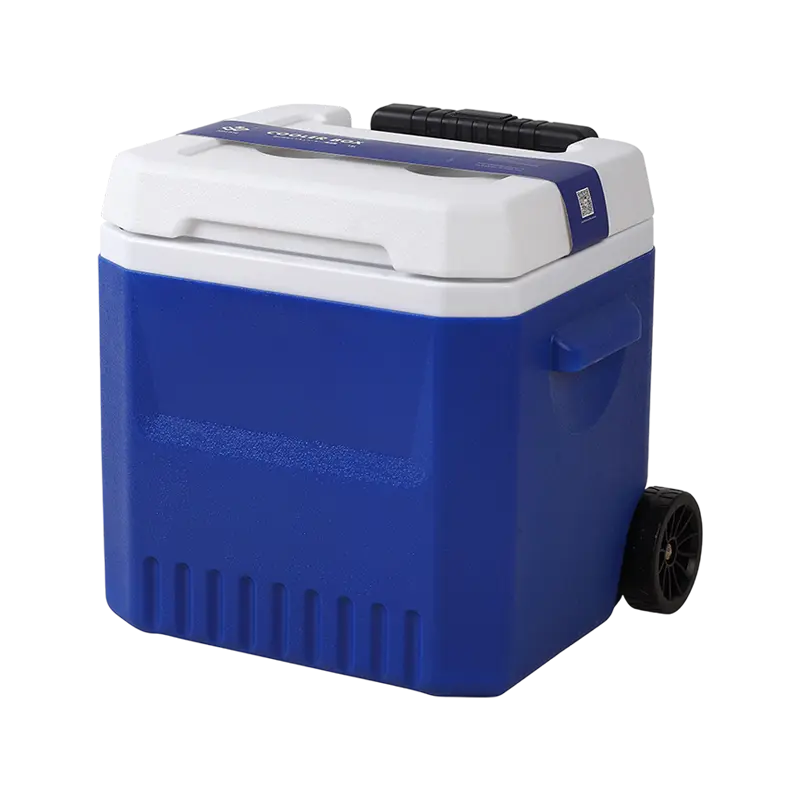
The outer dimensions are 430 millimeters by 340 millimeters by 425 millimeters. The inner dimensions are 370 millimeters by 250 millimeters by 340 millimeters. These dimensions provide a usable internal cavity while retaining a sturdy insulated wall structure. The unit weight is approximately 4,000 grams before contents are added.
The main material combination consists of a PP inner lining, a PE outer shell, and a PU insulation layer. Each material serves a different role. Polypropylene provides a practical interior surface for holding food, beverages, ice, or containers. Polyethylene contributes impact resistance and structural protection on the exterior. Polyurethane foam helps slow heat transfer between the internal contents and the surrounding environment.
| Specification | Details |
|---|---|
| Product type | Wheeled insulated cooler box |
| Capacity | 28 liters |
| Category | Medium cooler box, approximately 15L–38L |
| Inner material | PP, or polypropylene |
| Outer material | PE, or polyethylene |
| Insulation material | PU, or polyurethane |
| Unit weight | Approximately 4,000 grams |
| Outer dimensions | 430 mm × 340 mm × 425 mm |
| Inner dimensions | 370 mm × 250 mm × 340 mm |
| Mobility features | Telescoping handle and wheels |
| Lid features | Secure-fitting lid and cup-hole design |
| Insulation statement | Vacuum lid and body PU insulation, with insulation time stated as up to 48 hours under suitable conditions |
| Customization | OEM and ODM support, including color, logo, packaging, drawings, and samples |
Actual cooling duration depends on the starting temperature of the contents, the quantity and type of ice, how often the lid is opened, ambient temperature, direct sunlight, and loading arrangement. The stated insulation time of up to 48 hours should therefore be understood as a product performance reference under appropriate conditions rather than a guarantee for every environment.
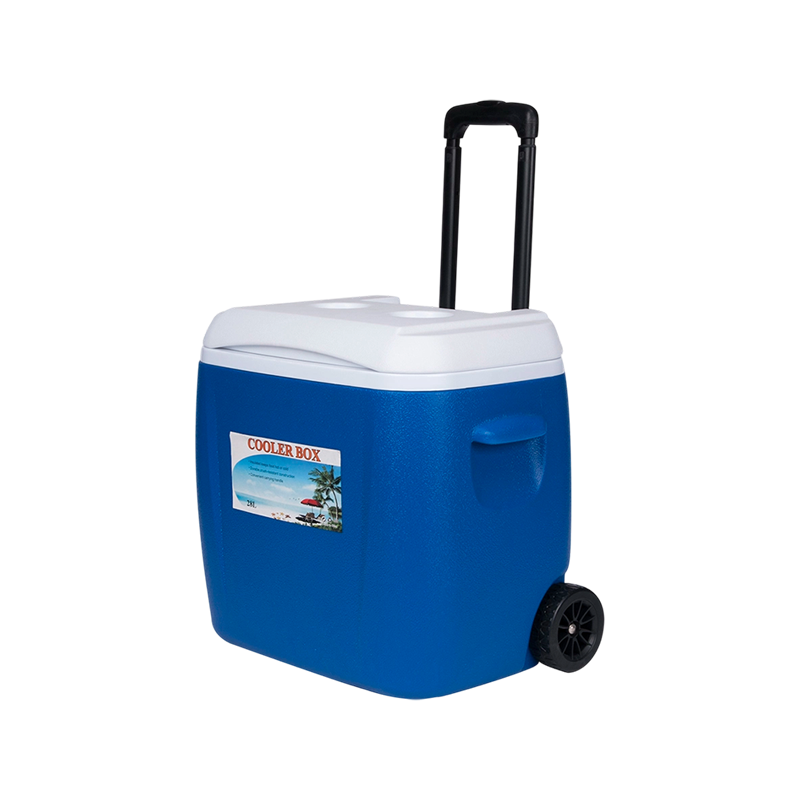
28L Wheeled Insulated Cooler Box for Large Outdoor Activities
Designed for Large Outdoor Activities
Outdoor activities often involve more people, longer distances, and more supplies than ordinary daily use. A compact lunch bag may be sufficient for one person, but it is not always suitable for a family road trip, a fishing excursion, a beach day, or a group picnic. The 28L cooler box is designed to support these broader requirements.
Its internal dimensions provide room for a combination of containers instead of requiring users to carry several separate small bags. Bottles can be arranged vertically, while cans, food boxes, fruit, sandwiches, and ice packs can occupy the surrounding space. The deep internal cavity is also useful for keeping larger drink bottles upright and reducing the risk of spills during transport.
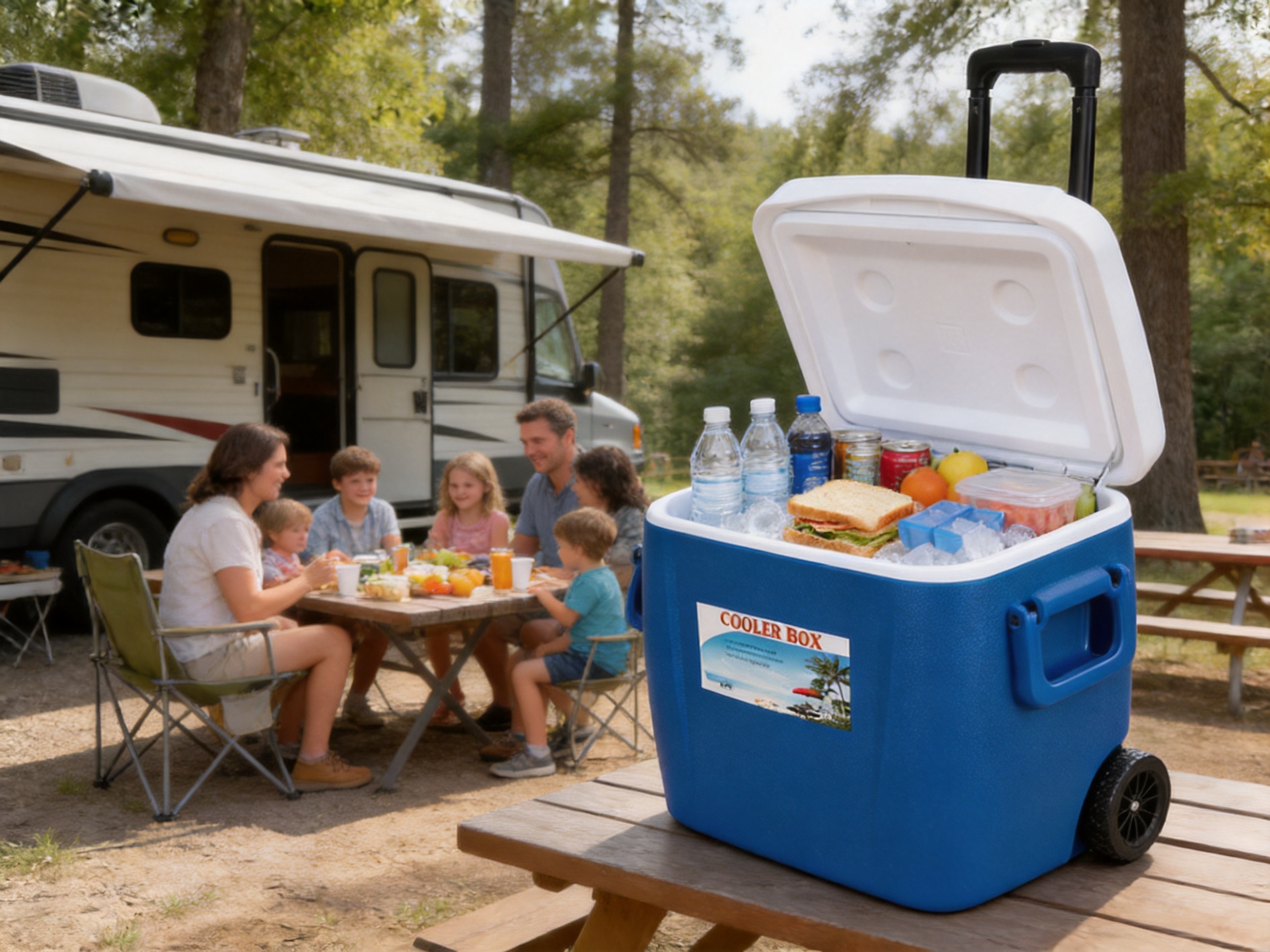
For camping, the cooler can be used to store chilled beverages, fresh meat, prepared meals, dairy products, fruit, sauces, and ingredients for outdoor cooking. At a beach, it can protect drinks and snacks from heat and sand while serving as a convenient central storage unit for the whole group. During a road trip, it can reduce the need to stop frequently for refreshments.
At tailgate parties and sporting events, the cooler provides organized access to cold drinks and food. During fishing activities, it can be used for beverages, bait, or selected catches, subject to applicable food safety and local handling requirements. For family picnics, the cooler can function as a shared food and drink station rather than a personal container.
The product is also useful for business events, promotional activities, outdoor catering, and temporary refreshment stations. Buyers can apply customized colors, logos, or packaging to align the cooler with a company, event, sports team, retailer, or hospitality program.
Advantages of the 28-Liter Capacity
Capacity is one of the most important factors when selecting a cooler. A product with insufficient space forces users to leave essential provisions behind or carry additional bags. A container with excessive capacity can become difficult to lift, store, or transport. The 28-liter format addresses this balance by providing practical group capacity without becoming an oversized commercial chest.
The internal space can be divided according to the user’s needs. For example, a family may place bottled water and soft drinks at the bottom, add a layer of ice, and then position sealed food containers above. A fishing group may allocate space for drinks and snacks while keeping certain items separated in waterproof bags. A catering user may organize ingredients by meal period or service sequence.
The rectangular structure helps make efficient use of storage space. Compared with irregularly shaped containers, a rectangular cooler is generally easier to arrange in a vehicle trunk, camping storage area, warehouse, or retail display. The defined external footprint also helps buyers plan packaging and shipping requirements.
The 28-liter size can be particularly attractive to retailers because it serves a broad customer base. It is not restricted to a single activity or seasonal use. Customers may purchase it for camping in summer, road travel during holidays, fishing throughout the year, sporting events, beach outings, or household emergency storage. This versatility can support a wider product range than a highly specialized cooler.
Multi-Layer Construction for Thermal Retention
PP Inner Lining
The inner structure is made from polypropylene, commonly referred to as PP. Polypropylene is widely used in storage and consumer products because it is lightweight, practical, and suitable for molded components. In a cooler box, the inner lining forms the primary contact surface for cold drinks, food packages, ice, and water from melting ice.
A molded PP interior can be designed with smooth surfaces that are easier to wipe and maintain than fabric-lined alternatives. It also provides a defined cavity that is less likely to collapse when loaded. This is important for users who need to pack the cooler efficiently and access items repeatedly during an outdoor activity.
Food and beverage users should still follow appropriate hygiene practices. The cooler should be cleaned after use, dried thoroughly, and packed with properly sealed food. Raw ingredients should be separated from ready-to-eat food, and temperature-sensitive products should be handled according to applicable food safety guidance.
PE Outer Shell
The outer shell uses polyethylene, or PE. The external shell protects the insulation and internal contents from everyday handling. Outdoor equipment may be exposed to vehicle loading, uneven ground, accidental impacts, contact with sand, and repeated movement. A tough molded exterior is therefore more suitable for these conditions than a thin flexible fabric body.
The PE shell also gives the cooler a firm shape. This allows the telescoping handle and wheel system to be integrated into a stable structure. It supports stacking and positioning inside vehicles while helping the product retain its form during regular use.
Hard-shell construction can offer advantages over soft coolers when users need protection for bottles, containers, or delicate food packages. The rigid body also makes the cooler easier to use as a central storage unit at a campsite or event, where it may be opened and closed many times.
PU Insulation Layer
The insulation layer is made from polyurethane, or PU. Its role is to slow the transfer of heat between the external environment and the contents inside the cooler. When the box is correctly loaded with pre-chilled food, drinks, and sufficient ice or cold packs, the insulation can help maintain a lower internal temperature for an extended period.
The product information specifies vacuum lid and body PU insulation, with insulation time stated as 48 hours. This configuration is intended to improve thermal retention in both the lid and the main body. Insulation performance is especially important during long-distance travel, overnight camping, and outdoor events where refrigeration is unavailable.
Users can improve performance by pre-cooling the cooler before loading it, using cold contents, minimizing empty air space, limiting the frequency of lid opening, and keeping the box out of direct sunlight whenever possible. These practical measures complement the built-in insulation and help reduce unnecessary heat gain.
Wheeled Mobility and Telescoping Handle
One of the product’s clearest advantages over many standard cooler boxes is its wheeled transport system. A loaded cooler can become substantially heavier than its empty weight. Ice, bottled drinks, food containers, and cookware can quickly create a load that is inconvenient to carry over long distances. Wheels transfer much of the load from the user’s arms to the ground, making transport more comfortable.
The telescoping handle provides a pulling point that can be adjusted for movement. This is useful in parking areas, campsites, promenades, beaches with suitable firm surfaces, and event venues. Users can pull the cooler behind them instead of repeatedly lifting it. Side handles remain useful when two people need to lift the unit into a vehicle or carry it across stairs and rough terrain.
The product information also identifies an iron rod and wheel construction. This combination is intended to provide a durable support system for regular outdoor handling. The wheels are especially valuable when the cooler is fully loaded, although users should select the route carefully because very soft sand, steep steps, and highly uneven ground may require lifting.
Compared with a traditional carry-only cooler, a wheeled design can reduce physical strain and improve accessibility. Compared with a large wheeled chest, the 28-liter size is easier to store and maneuver in ordinary vehicles. These features make the product attractive to families, older users, event staff, and anyone who expects to move refreshments over a moderate distance.
Practical Lid Design
The lid is a major part of a cooler’s usability because it controls access, helps retain internal temperature, and protects the contents during movement. This product includes a secure-fitting lid designed to close the main cavity and support thermal retention. A well-fitted lid also helps reduce the entry of dust and outdoor debris when the cooler is used in open environments.
The lid includes a cup-hole design. This detail provides a convenient place for cups or drink containers during picnics, tailgate events, and casual outdoor gatherings. It can help transform the cooler from a simple storage container into a more functional refreshment station.
A practical lid should be opened only when necessary during temperature-sensitive storage. Each opening allows warm air to enter and cold air to escape. Users can improve performance by organizing frequently used items near the top and less frequently used products deeper inside the cooler.
The lid and body combination also supports different activity styles. During a road trip, the lid can remain closed while the cooler is stored in the vehicle. At a picnic, it can be opened periodically for group access. At a campsite, it can remain in a shaded area and serve as a shared food and drink container.
Comparison with Other Cooler Solutions
The product’s advantages become clearer when compared with common alternatives. No cooler is ideal for every application, but different construction types serve different user priorities. The 28L wheeled model is positioned between compact personal coolers and much larger heavy-duty ice chests.
| Cooler type | Typical strengths | Possible limitations | Advantages of the 28L wheeled model |
|---|---|---|---|
| Soft cooler bag | Lightweight, foldable, and easy to store | Less rigid protection and limited load stability | Provides a firm shell, organized interior, and wheeled transport |
| Small personal cooler | Easy to carry for one person | Limited space for group outings | Offers greater capacity for family and group use |
| Basic hard cooler | Rigid construction and simple storage | May require lifting throughout the trip | Adds wheels and a telescoping handle for easier movement |
| Large commercial ice chest | Very high capacity | Can be bulky, heavy, and difficult to store | Provides a more manageable 28-liter format for general outdoor use |
| Disposable insulated box | Low initial cost and short-term convenience | Limited durability and repeated-use value | Designed as a reusable, structured outdoor product |
Compared with a soft cooler, the hard-shell body offers more protection and maintains its shape when loaded. Compared with a carry-only hard cooler, the wheels and telescoping handle provide improved transport convenience. Compared with a large chest cooler, the 28-liter format is easier to position in a car and more suitable for ordinary family outings.
These advantages are particularly relevant to buyers who value repeated use, mobility, storage organization, and a balance between capacity and portability. The product is not intended to replace every specialized high-capacity cooler, but it provides a versatile option for many common outdoor scenarios.
Applications Across Different Outdoor Scenarios
Camping and Outdoor Cooking
Camping requires careful management of food and beverages. A 28-liter insulated cooler can hold ingredients for simple meals, bottled water, fruit, dairy products, sauces, and prepared food. Its wheels make it easier to move from a vehicle to a campsite, while the hard shell protects contents from routine handling.
For best results, campers can divide the contents into sealed containers and use ice or cold packs around the products. The cooler should be placed on a stable surface, preferably in shade. Separate packaging is recommended for raw meat, seafood, and ready-to-eat foods. After the trip, the interior should be emptied, washed, and dried.
Beach Vacations
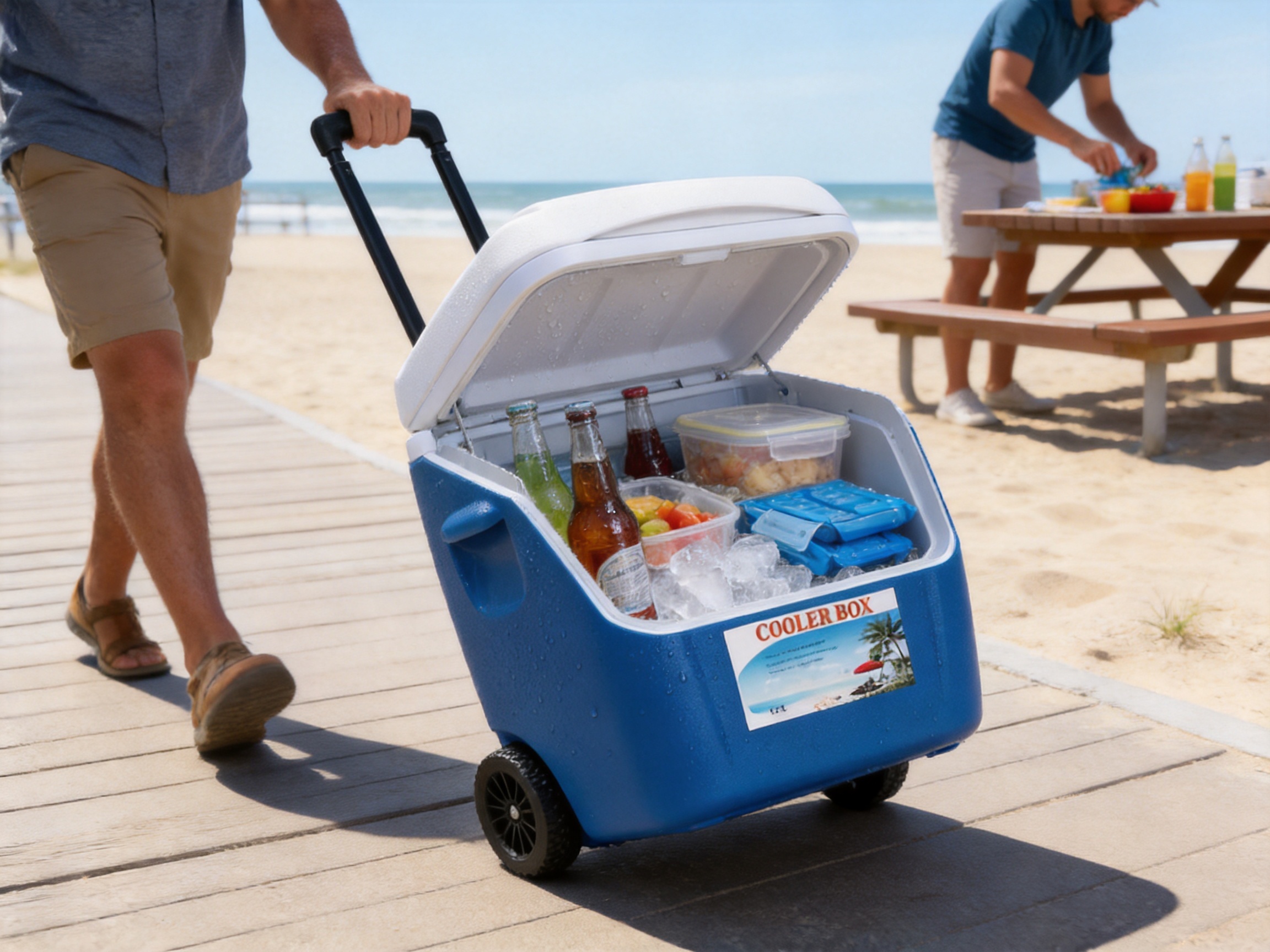
Beach users often need cold water, soft drinks, fruit, sandwiches, and snacks for several hours. Carrying these supplies by hand can be inconvenient, especially when the distance from the vehicle to the beach is significant. The wheeled design helps users transport the cooler with less effort on firm surfaces.
Although wheels may not perform equally well on deep loose sand, the product remains useful when moved across boardwalks, paved paths, compact sand, parking areas, and picnic zones. Keeping the lid closed and positioning the unit away from direct sunlight can help preserve cooling performance.
Fishing Trips
Fishing activities often involve long periods outdoors and limited access to refrigeration. The cooler can store drinks, packed meals, bait, and selected catches. The rigid body helps protect contents during transport, while the interior is easier to clean than many soft alternatives.
Users should consider local regulations and hygiene practices when storing fish or other perishable items. Seafood should be kept cold, separated from ready-to-eat foods, and removed from the cooler promptly after the activity.
Family Road Trips
Road trips are one of the most practical applications for this product. The cooler can be loaded before departure and positioned in a convenient part of the vehicle. Its dimensions are suitable for many car storage areas, although buyers should always measure their own vehicle before ordering in large quantities or planning a specific placement.
Cold beverages and prepared meals can reduce reliance on roadside purchases. The wheels also make the cooler easier to move between the vehicle, accommodation, picnic area, and event destination. The cup-hole design can provide additional convenience during roadside breaks.
Picnics and Tailgate Events
At a picnic or tailgate event, several people may access the same cooler throughout the day. The 28-liter capacity supports shared use, while the lid design and stable body make it suitable for placement near seating areas. The cooler can hold drinks, sandwiches, fruit, desserts, and ice packs in one organized location.
For promotional or team events, customized colors and logos can make the cooler part of the event presentation. It can be used as both a functional storage product and a visible branded item, provided that the customization is agreed upon during the OEM or ODM development process.
Manufacturing Strengths of Ningbo Junlong Outdoor Products Co., Ltd.
Ningbo Junlong Outdoor Products Co., Ltd. was founded in 2000 and is located in Cixi, Ningbo, Zhejiang Province, China. Cixi is part of the Yangtze River Delta manufacturing region, which provides access to industrial supply chains, transportation networks, tooling resources, and experienced production personnel.
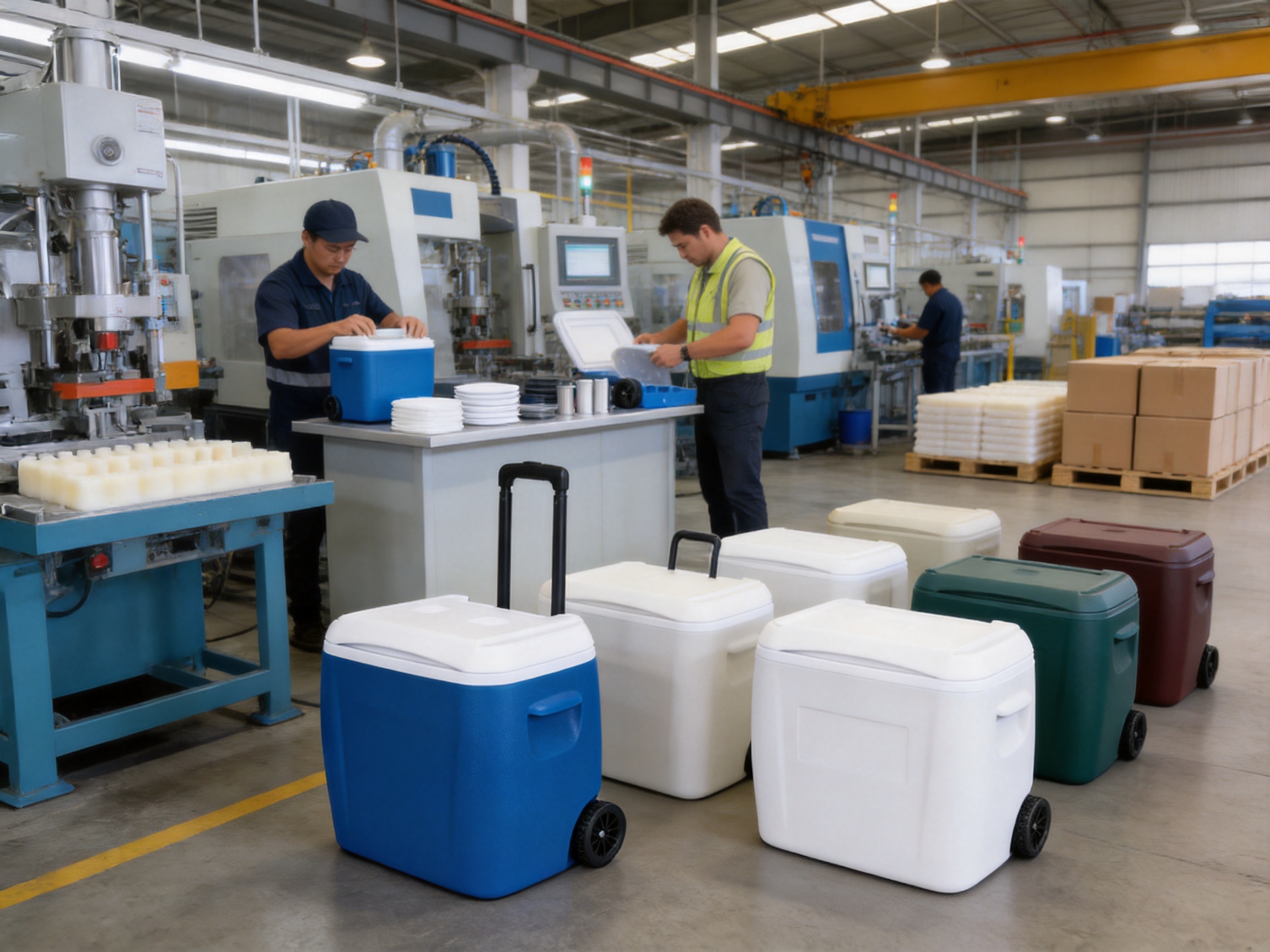
The company operates an independent factory covering 12,000 square meters and employs more than 100 people. Its business integrates product development, manufacturing, and sales. This integrated structure can help reduce communication gaps between design and production and allows customer requirements to be discussed directly with teams involved in manufacturing.
The factory includes automatic injection molding machines, blow molding machines, and foaming equipment. These production capabilities correspond closely with the materials and structures used in cooler boxes and outdoor water products.
Automatic Injection Molding
Injection molding is suitable for producing precise plastic components such as cooler bodies, inner liners, lids, handles, structural supports, and other molded parts. Automatic injection molding equipment can support repeatable production, consistent dimensions, and efficient output when tooling and process parameters are properly controlled.
For a cooler box, dimensional consistency matters because the body, lid, insulation area, handle fittings, and wheel assembly must work together. A stable molding process can help maintain the intended shape across production batches. It also supports the development of customized components for different customer programs.
Injection molding can be used with engineering decisions involving wall thickness, ribs, corners, fastening points, and surface details. These design elements affect strength, weight, assembly, and appearance. Junlong’s production capabilities allow the company to develop products based on customer drawings, samples, and practical requirements.
Blow Molding Capability
Blow molding is another important plastic manufacturing process, particularly for hollow products and certain outdoor containers. The company’s blow molding equipment supports its broader product portfolio, which includes outdoor water containers and related storage products.
The availability of more than one molding technology gives the manufacturer greater flexibility when evaluating new product structures. Different products may require different manufacturing methods depending on their shape, wall structure, volume, performance requirements, and target cost. A factory with several relevant processes can offer more practical development options to customers.
Foaming Equipment for Insulation
Foaming equipment is essential for products that use polyurethane insulation. The insulation layer must be formed between or within the structural components of the cooler. Consistent foaming helps support the thermal performance and physical integrity of the finished product.
Insulation manufacturing requires attention to material handling, mold preparation, filling, expansion, curing, and quality inspection. Process control is important because uneven insulation may reduce thermal retention or affect the fit between the inner and outer components. A manufacturer with dedicated foaming equipment is better positioned to manage this part of production internally.
Research and Development
Junlong maintains an R&D team that develops new products and supports customer requirements. Product development in the outdoor cooling sector involves more than changing color or adding a logo. It may include modifying capacity, handle structure, wheel configuration, lid details, insulation design, packaging, and internal organization.
The company states that it can develop products based on drawings or samples. This is valuable for buyers that already have a concept, an existing product reference, or a specific market requirement. The engineering process can help convert an early idea into a manufacturable design while considering materials, tooling, assembly, and production efficiency.
Quality Management and Production Consistency
Quality management is especially important for products intended for repeated outdoor use. A cooler must perform as a complete system, not merely as a collection of individual parts. The shell, insulation, lid, handle, wheels, fittings, and interior surfaces all contribute to user satisfaction.
A rigorous quality process may include inspection of incoming materials, monitoring of molding parameters, dimensional checks, visual inspection, assembly verification, and review of finished products. Specific inspection procedures should be agreed upon between the supplier and buyer according to the order, market, and applicable standards.
For OEM customers, consistency between samples and mass production is a major consideration. The color, logo position, packaging, dimensions, and functional components should match the approved specifications. Clear technical documentation and pre-production sample approval can help establish a reliable production reference.
Junlong’s integrated factory model enables communication between development, production, and sales teams. This can simplify the handling of design changes, packaging adjustments, and customer feedback. It also supports long-term product improvement rather than treating each order as an isolated transaction.
OEM and ODM Customization Options
The 28L cooler box can be used as a standard product or as a starting point for a customized program. OEM services are suitable for buyers that already have specifications, drawings, brand guidelines, or packaging requirements. ODM services are useful for customers that want assistance developing a product based on a market concept or application.
Available customization areas include product color, logo, packaging, and product development based on drawings or samples. The exact feasibility of each request depends on order volume, mold requirements, material availability, production scheduling, and technical review.
Color Customization
Color can influence product identity, retail presentation, and customer recognition. Outdoor retailers may select colors that fit an existing product range. Beverage companies may choose colors connected to a promotional campaign. Hospitality businesses may request neutral or coordinated tones.
Color consistency should be confirmed through approved samples or color references before mass production. Different materials and surface finishes may affect the final visual appearance, so the buyer and manufacturer should agree on the acceptable tolerance.
Logo and Surface Branding
A logo can be applied to create a branded promotional cooler or to support private-label retail distribution. The placement, size, method, and color of the logo should be reviewed during the product development process. Buyers should also confirm trademark ownership and provide authorization for any protected artwork.
Branding can turn a practical cooler into a long-term marketing asset. When used at sporting events, outdoor festivals, company gatherings, or hospitality venues, a customized cooler can remain visible throughout the activity and continue to be used after the event.
Packaging Customization
Packaging influences transport protection, warehouse handling, retail presentation, and customer experience. Buyers may request customized cartons, printed instructions, labels, barcodes, inserts, or packaging colors. Packaging specifications should account for the product dimensions, wheel and handle configuration, stacking requirements, and shipping environment.
Good packaging design should protect the cooler while avoiding unnecessary material and excessive shipping volume. The final packaging plan should be confirmed before mass production to ensure that the product, accessories, and printed materials fit correctly.
Selection Guidance for Importers and Distributors
Importers and distributors should evaluate the product according to their target market and sales channel. The 28-liter capacity is well suited to general outdoor retail, camping supply stores, fishing shops, travel product distributors, promotional merchandise companies, and online retailers.
Before placing an order, buyers should confirm the required quantity, target color, logo artwork, packaging format, shipping terms, delivery schedule, inspection requirements, and destination regulations. They should also decide whether to purchase the standard product or request modifications.
Product images, technical drawings, samples, and packaging mockups can help all parties confirm the product before production. If the cooler will be sold in a market with specific labeling or material requirements, these points should be reviewed at the beginning of the project rather than after production has started.
Importers should also consider how the cooler will be displayed. Because the product has wheels, a telescoping handle, and a hard exterior, retail demonstrations can highlight mobility and capacity. Online listings should include accurate dimensions, capacity, unit weight, materials, and recommended uses.
Using the Cooler for Better Performance
The product’s insulation works most effectively when users load and operate it correctly. The following practices can help maintain internal temperature for longer periods.
Pre-cool the cooler before a long trip when possible. A short period of cooling can reduce the amount of heat absorbed by the internal lining at the beginning of use.
Use pre-chilled beverages and food rather than loading warm products. The cooler is designed to retain temperature, not to rapidly chill large quantities of warm food.
Use an appropriate amount of ice or cold packs. Cold sources should be distributed around the contents rather than placed only in one area. Empty spaces can increase warm air circulation, so the cooler should be packed efficiently without forcing the lid open.
Open the lid only when needed. Organizing frequently used drinks and snacks near the top can reduce the time spent searching through the cooler.
Keep the cooler in shade whenever possible. Direct sunlight can increase the temperature of the outer shell and make the insulation work harder.
Clean the interior after use. Remove melted ice and food residue, wash the interior with a suitable cleaning solution, and allow the cooler to dry before closing it for storage.
Inspect the handle, wheels, lid, and fittings periodically. If the cooler has been used on rough surfaces or transported frequently, checking these parts can help identify maintenance needs early.
Why the Product Is a Strong Market Option
The 28L Wheeled Insulated Cooler Box combines several features that are often selected separately: medium-large capacity, rigid construction, thermal insulation, wheels, a telescoping handle, side handles, and a functional lid. This combination allows it to serve a broad range of users without the bulk of a very large commercial cooler.
Its material structure provides a practical balance of strength and weight. The PP interior supports everyday storage, the PE exterior protects the body, and the PU insulation layer supports temperature retention. The 4,000-gram unit weight is manageable before loading, while the wheels help address the increased weight that comes with ice and beverages.
Its manufacturing background is another important advantage for wholesale and private-label buyers. Junlong has operated since 2000, maintains an independent factory, and has equipment for injection molding, blow molding, and foaming. Its R&D and OEM/ODM capabilities allow the product to be adapted for different markets and customer programs.
Compared with a simple carry-only cooler, it provides more convenient transportation. Compared with a soft bag, it provides a more structured and protective body. Compared with an oversized ice chest, it provides a more manageable capacity and footprint. These qualities position it as a versatile product for modern outdoor lifestyles.
Frequently Asked Questions
What is the capacity of this cooler box?
The cooler box has a stated capacity of 28 liters. It is classified as a medium cooler box in the approximately 15-liter to 38-liter range.
What are the external and internal dimensions?
The external dimensions are 430 millimeters by 340 millimeters by 425 millimeters. The internal dimensions are 370 millimeters by 250 millimeters by 340 millimeters.
What materials are used in the cooler?
The inner material is PP, or polypropylene. The outer shell is PE, or polyethylene. The insulation layer is PU, or polyurethane.
How long can the cooler retain temperature?
The product information states that the vacuum lid and body PU insulation provide an insulation time of up to 48 hours under suitable conditions. Actual results depend on ice quantity, starting temperature, ambient conditions, sunlight, lid opening frequency, and loading arrangement.
Does the cooler have wheels?
Yes. The cooler includes wheels, an iron rod structure, and a telescoping handle to make transport easier, especially when the box is loaded with food, drinks, and ice.
Can the cooler be lifted as well as pulled?
Yes. Side handles are included for lifting by one or two people. The wheels and telescoping handle are intended for pulling on suitable surfaces.
Is the cooler suitable for camping?
Yes. Its capacity, insulation, durable shell, and wheels make it suitable for camping, family trips, outdoor cooking, and group activities.
Can it be used for fishing?
Yes. It can store drinks, meals, bait, and selected catches. Users should follow local regulations and appropriate food hygiene practices when storing fish or other perishable products.
Does the lid have any additional features?
The lid has a cup-hole design that can provide a convenient place for cups or drink containers during picnics, tailgate events, and other outdoor activities.
Can the cooler be customized?
Customization options include product color, logo, packaging, and product development based on drawings or samples. Specific requirements should be reviewed with the manufacturer before production.
Does the manufacturer provide OEM and ODM services?
Yes. Ningbo Junlong Outdoor Products Co., Ltd. provides OEM and ODM services for outdoor cooling and water storage products.
What manufacturing equipment does the company operate?
The company operates automatic injection molding machines, blow molding machines, and foaming equipment. These capabilities support plastic component production, hollow product manufacturing, and polyurethane insulation processes.
What should buyers confirm before placing an order?
Buyers should confirm capacity, dimensions, color, logo artwork, packaging, order quantity, sample approval, inspection requirements, delivery schedule, and any market-specific documentation or labeling needs.
Conclusion
The 28L Wheeled Insulated Cooler Box is a practical solution for users who need more capacity than a personal cooler but do not want the bulk of a very large ice chest. Its 28-liter interior, PP lining, PE exterior, PU insulation, secure-fitting lid, cup-hole design, side handles, telescoping handle, and wheels work together to support comfortable and organized outdoor use.
It is suitable for camping, beach vacations, fishing, family road trips, picnics, tailgate parties, sporting events, and other large outdoor activities. The hard-shell structure provides stability and protection, while the wheeled design improves mobility when the cooler is fully loaded.
For distributors, retailers, promotional companies, and private-label buyers, the product also offers a useful foundation for OEM and ODM development. Ningbo Junlong Outdoor Products Co., Ltd. brings more than two decades of manufacturing experience, a 12,000-square-meter factory, a workforce of more than 100 employees, injection molding, blow molding, foaming equipment, R&D support, and quality management capabilities.
By combining practical product design with integrated manufacturing strengths, the company can support both standard cooler box orders and customized outdoor product programs. For buyers seeking a reusable, mobile, medium-capacity insulated cooler, this model offers a balanced combination of storage, thermal retention, durability, and transport convenience.
References
1. Product specification sheet for the 28L Wheeled Insulated Cooler Box, including capacity, materials, dimensions, weight, insulation, and feature information.
2. Technical descriptions of polypropylene, polyethylene, and polyurethane materials used in molded outdoor storage products.
3. General outdoor food storage and temperature management practices for camping, travel, fishing, picnics, and group events.
4. Manufacturing process references for injection molding, blow molding, and polyurethane foaming in plastic product production.
5. Company information provided by Ningbo Junlong Outdoor Products Co., Ltd., including factory capacity, product development, OEM/ODM services, and outdoor product categories.
Product: 28L Wheeled Insulated Cooler Box for Large Outdoor Activities

Product Recommendation
link
Office
- TEL: +86-574-63787606
- Phone: +86-13777994798
- E-mail: sales@nbjunlong.com
- WhatsApp: 13777967488
- Address: No. 1, Lane 3, Development Road, Longtouchang, Longshan Town, Cixi City, Zhejiang Province, China
Get In Touch
Copyright © Ningbo Junlong Outdoor Products Co., Ltd. All Rights Reserved.
China Plastic Insulated Cooler Box Manufacturer Custom Cooler Box Supplier
