- SMALL ORDERS FOR STANDARD ITEMS. Contact Now
- OUTDOOR COOLING SOLUTIONS, MADE IN‑HOUSE. Contact Now
- COOLER BOXES THAT FIT REAL OUTDOOR LIFE. Contact Now

 LANGUAGE
 日本語
 Español
 عربى

Content
- 1 1. Product Overview and Core Specifications
- 2 2. A Practical 26-Liter Capacity for Everyday Outdoor Use
- 3 3. EPS Foam Insulation for Longer Cooling Performance
- 4 4. The Non-Slip Base as a Distinctive Competitive Advantage
- 5 5. Food-Grade PP and PE for a Durable Outer Structure
- 6 6. Integrated Cup-Hole Design for Greater Convenience
- 7 7. Suitable Applications Across Outdoor and Commercial Settings
- 8 8. Comparison with Common Cooler Alternatives
- 9 9. Manufacturing Capabilities Supporting Product Consistency
- 10 10. Product Development, Tooling, and Engineering Support
- 11 11. Quality Management from Raw Material to Finished Product
- 12 12. Why an Integrated Factory Matters to Buyers
- 13 13. OEM and ODM Opportunities for Different Markets
- 14 14. Responsible Use and Care Recommendations
- 15 15. Considerations for Importers and Wholesale Buyers
- 16 16. Sustainability and Material Efficiency Considerations
- 17 17. A Strong Product Platform for Outdoor Cooling Programs
- 18 18. Frequently Asked Questions
- 18.1 What is the capacity of the cooler?
- 18.2 How long can it keep contents cold?
- 18.3 What materials are used?
- 18.4 What makes the base different from a standard cooler base?
- 18.5 Can the cooler be used with smaller insulated products?
- 18.6 What is the purpose of the cup-hole design?
- 18.7 Is the cooler suitable for boating?
- 18.8 Can the product be customized?
- 18.9 What manufacturing capabilities does the company have?
- 18.10 How should the cooler be cleaned?
- 18.11 Is the 26-liter size suitable for retail?
- 19 19. Conclusion
- 20 References
- 21 Product: 26L Portable Foam Insulated Cooler with Non-Slip Base
Outdoor cooling products must do more than keep food and drinks cold. They must remain stable on uneven ground, withstand repeated handling, use safe materials, provide practical storage capacity, and remain easy to transport from one destination to another. For families, retailers, hospitality businesses, outdoor event organizers, and private-label buyers, the ideal cooler box combines dependable insulation with thoughtful structural design. The 26L Portable Foam Insulated Cooler with Non-Slip Base addresses these requirements through a balanced combination of capacity, insulation, stability, user convenience, and manufacturing flexibility.
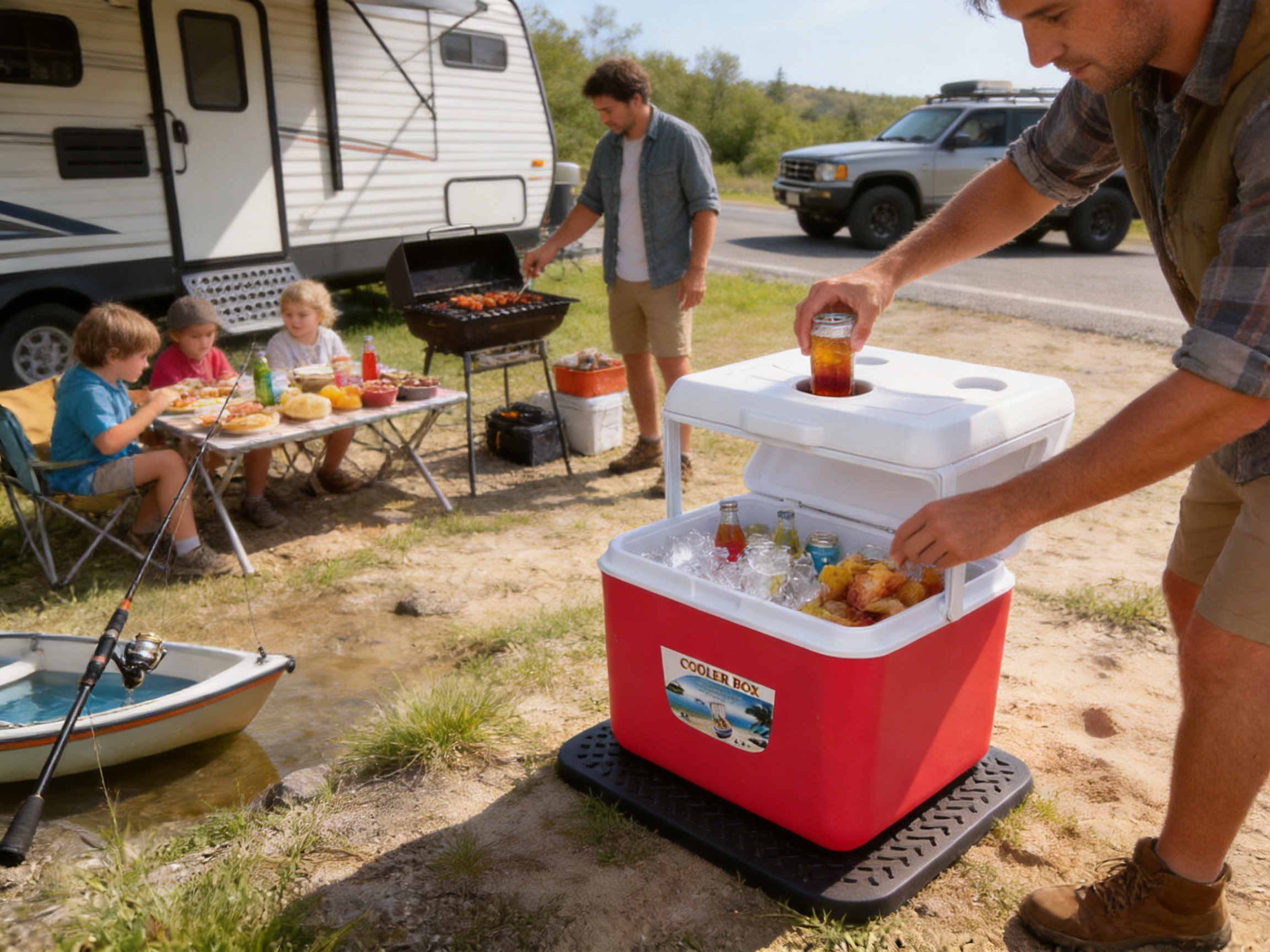
Designed for picnics, barbecues, boating, recreational vehicle travel, camping, fishing, road trips, and outdoor gatherings, this medium-sized cooler offers a useful capacity without becoming excessively heavy or difficult to move. Its 26-liter internal volume can accommodate up to 40 cans of 330 ml cola, while its internal arrangement can also accept a 3-liter insulated bucket and a 13-liter insulated box. This makes it suitable for both conventional food-and-beverage storage and modular cooler combinations.
The product measures 420 × 380 × 330 mm and weighs approximately 2.75 kg. Its construction uses food-grade PP, PE, and EPS materials. A double-layer insulation structure formed by the lid and body is designed to provide an insulation time of up to 48 hours under appropriate conditions. The lid also incorporates a cup-hole design, adding a practical feature for users who want to place drinks securely during outdoor activities. Most importantly, the specialized non-slip base helps prevent movement, sliding, and tipping on grass, sand, decking, boat surfaces, and other uneven locations.
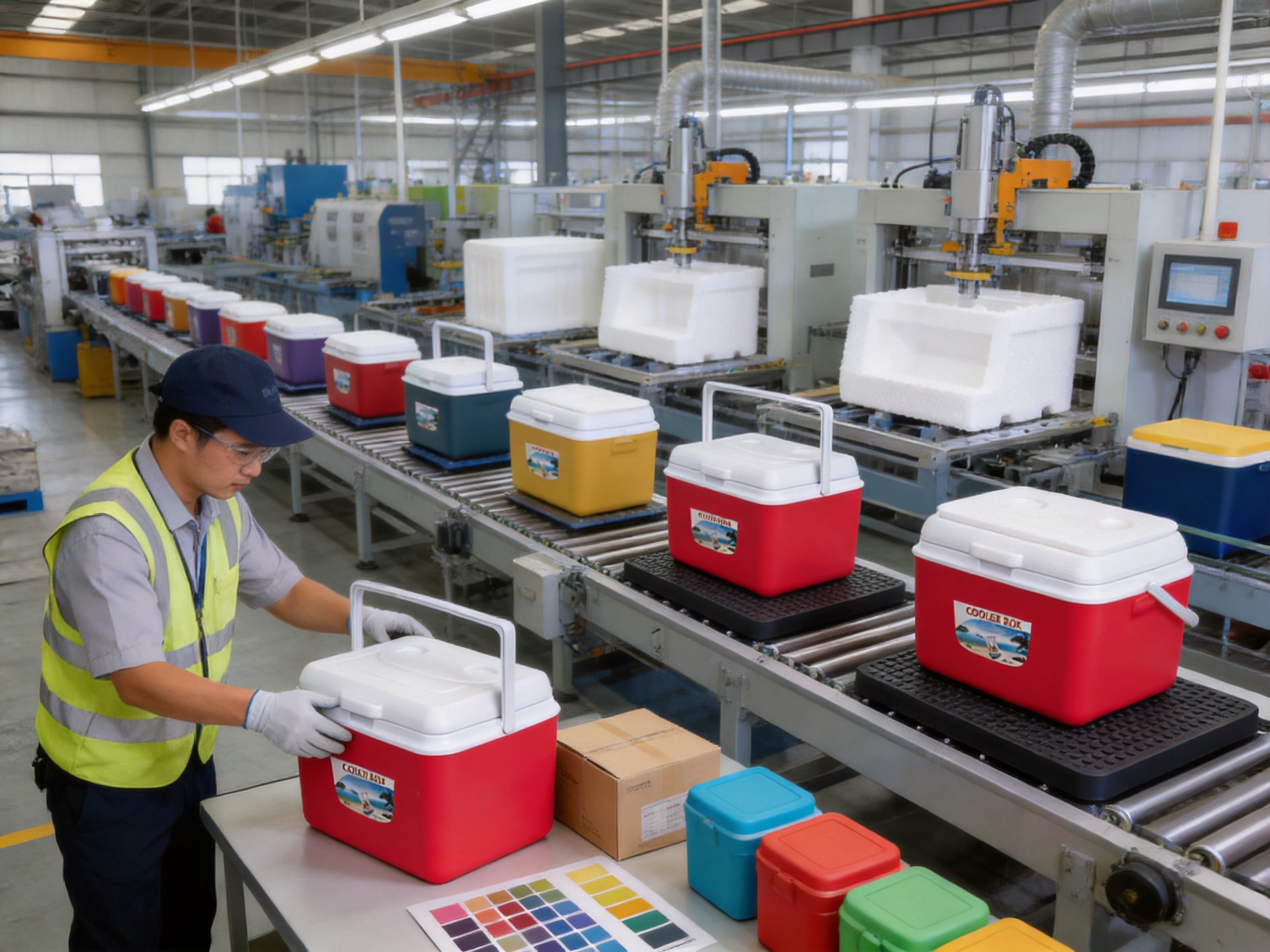
Behind this product is Ningbo Junlong Outdoor Products Co., Ltd., a manufacturer specializing in outdoor cooling and water storage products. The company combines product development, injection molding, blow molding, foaming, assembly, quality management, and sales support within its manufacturing operation. This integrated model gives buyers access not only to a finished cooler box, but also to OEM, ODM, color, logo, packaging, and product-development services.
1. Product Overview and Core Specifications
The 26L cooler is positioned in the medium cooler box category, generally covering products from 15 to 38 liters. This category is widely used because it offers a practical middle ground. Smaller coolers may not provide enough room for a full-day outing, while larger coolers can be cumbersome when carried by one person. A 26-liter design can hold a substantial quantity of beverages, snacks, prepared meals, fresh produce, or picnic ingredients while remaining suitable for routine transport.
| Specification | Product Information |
|---|---|
| Product type | Portable foam insulated cooler box |
| Nominal volume | 26 liters |
| Dimensions | 420 × 380 × 330 mm |
| Approximate weight | 2,750 g |
| Main materials | Food-grade PP, PE, and EPS |
| Insulation structure | Insulated lid and insulated body with EPS foam |
| Stated insulation time | Up to 48 hours under suitable conditions |
| Approximate beverage capacity | Up to 40 cans of 330 ml cola |
| Stability feature | Specialized non-slip base |
| Lid feature | Integrated cup-hole design |
| Combination compatibility | Can accommodate a 3-liter insulated bucket and a 13-liter insulated box |
| Typical applications | Picnics, barbecues, boating, camping, RV travel, fishing, road trips, and outdoor events |
These specifications make the cooler suitable for consumers who need reliable capacity without moving into the oversized commercial chest category. It can be used as a family picnic cooler, a vehicle travel cooler, a beverage box for outdoor workers, or a private-label product for retailers and distributors.
2. A Practical 26-Liter Capacity for Everyday Outdoor Use
Capacity is one of the first factors buyers consider when selecting a cooler. A product that is too small may require several separate containers, while a very large cooler often takes up excessive space in a vehicle and becomes difficult to carry when fully loaded. The 26-liter volume is designed to support a wide range of routine outdoor needs without creating unnecessary transport problems.
For beverage storage, the cooler can hold up to 40 cans of 330 ml cola. Actual loading capacity may vary according to the use of ice, dividers, food packaging, and the shape of individual containers, but the stated capacity gives buyers a clear indication of the cooler’s storage potential. It is large enough for a group of people attending a picnic or barbecue, yet compact enough to fit into many vehicle trunks, boat storage areas, RV compartments, or campsite arrangements.
Food storage is another important application. Users can organize sandwiches, fruit, salads, packaged meals, dairy products, desserts, and chilled ingredients inside the box. The rigid outer construction gives the contents more protection than a soft cooler bag, especially when other equipment is stored nearby. The box format also makes it easier to stack or position the cooler in a stable location.
The internal space supports a modular approach as well. According to the product design, the cooler can accommodate a 3-liter insulated bucket and a 13-liter insulated box. This combination can help users separate food, beverages, ice, or smaller items. It also gives distributors an opportunity to market the 26-liter cooler with compatible smaller products as a coordinated product set.
For retailers, this modular compatibility can simplify product merchandising. A medium cooler can be sold independently as the primary item, while the 3-liter and 13-liter products can be offered as accessories or bundled sets. Consumers may purchase the larger box for family use and later add smaller containers for personal drinks, snacks, sauces, fishing bait, or individual meals.
3. EPS Foam Insulation for Longer Cooling Performance
Insulation efficiency depends on multiple factors, including the thickness and continuity of the insulating material, the quality of the lid seal, the starting temperature of the contents, the amount of ice used, how often the lid is opened, and the surrounding temperature. The 26L cooler uses EPS foam insulation within both the body and the lid. This double-insulated construction is intended to reduce heat transfer and support a stated insulation period of up to 48 hours under suitable conditions.
Expanded polystyrene, commonly known as EPS, is widely used in insulated packaging and cooling products because it contains a large amount of trapped air. The cellular structure reduces the speed at which external heat enters the cooler. When combined with a rigid food-grade PP outer shell and an appropriate inner structure, EPS can provide a favorable balance between insulation performance, weight, manufacturability, and cost.
Insulating the lid is especially important. A cooler can lose a considerable amount of cooling efficiency through the top if the lid is not designed as part of the thermal barrier. By incorporating insulation into both the lid and body, this model creates a more complete enclosed cooling structure. This is a significant advantage over basic containers that use a thin plastic wall or a lid with little or no insulation.
The 48-hour insulation statement should be understood as a design reference rather than an identical result in every environment. Cooling duration depends on loading conditions and usage habits. Pre-chilling beverages, using sufficient ice, limiting the frequency of opening, keeping the box out of direct sunlight, and ensuring that the lid is properly closed can all improve performance. In commercial product communication, responsible sellers can present the 48-hour figure together with practical usage guidance.
Compared with ordinary plastic storage boxes, an insulated EPS cooler provides a dedicated thermal function. A standard storage box may protect contents from dust and physical contact, but it does not provide the same level of resistance to external heat. The foam-insulated structure therefore offers a clearer value proposition for outdoor users who need temperature retention rather than simple storage.
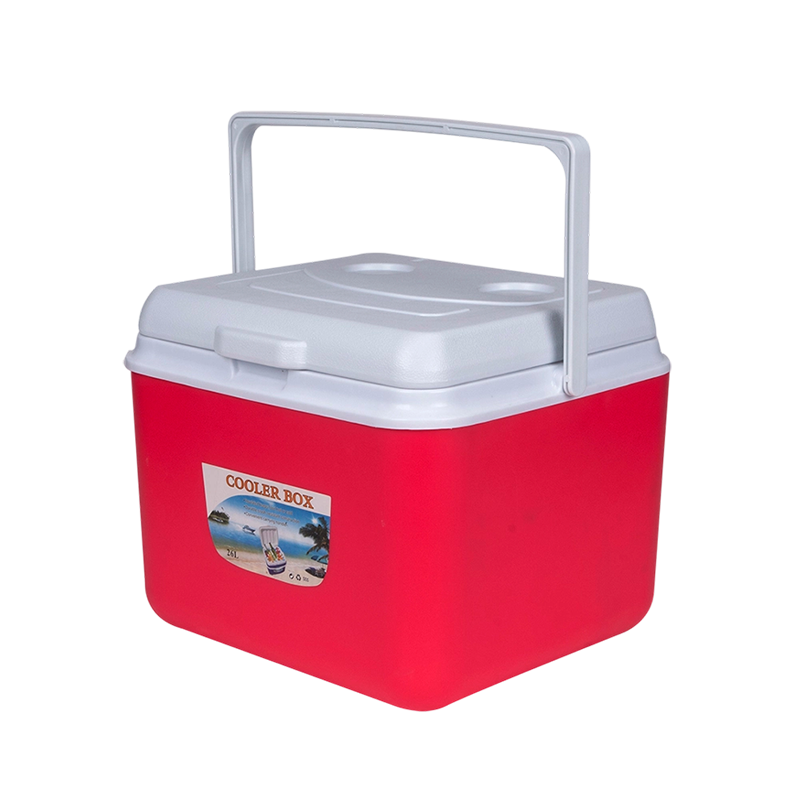
26L Portable Foam Insulated Cooler with Non-Slip Base
4. The Non-Slip Base as a Distinctive Competitive Advantage
Many cooler boxes focus primarily on capacity and insulation, but outdoor users also need stability. A cooler placed on a wet deck, sandy beach, grassy campsite, sloping picnic area, or moving boat can slide or tip when people walk past it, when the vehicle moves, or when the lid is opened. The specialized non-slip base on this model is designed to reduce such movement and provide a more secure position.
The non-slip base is particularly useful because outdoor surfaces are rarely perfectly level. Grass can be soft and uneven. Sand can shift under weight. Boat decks may become wet. RV tables and vehicle floors may vibrate during travel. A cooler without a stable base may gradually move away from its original position or become vulnerable to tipping when loaded unevenly.
Stability also improves user confidence. People are more likely to place drinks on or around a cooler when they know the main container is less likely to slide. The base can help reduce accidental movement when the lid is opened and closed repeatedly. It may also help protect the exterior of the cooler from direct contact with rough surfaces, depending on the specific base construction and operating environment.
From a competitive perspective, this feature gives the product a practical point of difference. Many entry-level cooler boxes offer similar nominal volumes, but fewer products emphasize stability as a dedicated design objective. For distributors and private-label buyers, the non-slip base can be highlighted in product listings, packaging, showroom displays, and promotional campaigns because it addresses a common outdoor-use problem in simple, understandable terms.
The base does not replace safe placement practices. Users should still position the cooler on the most level surface available, avoid placing it near unstable edges, and secure it appropriately during vehicle or boat travel. Nevertheless, the additional grip provided by the base can improve everyday handling and reduce unwanted sliding in ordinary outdoor conditions.
5. Food-Grade PP and PE for a Durable Outer Structure
Material selection affects product safety, service life, appearance, cleanability, and production consistency. The cooler uses food-grade PP and PE together with EPS insulation. Polypropylene is valued for its relatively low density, chemical resistance, rigidity, and suitability for injection-molded components. Polyethylene is widely used for impact-resistant and durable plastic parts. EPS provides the thermal insulation layer.
Food-grade material selection is important for a cooler intended to store beverages, packaged foods, fresh ingredients, and ice. The use of food-grade PP and PE indicates that the product is designed with food-contact-related applications in mind. Buyers should still follow the applicable regulations and testing requirements of their intended market, especially when the cooler is promoted for direct food contact or when it is sold under a private label.
The rigid plastic exterior provides several advantages over a soft fabric cooler. It is easier to wipe clean, less likely to collapse when empty, and better suited to protecting contents from compression. Its molded shape also allows manufacturers to integrate features such as a cup hole, structural ribs, recessed surfaces, stacking geometry, and a specialized base.
Durability is also important for repeated commercial use. Outdoor coolers can be exposed to moisture, ultraviolet light, dirt, temperature changes, rough handling, and frequent loading. Properly selected plastic materials and controlled molding processes can help the finished product maintain its dimensional integrity and appearance over repeated use.
Like all plastic products, the cooler should be used in accordance with its intended application. Users should avoid direct exposure to open flames, sharp tools, unsuitable chemicals, and excessive heat. Cleaning with mild detergent and clean water is generally more appropriate than using aggressive solvents that may damage the surface or affect printed decoration.
6. Integrated Cup-Hole Design for Greater Convenience
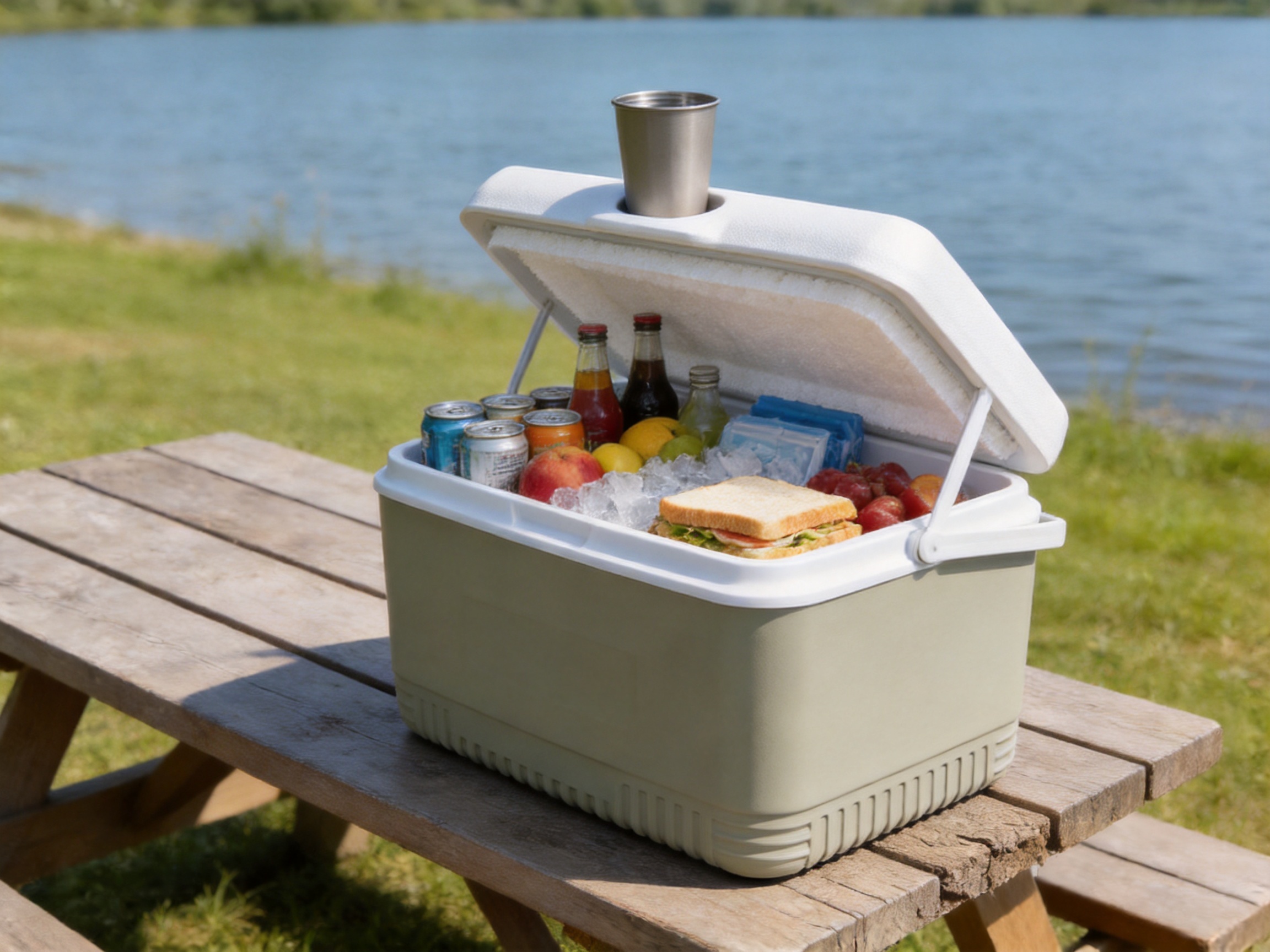
The lid includes a cup-hole design that adds utility beyond simple storage. Users can place a compatible cup, bottle, or beverage container in the opening while using the cooler as a temporary outdoor surface. This can be helpful during picnics, barbecues, tailgating, fishing trips, and campsite meals, when a stable place for a drink may not always be available.
A cup holder integrated into the lid also makes the product feel more purpose-built. Rather than functioning only as an insulated box, the cooler becomes part of the user’s outdoor setup. It can serve as a storage container, a beverage station, and a convenient accessory surface in one compact product.
The cup-hole design should not be considered a guarantee against spills. Cup dimensions, beverage containers, surface angles, and user movement all affect stability. However, the feature can reduce the need for separate cup holders and create a more organized arrangement around the cooler.
For product marketing, this small feature can have a meaningful impact. Buyers often respond to practical details that simplify outdoor activities. A cup hole is easy to demonstrate in photographs and retail displays, and it complements the larger benefits of insulation and stability.
7. Suitable Applications Across Outdoor and Commercial Settings
Picnics and Family Outings
Families often need to transport a mixture of cold beverages, fruit, sandwiches, desserts, sauces, and snacks. The 26-liter volume offers sufficient room for a day trip while avoiding the bulk of a very large chest cooler. The non-slip base is useful when the cooler is placed on grass or a picnic table, and the cup-hole feature can help organize drinks during meals.
Barbecues and Outdoor Gatherings
At a barbecue, the cooler may be used for canned beverages, bottled drinks, raw ingredients, condiments, or prepared food. Its rigid construction helps protect contents, while the insulated body and lid support longer cooling. The product can also serve as part of a larger set when combined with smaller insulated containers for separating food types or personal drinks.
Boating and Fishing
Boating environments create special demands because surfaces can become wet and movement is common. A non-slip base is valuable on decks and other boat surfaces, although users should still secure the cooler during navigation. The insulated interior can be used for beverages, packed meals, bait, or selected catches, subject to appropriate hygiene practices and local requirements.
Camping and Recreational Vehicle Travel
For campers and RV travelers, storage space must be used efficiently. A 26-liter cooler provides a moderate footprint and can be placed in a vehicle, under a table, or within an outdoor cooking area. Its capacity can support several people for a day or provide supplementary cooling space when a vehicle refrigerator is full.
Road Trips and Outdoor Work
Drivers, construction teams, maintenance crews, and outdoor workers may use the cooler to keep drinks and meals available during long working days. The hard-shell construction can be more practical than a flexible bag when the container must be placed among tools or equipment. A cooler can also help employers provide convenient chilled beverages at temporary work locations.
Retail, Promotional, and Hospitality Use
Retailers may offer the cooler as a seasonal outdoor product, while hospitality businesses can use it for event beverage service, resort activities, excursion packages, and guest amenities. Companies can also use customized coolers as promotional merchandise. Logo printing, color selection, and custom packaging can help transform a functional product into a branded marketing item.
8. Comparison with Common Cooler Alternatives
Understanding how this cooler compares with other product types helps clarify its market position. It is not intended to replace every form of cold storage. Instead, it combines features that address several common weaknesses in basic alternatives.
| Product type | Typical strengths | Common limitations | Advantages of the 26L insulated cooler |
|---|---|---|---|
| Soft cooler bag | Lightweight, foldable, easy to store | Less rigid protection, may be harder to clean, often less stable on uneven surfaces | Rigid structure, molded stability features, easier organization, and stronger physical protection |
| Uninsulated plastic box | Simple storage, easy molding, often low cost | Limited temperature retention | EPS insulation in the lid and body supports longer cooling performance |
| Small personal cooler | Easy to carry, suitable for one person | Limited capacity for families or groups | 26-liter volume supports group use while remaining portable |
| Large commercial cooler | High storage capacity | Heavy, bulky, difficult to move when fully loaded | Medium capacity offers a more manageable balance between space and portability |
| Basic rigid cooler | Durable shell and reusable structure | May lack stability features or integrated user conveniences | Non-slip base and cup-hole lid add practical outdoor functionality |
This comparison shows that the product’s main competitive advantage is not based on one isolated feature. Its value comes from the way several functions work together. The insulated body supports cooling, the rigid shell protects contents, the non-slip base improves stability, the cup hole adds convenience, and the medium capacity suits a wide range of activities.
Cost is another important consideration. A product with advanced features must remain commercially viable for distributors and end users. The use of established plastic processing methods and an integrated factory can help support efficient production while preserving the design features that differentiate the product from basic storage boxes.
9. Manufacturing Capabilities Supporting Product Consistency
Ningbo Junlong Outdoor Products Co., Ltd. was founded in 2000 and is located in Cixi, Ningbo, Zhejiang Province, an important manufacturing region in the Yangtze River Delta. The company operates an independent factory covering approximately 12,000 square meters and employs more than 100 people. Its production system integrates product development, manufacturing, sales, and customer service.
The company’s facilities include automatic injection molding machines, blow molding machines, and foaming equipment. These capabilities are directly relevant to the production of cooler boxes, insulated jugs, outdoor water containers, and related plastic products. Having multiple processing capabilities under one manufacturing organization can simplify project coordination and reduce dependence on unrelated external suppliers.
Injection molding is typically used to create precise plastic parts by injecting molten polymer into a prepared mold. For cooler production, this process can support the manufacture of outer shells, lids, handles, base components, structural elements, and integrated accessories. Automated injection equipment can contribute to repeatable cycle times, consistent dimensions, and controlled material use.
Blow molding is suitable for producing hollow plastic containers and related components. While different cooler designs may use different combinations of molding technologies, blow-molding capability expands a manufacturer’s ability to develop outdoor water containers, jugs, bottles, and other hollow products within the same broader product category.
Foaming equipment is especially significant for insulated products. EPS insulation must be formed and positioned in a way that supports the thermal design of the lid and body. Controlled foaming operations can help the manufacturer manage density, shape, and fit while integrating insulation with the outer plastic structure.
Manufacturing equipment alone does not guarantee quality. Process control, mold maintenance, material management, operator training, inspection standards, and corrective-action procedures are equally important. Junlong describes its operation as supported by a rigorous quality management system and a creative research and development team. These elements help transform equipment capacity into repeatable commercial production.
10. Product Development, Tooling, and Engineering Support
Outdoor products must be designed for both appearance and function. A cooler shell needs adequate wall strength, an effective lid interface, stable proportions, usable internal space, and features that can be produced efficiently. The company’s product-development capabilities allow it to work from drawings, samples, or customer concepts when developing customized products.
During product development, engineers may evaluate the relationship between external dimensions and usable internal volume. A thicker insulation layer may improve thermal performance but reduce interior capacity. A more complex base may improve stability but influence mold design and production cost. A larger cup hole may accommodate more containers but reduce the usable lid area. These trade-offs require practical engineering decisions rather than simply adding features.
Mold design is another critical area. Proper draft angles, parting lines, wall thickness, gates, cooling channels, and ejection systems affect the appearance and performance of molded parts. Well-designed tooling can reduce defects, improve cycle efficiency, and support consistent assembly. For buyers ordering a private-label or customized product, early engineering discussions can help balance product specifications with target pricing and expected order quantities.
Junlong’s OEM and ODM services allow customers to choose different levels of involvement. An OEM customer may provide a design or sample and request manufacturing according to defined specifications. An ODM customer may request support with product concepts, functional improvements, shape development, color schemes, branding, and packaging. This flexibility is useful for importers, wholesalers, retailers, outdoor brands, promotional companies, and regional distributors.
Customization may include product color, logo application, packaging format, printed instructions, labels, and coordinated accessories. Depending on project requirements, customers should confirm available decoration methods, minimum order quantities, sample approval procedures, testing documentation, lead times, and packaging specifications before placing a production order.
11. Quality Management from Raw Material to Finished Product
A cooler box passes through several quality-sensitive stages. The raw materials must be suitable for the intended application. Plastic components must meet dimensional and visual requirements. EPS insulation must fit correctly within the shell. The lid must align with the body. The non-slip base must be properly installed or formed. Finished products must be inspected, packed, and stored in a way that prevents damage before shipment.
Material control is the starting point. Food-grade PP and PE should be purchased according to defined specifications and managed to reduce contamination or unintended material mixing. Colorants and additives should also be selected according to the customer’s market requirements. For export projects, buyers may request material declarations, test reports, or compliance documentation related to applicable food-contact and chemical regulations.
Dimensional inspection helps confirm that the finished cooler matches approved samples and drawings. Important inspection points may include external length, width, height, lid fit, internal clearance, base position, cup-hole dimensions, and component alignment. Consistent dimensions are especially important when several cooler sizes are designed to work together as a set.
Visual inspection can identify scratches, weld lines, sink marks, flash, deformation, color inconsistency, contamination, or printing defects. Some molded marks are normal in plastic manufacturing, but unacceptable defects should be defined in the approved quality standard. A clear inspection agreement helps both manufacturer and buyer evaluate products consistently.
Functional checks may include lid opening and closing, stability on a defined surface, cup-hole compatibility, internal assembly, packaging strength, and selected insulation tests. Thermal testing should identify the test conditions, including starting temperature, ice quantity, ambient temperature, opening frequency, and measurement method. This makes performance claims more transparent and useful.
Packaging quality is also important because coolers may travel long distances through multiple handling stages. Cartons, protective materials, pallet configurations, and shipping marks should be selected according to the product’s dimensions and destination. Proper packaging helps preserve the non-slip base, lid, outer shell, and decorative surfaces until the goods reach the customer.
12. Why an Integrated Factory Matters to Buyers
Working with an integrated manufacturer can provide several advantages over coordinating multiple unrelated suppliers. Product development, molding, foaming, assembly, inspection, and sales communication can be managed through one organization. This can reduce communication gaps and make it easier to trace decisions from the initial concept to mass production.
Integrated production may also improve responsiveness. If a customer requests a color adjustment, logo change, structural modification, or packaging revision, the manufacturer can evaluate the effect across its own production processes. Changes can be reviewed with engineering, tooling, molding, foaming, and assembly teams rather than being passed through several independent companies.
For long-term customers, factory familiarity with outdoor cooling products can shorten the learning curve. The company already works with insulated cooler jugs, outdoor water containers, ice buckets, and cooler boxes. This category experience can help buyers discuss insulation structures, food-grade plastics, cleaning considerations, handles, lids, accessories, and modular product families more efficiently.
Manufacturing scale is also relevant. A 12,000-square-meter factory and a workforce of more than 100 employees provide a foundation for handling regular production programs and customized orders. Actual capacity depends on the product, mold availability, order quantity, season, and production schedule, so buyers should confirm capacity for each project. Nevertheless, the stated facilities indicate that the company is structured as a dedicated manufacturer rather than a purely trading operation.
13. OEM and ODM Opportunities for Different Markets
The cooler’s practical design can be adapted for multiple market positions. A sporting-goods retailer may emphasize camping and fishing. A supermarket may promote family picnics and summer beverages. A beverage company may use the cooler as a promotional item. A marine-supply distributor may focus on boating stability. An RV accessory brand may present it as a compact travel cooler. The same core platform can therefore support different sales messages.
Color customization is one of the simplest ways to align the cooler with a customer’s brand identity. Neutral colors may suit general retail, while high-visibility colors can appeal to outdoor activity consumers. Corporate colors can support promotional campaigns, and coordinated colors can be used across multiple sizes in a product family.
Logo application can increase recognition and help the cooler function as a reusable advertising medium. Because the product is used outdoors and transported to different locations, a well-placed logo may be visible during picnics, events, sporting activities, and travel. The decoration process should be selected according to the material, surface shape, expected durability, order volume, and target market requirements.
Packaging can also be customized. A retail-ready carton may include product photography, capacity information, insulation features, use scenarios, care instructions, and safety guidance. A wholesale package may prioritize efficient stacking and transport. Promotional packaging may include campaign messaging or coordinated accessories. Buyers should review packaging prototypes before bulk production to confirm color, text, barcode placement, and regulatory information.
ODM cooperation may extend beyond visual changes. Buyers can request adjustments to internal dividers, handles, lid features, stacking geometry, accessories, or compatible product sets. Each change should be evaluated for tooling cost, production feasibility, insulation performance, and order quantity. A professional manufacturer can help identify which modifications provide meaningful market value and which may create unnecessary complexity.
14. Responsible Use and Care Recommendations
To obtain the best cooling performance, users should pre-chill beverages and food whenever possible. Loading the cooler with warm contents increases the thermal demand and consumes available cooling capacity. Ice packs or suitable ice should be distributed around the contents rather than placed only in one area. Empty spaces can reduce efficiency, although excessive packing may prevent the lid from closing correctly.
The lid should remain closed except when necessary. Every opening allows warm air to enter and cold air to escape. During a picnic or barbecue, users can improve efficiency by organizing frequently used drinks near the top and less frequently used food lower in the cooler. Keeping the cooler in shade and away from hot vehicle surfaces can also help extend cooling time.
Users should place the cooler on a stable surface even though the non-slip base helps resist sliding. On boats, in vehicles, or on steep slopes, additional restraints may be appropriate. The cooler should not be used as a seat, step, or load-bearing platform unless the manufacturer has specifically designed and tested it for that purpose.
Cleaning should be performed after use, especially when the cooler has held food, melted ice, or liquids. A mild detergent, soft cloth, and clean water are generally suitable for routine cleaning. The interior should be dried before storage to reduce odors and moisture accumulation. Abrasive tools and harsh chemicals may scratch or damage the plastic surface.
Users should inspect the cooler periodically for cracks, damaged hinges, lid deformation, base wear, or other conditions that could affect performance. If the product is used for direct food contact, local hygiene procedures should be followed. Ice intended for consumption should be kept separate from contaminated surfaces and stored according to appropriate food-safety practices.
15. Considerations for Importers and Wholesale Buyers
Importers should assess the cooler from both a product and supply-chain perspective. Product requirements should be recorded clearly, including dimensions, volume, material specifications, color, logo, packaging, accessories, testing documentation, and acceptable quality limits. A signed sample or approved pre-production sample can provide a useful reference for mass manufacturing.
Buyers should also confirm the commercial terms for tooling, sample development, production lead time, inspection, payment, shipping marks, carton dimensions, and loading quantity. If multiple cooler sizes are planned as a set, the compatibility of the products should be confirmed before tooling and production. The 26-liter cooler’s ability to accommodate a 3-liter bucket and a 13-liter box may be particularly relevant to buyers planning a coordinated range.
Seasonality should be considered. Cooler demand often increases before summer, holidays, travel periods, camping seasons, and outdoor event schedules. Early planning can help buyers manage sample approvals, artwork confirmation, production, shipping, and warehouse arrival. Customized projects generally require more preparation than standard products because color, logo, packaging, and testing decisions must be completed before mass production.
Retailers should develop product information that explains both the benefits and the limitations. Capacity claims should be presented as approximate where appropriate. The 48-hour insulation statement should be accompanied by practical conditions or usage guidance. Product images should show the cooler in realistic outdoor settings, while packaging should identify dimensions, materials, care instructions, and intended applications in the language required by the destination market.
16. Sustainability and Material Efficiency Considerations
Plastic cooler products are reusable items designed for repeated use, which can reduce dependence on disposable packaging when consumers use them over a long service life. Durable construction, repairable or replaceable components where available, and responsible care can extend the useful period of the product. Buyers may also evaluate packaging reduction, carton efficiency, and transport density when planning a product program.
Manufacturing efficiency can contribute to responsible resource use. Automatic molding equipment, controlled foaming processes, appropriate mold design, and material management can help reduce avoidable waste. Any production scrap should be handled according to the manufacturer’s internal procedures and applicable regulations. The specific recyclability of the finished cooler depends on its material combination, insulation structure, adhesives, decoration, and local recycling infrastructure.
Because the cooler combines PP, PE, and EPS components, end-of-life processing may require separation or specialized handling in some regions. Buyers seeking environmental claims should verify the actual material structure, local recycling options, and relevant certification requirements rather than making broad unsupported statements. Transparent communication is preferable to vague claims about sustainability.
17. A Strong Product Platform for Outdoor Cooling Programs
The 26L cooler is more than a single storage container. It can serve as a platform for a broader outdoor cooling program. The compatibility with smaller insulated products allows brands to create a family of containers for different users and activities. A large medium cooler can serve as the central product, while smaller boxes and buckets support personal or specialized storage.
This product-family approach can help retailers improve cross-selling. A customer purchasing the 26-liter cooler may also need a smaller container for sauces, snacks, bait, personal drinks, or temperature-sensitive items. Coordinated colors and common branding can make the products appear as a unified range. For OEM buyers, a modular product strategy may increase shelf presence and encourage repeat purchases.
The cooler’s balanced specifications also make it suitable for different price levels. The core product can be marketed as an affordable family cooler, while upgraded versions may include enhanced decoration, accessories, custom packaging, or bundled smaller products. Buyers can discuss these possibilities with the manufacturer according to their market goals and target retail price.
18. Frequently Asked Questions
What is the capacity of the cooler?
The cooler has a nominal capacity of 26 liters. It is designed for medium-scale outdoor use and can hold up to approximately 40 cans of 330 ml cola, depending on how the interior is arranged and how much ice or additional packaging is used.
How long can it keep contents cold?
The insulated lid and body use EPS insulation and are designed to provide an insulation time of up to 48 hours under suitable conditions. Actual cooling duration depends on ice quantity, starting temperature, ambient conditions, direct sunlight, how frequently the lid is opened, and how tightly the cooler is packed.
What materials are used?
The product uses food-grade PP and PE for the plastic structure and EPS for insulation. Buyers should confirm market-specific compliance documentation when the product is intended for direct food-contact applications or sale in regulated markets.
What makes the base different from a standard cooler base?
The product includes a specialized non-slip base intended to reduce sliding and tipping on surfaces such as grass, sand, decks, and other outdoor locations. It improves stability but does not eliminate the need for careful placement or additional restraint during boat or vehicle travel.
Can the cooler be used with smaller insulated products?
Yes. The internal space can accommodate a 3-liter insulated bucket and a 13-liter insulated box, allowing the products to be used together as a set or modular storage system.
What is the purpose of the cup-hole design?
The cup-hole design in the lid provides a convenient place for a compatible cup or beverage container. It helps users organize drinks during outdoor activities, although the stability of a cup will depend on its size, shape, the surface angle, and the conditions of use.
Is the cooler suitable for boating?
It is suitable for boating applications because its insulated structure supports chilled storage and its non-slip base can help reduce movement on suitable surfaces. Users should secure the cooler when a boat is moving and should follow appropriate hygiene procedures if it is used for food or catch storage.
Can the product be customized?
Customization options may include product color, logo, packaging, and selected product-development changes. Ningbo Junlong Outdoor Products Co., Ltd. provides OEM and ODM services and can work from drawings, samples, or customer concepts. Exact options, minimum order quantities, tooling requirements, and lead times should be confirmed for each project.
What manufacturing capabilities does the company have?
The company operates an approximately 12,000-square-meter independent factory with more than 100 employees. Its stated facilities include automatic injection molding machines, blow molding machines, and foaming equipment, supported by product development and quality management functions.
How should the cooler be cleaned?
After use, the cooler should be emptied, wiped with mild detergent and clean water, and dried before storage. Harsh solvents, abrasive tools, and excessive heat should be avoided because they may damage the plastic surface or other components.
Is the 26-liter size suitable for retail?
Yes. The medium capacity, practical dimensions, stability feature, cup-hole design, and modular compatibility make the product suitable for outdoor retail, seasonal promotions, sporting-goods distribution, marine-supply channels, RV accessories, hospitality applications, and private-label programs.
19. Conclusion
The 26L Portable Foam Insulated Cooler with Non-Slip Base combines the features that matter most in a practical outdoor cooling product. Its 26-liter capacity supports family outings and group activities without the excessive bulk of a large commercial cooler. Its food-grade PP and PE structure provides a durable, cleanable exterior, while EPS insulation in both the lid and body is designed to support cooling performance for up to 48 hours under suitable conditions.
The specialized non-slip base is a clear point of differentiation. It addresses the movement and instability that can occur on grass, sand, wet decks, vehicle floors, and other outdoor surfaces. The integrated cup-hole design adds convenience, and the ability to accommodate a 3-liter insulated bucket and a 13-liter insulated box creates opportunities for modular product sets.
For buyers, the product is supported by a manufacturer with experience in outdoor cooling and water storage products, an independent factory, automatic injection molding equipment, blow-molding capability, foaming equipment, product-development resources, and OEM/ODM services. These capabilities provide a foundation for consistent production, customized colors and logos, tailored packaging, and broader product-family development.
Whether marketed for picnics, barbecues, boating, camping, RV travel, fishing, road trips, outdoor work, or promotional programs, this cooler offers a balanced combination of capacity, insulation, stability, usability, and customization potential. Its value lies not only in keeping contents cold, but also in making outdoor storage more organized, secure, and convenient.
References
1. Product specification sheet for the 26L Portable Foam Insulated Cooler with Non-Slip Base, including dimensions, capacity, materials, weight, insulation structure, and functional features.
2. Technical information concerning food-grade polypropylene and polyethylene in molded storage and outdoor product applications.
3. General engineering principles for expanded polystyrene insulation in portable cooling containers.
4. Outdoor cooler handling and care practices for improving temperature retention and product service life.
5. Manufacturing information regarding injection molding, blow molding, foaming processes, mold development, and plastic product quality control.
6. Company profile and manufacturing overview of Ningbo Junlong Outdoor Products Co., Ltd., including factory facilities, product categories, OEM/ODM services, and product-development capabilities.
Product: 26L Portable Foam Insulated Cooler with Non-Slip Base

Product Recommendation
link
Office
- TEL: +86-574-63787606
- Phone: +86-13777994798
- E-mail: sales@nbjunlong.com
- WhatsApp: 13777967488
- Address: No. 1, Lane 3, Development Road, Longtouchang, Longshan Town, Cixi City, Zhejiang Province, China
Get In Touch
Copyright © Ningbo Junlong Outdoor Products Co., Ltd. All Rights Reserved.
China Plastic Insulated Cooler Box Manufacturer Custom Cooler Box Supplier
