- SMALL ORDERS FOR STANDARD ITEMS. Contact Now
- OUTDOOR COOLING SOLUTIONS, MADE IN‑HOUSE. Contact Now
- COOLER BOXES THAT FIT REAL OUTDOOR LIFE. Contact Now

 LANGUAGE
 日本語
 Español
 عربى

Content
- 1 1. A Practical Medium-Capacity Cooler for Multiple Uses
- 2 2. Rigid Construction Compared with Soft Coolers
- 3 3. Polyurethane Insulation for Extended Temperature Retention
- 4 4. Mobility Through Wheels and a Telescoping Handle
- 5 5. Lid Design with Built-In Cup Holders
- 6 6. Product Specifications at a Glance
- 7 7. Efficient Use of the Internal Space
- 8 8. Applications in Outdoor Recreation
- 9 9. Manufacturing Process and Material Integration
- 10 10. Product Development and Quality Management
- 11 11. OEM and ODM Customization Capabilities
- 12 12. Advantages for Importers, Retailers, and Distributors
- 13 13. Comparison with Common Cooler Types
- 14 14. Care, Cleaning, and Storage
- 15 15. Safety and Responsible Use
- 16 16. Why Manufacturing Location and Capability Matter
- 17 17. Frequently Asked Questions
- 17.1 Q1: What is the capacity of this cooler box?
- 17.2 Q2: What are the outside dimensions?
- 17.3 Q3: What are the internal dimensions?
- 17.4 Q4: What materials are used?
- 17.5 Q5: How long can the cooler retain cold temperatures?
- 17.6 Q6: Does the cooler have wheels?
- 17.7 Q7: Is the handle retractable?
- 17.8 Q8: Does the lid have additional features?
- 17.9 Q9: Can the cooler be used for hot items?
- 17.10 Q10: Is the cooler suitable for camping and picnics?
- 17.11 Q11: Can the product be customized?
- 17.12 Q12: Can different colors be supplied?
- 17.13 Q13: What manufacturing equipment does the supplier operate?
- 17.14 Q14: What is the unit weight?
- 17.15 Q15: How should the cooler be cleaned?
- 17.16 Q16: What types of businesses may purchase this product?
- 18 18. Conclusion
- 19 References
- 20 Product: 18L Wheeled Insulated Cooler Box for Outdoor Camping Picnic Trips
Outdoor activities demand equipment that is practical, durable, and easy to transport. Whether the destination is a campsite, beach, fishing location, picnic area, sports event, or grocery store, keeping food and drinks at a suitable temperature can make the experience more comfortable and convenient. The 18L wheeled insulated cooler box is designed to meet these needs with a combination of strong construction, effective thermal insulation, useful storage capacity, and convenient mobility.
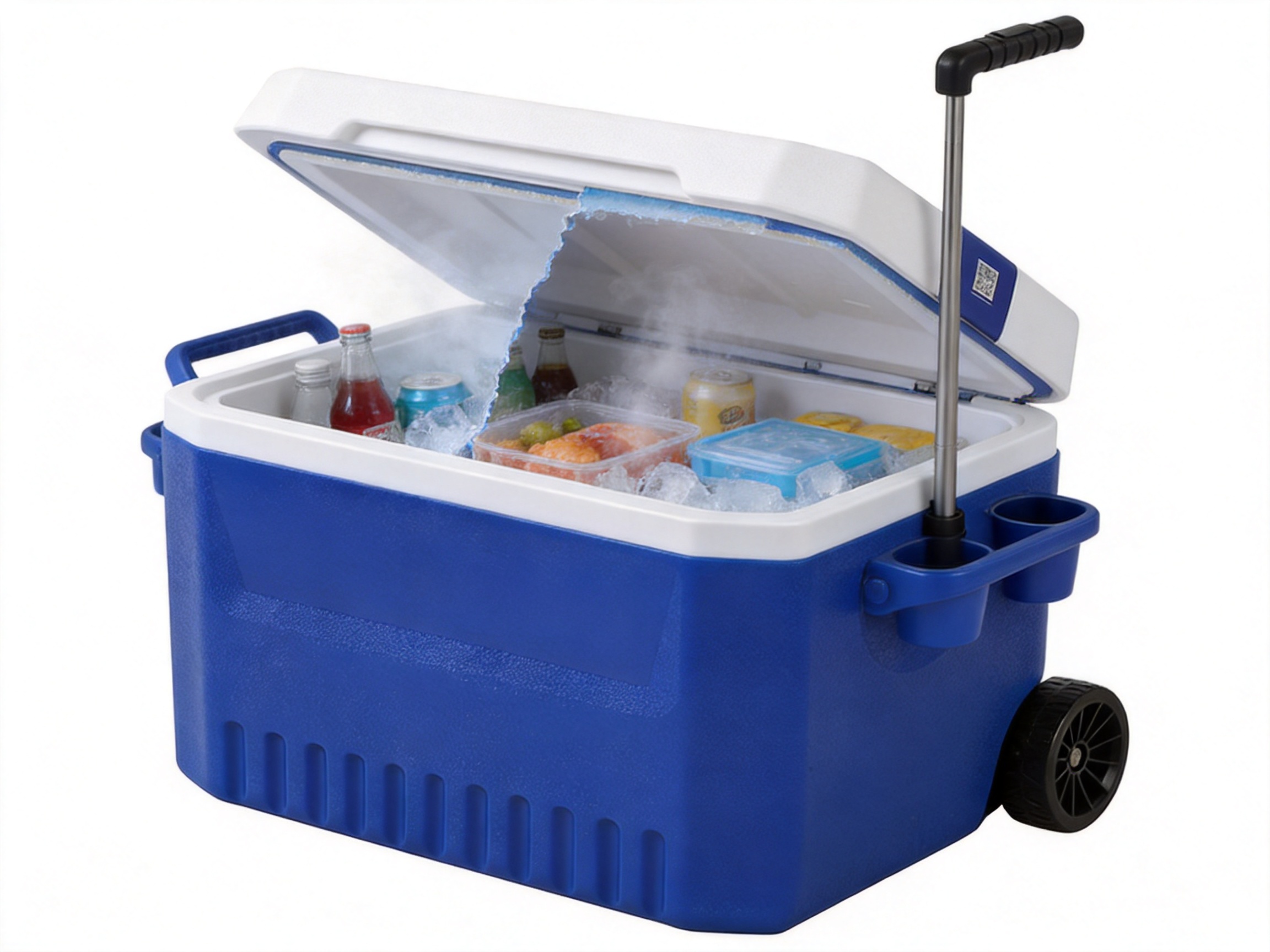
Unlike a basic soft cooler or a simple plastic storage box, this medium-sized cooler box is built as a complete portable cooling solution. It combines a rigid polyethylene outer shell, a polypropylene inner compartment, and a polyurethane insulation layer. A telescoping handle and integrated wheels make transportation easier, while the lid includes built-in cup holders for added outdoor convenience. Its 18-liter capacity provides enough space for drinks, packed meals, fresh produce, snacks, ice, and other temperature-sensitive items without becoming excessively large or difficult to handle.
The cooler box is manufactured by Ningbo Junlong Outdoor Products Co., Ltd., a China-based manufacturer specializing in cooler boxes, insulated cooler jugs, ice buckets, and outdoor water containers. With an independent factory, injection molding equipment, blow molding machines, foaming equipment, product development capabilities, and OEM/ODM services, the company can support both standard product supply and customized manufacturing programs.
1. A Practical Medium-Capacity Cooler for Multiple Uses
With an 18-liter internal capacity, this cooler box occupies a useful position between compact personal coolers and large family-sized models. Small coolers may be easy to carry but often lack enough room for a full day’s food and beverages. Large coolers can offer more capacity, but they are usually heavier, bulkier, and less convenient for short trips. The 18L format provides a balanced solution for users who need meaningful storage without sacrificing portability.
The cooler is suitable for camping trips, family picnics, beach outings, road journeys, tailgate parties, fishing excursions, outdoor sports, workplace lunches, and daily grocery transportation. It can also be used by catering businesses, event organizers, retailers, promotional product distributors, and outdoor equipment brands looking for a customizable cooler platform.
The external dimensions are approximately 37 cm × 32 cm × 33.5 cm, while the internal dimensions are approximately 29.5 cm × 23 cm × 27 cm. This compact footprint makes it easier to position in a vehicle trunk, rear seat, tent, camper, boat, or storage room. At the same time, its upright shape uses vertical space efficiently, helping users organize bottles and containers without requiring a wide horizontal surface.
The 18L capacity is especially appropriate for a small group or a family day trip. It can hold bottled water, canned beverages, juice, sandwiches, fruit, dairy products, chilled ingredients, and ice packs. Depending on the size and shape of the contents, the inner cavity can be arranged for a mixture of food and drinks rather than being limited to a single type of item.
2. Rigid Construction Compared with Soft Coolers
One of the principal advantages of this product is its rigid construction. The outer shell is made from polyethylene, a material commonly used for products that require impact resistance, durability, and a stable molded form. The inner compartment is made from polypropylene, which provides a practical surface for storing food and beverages while supporting repeated daily use.
A soft cooler generally depends on fabric, foam, zippers, and flexible panels. Such products may be lightweight, but they can lose their shape when loaded, become difficult to clean after spills, and offer limited protection against compression. A rigid cooler box provides stronger structural support and helps protect its contents from accidental pressure during transportation.
The molded body also makes the cooler more suitable for outdoor environments. It can be placed on grass, sand, pavement, wooden decks, vehicle floors, and other common surfaces without relying on delicate fabric panels. The hard shell is easier to wipe down after use, while the removable or accessible interior can be cleaned as part of normal maintenance.
Compared with an ordinary uninsulated plastic container, the product provides a dedicated thermal barrier. The PU insulation layer is positioned between the outer and inner components to reduce heat transfer. This design allows the cooler to help preserve chilled conditions for cold food and drinks and can also assist in maintaining warmth when used for suitable hot items.
The rigid body further supports the lid, cup holders, handle connection, and wheel assembly. These integrated elements are designed as part of one portable product rather than being added to a flexible bag after manufacturing. The result is a more stable and organized user experience, particularly when the cooler is filled and moved across uneven ground.
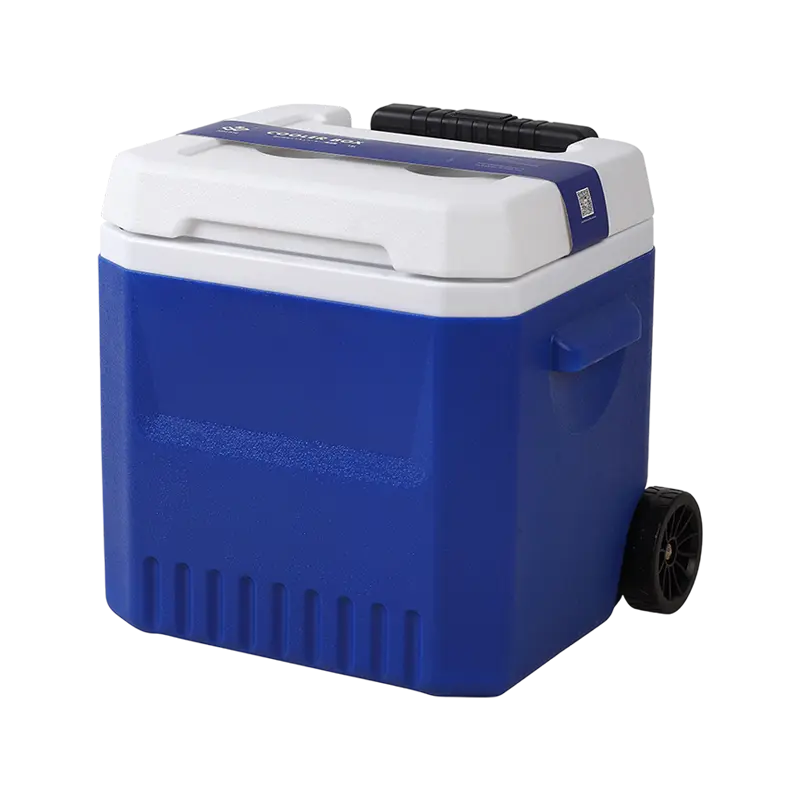
18L Wheeled Insulated Cooler Box for Outdoor Camping Picnic Trips
3. Polyurethane Insulation for Extended Temperature Retention
The insulation layer is made from polyurethane, commonly abbreviated as PU. Polyurethane foam is valued in cooler manufacturing because it can form a continuous insulating structure between the interior and exterior walls. This structure helps slow the movement of heat through the cooler walls, allowing ice, ice packs, chilled beverages, and cold food to remain at a suitable temperature for longer than they would in an ordinary container.
The product information specifies PU insulation in both the lid and the main body, with insulation performance described as supporting up to 48 hours of cooling under appropriate conditions. Actual performance can vary according to ambient temperature, the amount and type of ice used, how frequently the lid is opened, the temperature of the contents before loading, and the way the cooler is positioned. Pre-chilling the cooler and its contents can help improve thermal retention.
Insulation performance is not determined only by the thickness of a wall. A well-designed cooler must also reduce gaps, support a reliable lid fit, and maintain a stable molded structure. The combination of a rigid PP inner compartment, PE outer shell, and PU insulation layer creates a multi-material construction intended to improve durability and temperature control at the same time.
The insulated lid is particularly important because the top of a cooler is frequently exposed to direct sunlight and warm air. By extending the insulation structure into the lid, the design helps reduce heat transfer through the upper surface. A secure closure system can also limit the exchange of warm air when the cooler is closed.
For camping and picnic use, extended insulation can reduce the need to replenish ice frequently. For retailers and distributors, the insulation specification gives the cooler a clear functional benefit that can be communicated to customers. For OEM buyers, the same structure can serve as a dependable base for private-label products aimed at outdoor recreation, food delivery, sporting events, or vehicle travel.
Recommended Loading Practices
For the best cooling results, users should place chilled or frozen contents into the cooler rather than loading it entirely with items at room temperature. Ice packs or sealed ice containers can be distributed around the contents to improve contact with warm areas. Empty air space should be minimized where practical, although the lid should never be forced closed.
Frequently opened coolers lose cold air more quickly. Organizing drinks and meals before leaving home can reduce the time the lid remains open. Positioning the cooler in shade and avoiding unnecessary exposure to hot vehicle surfaces can also support longer thermal performance.
4. Mobility Through Wheels and a Telescoping Handle
A major advantage over many standard medium-sized cooler boxes is the integrated wheeled design. A loaded cooler can become substantially heavier than its empty weight, particularly when it contains bottled water, cans, ice, glass containers, or fresh food. Carrying that weight for a long distance can be inconvenient, especially on beaches, campsites, parking areas, or event grounds.
The telescoping handle allows the user to pull the cooler instead of lifting it continuously. Smooth-rolling wheels further reduce the effort required to move the product across suitable surfaces. This feature makes the cooler practical for users who prioritize convenience, including families, travelers, older users, event staff, and anyone transporting food over more than a short distance.
The handle can be extended when the cooler is being transported and retracted when the product is stored or placed inside a vehicle. A retractable design helps preserve the cooler’s compact profile. The wheel-and-handle configuration also allows the product to function more like a compact rolling case than a traditional stationary ice chest.
Integrated side handles provide a second method of transportation. Two people can lift the cooler when stairs, deep sand, rough ground, or other obstacles make rolling impractical. Side handles are also useful when loading the cooler into a vehicle or moving it from a storage room to an outdoor location.
The use of an iron rod in the wheel and handle structure contributes to mechanical support. The exact load capacity depends on usage conditions and distribution of the contents, but the presence of a metal support component reflects an effort to provide greater structural stability than a lightweight plastic-only transport mechanism.
Compared with a cooler that has only a shoulder strap, the wheeled design can be more comfortable for heavier loads. Compared with a large cooler equipped with oversized wheels, this model remains relatively compact and easier to store. It is therefore positioned as a practical middle ground between hand-carried portability and full-size rolling-cooler capacity.
5. Lid Design with Built-In Cup Holders
The cooler lid is designed to provide more than basic closure. Built-in cup holders create a convenient surface for temporarily placing bottles, cans, cups, or other beverage containers during outdoor activities. This feature can be particularly useful at picnics, sporting events, tailgate gatherings, campsites, and beach locations where tables may not be available.
Using the lid as a small utility surface helps maximize the value of the product. A cooler can serve as a storage container during transportation and as a functional accessory after arrival. Users can keep drinks nearby while preparing meals, playing games, fishing, or relaxing outdoors.
The cup holder design also helps reduce the chance of beverages being placed directly on uneven or dirty ground. Although the lid should not be treated as a full table unless the product is specifically rated for that purpose, it provides a useful and organized area for cups and cans.
The closure system is intended to keep the lid securely positioned during movement. A stable lid helps protect the contents, reduce unnecessary opening, and support the insulating function. The lid and body are both insulated, giving the product a more complete thermal design than containers where only the main body contains insulation.
6. Product Specifications at a Glance
| Item | Specification | Practical Benefit |
|---|---|---|
| Product type | Wheeled insulated cooler box | Combines temperature retention with portable transport |
| Capacity | 18 liters | Suitable for day trips, small groups, and daily use |
| Category | Medium cooler box, 15L–38L | Balances storage volume and portability |
| Outer material | PE, polyethylene | Supports a durable molded exterior |
| Inner material | PP, polypropylene | Provides a practical interior compartment |
| Insulation material | PU, polyurethane | Helps slow heat transfer |
| Insulation location | Main body and lid | Creates a more complete thermal barrier |
| Outer dimensions | 37 cm × 32 cm × 33.5 cm | Compact enough for vehicle and home storage |
| Inner dimensions | 29.5 cm × 23 cm × 27 cm | Provides organized usable space |
| Unit weight | Approximately 3,000 g | Balances solid construction with mobility |
| Transport features | Telescoping handle, wheels, side handles | Supports pulling, lifting, and shared carrying |
| Lid features | Built-in cup holders and secure closure | Adds convenience during outdoor use |
| Color availability | Multiple colors | Supports consumer choice and customized programs |
7. Efficient Use of the Internal Space
The inner dimensions of approximately 29.5 cm × 23 cm × 27 cm provide a useful vertical storage area. The design can accommodate a combination of cans, bottles, food containers, packaged snacks, fruit, and cooling packs. Users can place taller bottles upright and arrange smaller items around them, helping to reduce wasted space.
Internal organization is important in a cooler because the contents can vary considerably from one trip to another. A family may use the cooler for sandwiches and drinks, while an angler may use it for bait or refreshments. A worker may use it for packed meals, and a retailer may use it for product sampling or event promotion. The neutral internal format supports these different applications without requiring a specialized insert.
The 18L size is also suitable for short-term food transportation. It can help keep groceries cool when traveling between a store and home, particularly in warm weather. It may also be used for transporting chilled ingredients to a campsite, holiday home, outdoor kitchen, or community event.
Because the cooler has a rigid body, users can stack suitable lightweight items on top when the lid is closed, provided the load does not interfere with the cup holders, handle, or closure. The flat upper form may be easier to store than soft bags that collapse irregularly.
8. Applications in Outdoor Recreation
Camping
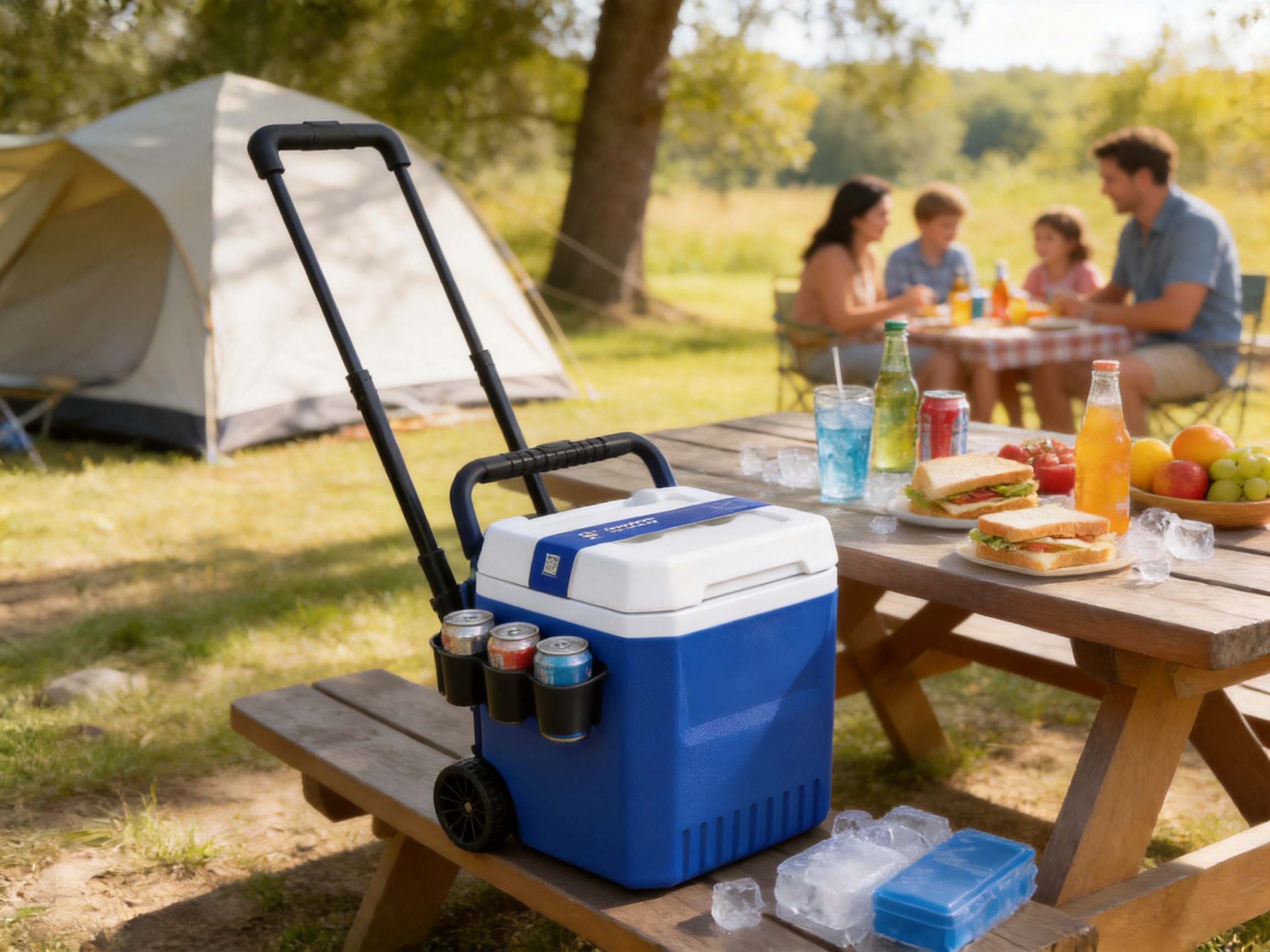
Camping often requires food and beverages to be transported over uneven paths from a vehicle to a tent or cooking area. Wheels can reduce the need to carry the full load by hand. The insulated structure helps protect chilled ingredients, while the hard body can withstand the general demands of outdoor use.
The lid cup holders offer an additional convenience at a campsite, where tables and furniture may be limited. The cooler can remain near the cooking or seating area and provide easy access to drinks throughout the day.
Picnics and Beach Trips
For picnics, the cooler can store sandwiches, fruit, dairy products, bottled drinks, and ice packs. The handle and wheels are helpful when moving across parking areas, paved paths, grass, or firm sand. At a beach, users should avoid submerging the cooler and should clean away sand before operating the handle or wheels.
At the destination, the lid can provide cup holders for drinks. Multiple color options also make it easier for families or groups to identify their cooler among other outdoor equipment.
Road Trips
The cooler’s compact external dimensions make it convenient for vehicle use. It can be positioned in a trunk, cargo area, or rear seating space, depending on the vehicle layout. It is suitable for drinks and snacks that travelers want to keep accessible during a journey.
A rolling cooler can also be useful when transferring food from a vehicle to a hotel, campsite, rest area, or rental property. The telescoping handle reduces repeated lifting during stops.
Fishing and Sporting Activities
Fishing trips and sports events often involve long periods outdoors and limited access to refrigeration. The insulated cooler can help keep beverages and selected food items chilled. The rigid shell also provides better protection than a fabric bag when equipment is placed nearby.
For fishing use, the cooler should be cleaned promptly after contact with fish, bait, or other strong-smelling materials. Its plastic surfaces can be more convenient to wash than absorbent textile interiors.
Tailgate Events and Outdoor Gatherings
At tailgate parties and community events, a cooler needs to serve both as storage and as a convenient beverage station. The cup holders help organize drinks, while the medium capacity is suitable for a small group. The wheeled design allows the cooler to be positioned near a vehicle, seating area, or serving location.
9. Manufacturing Process and Material Integration
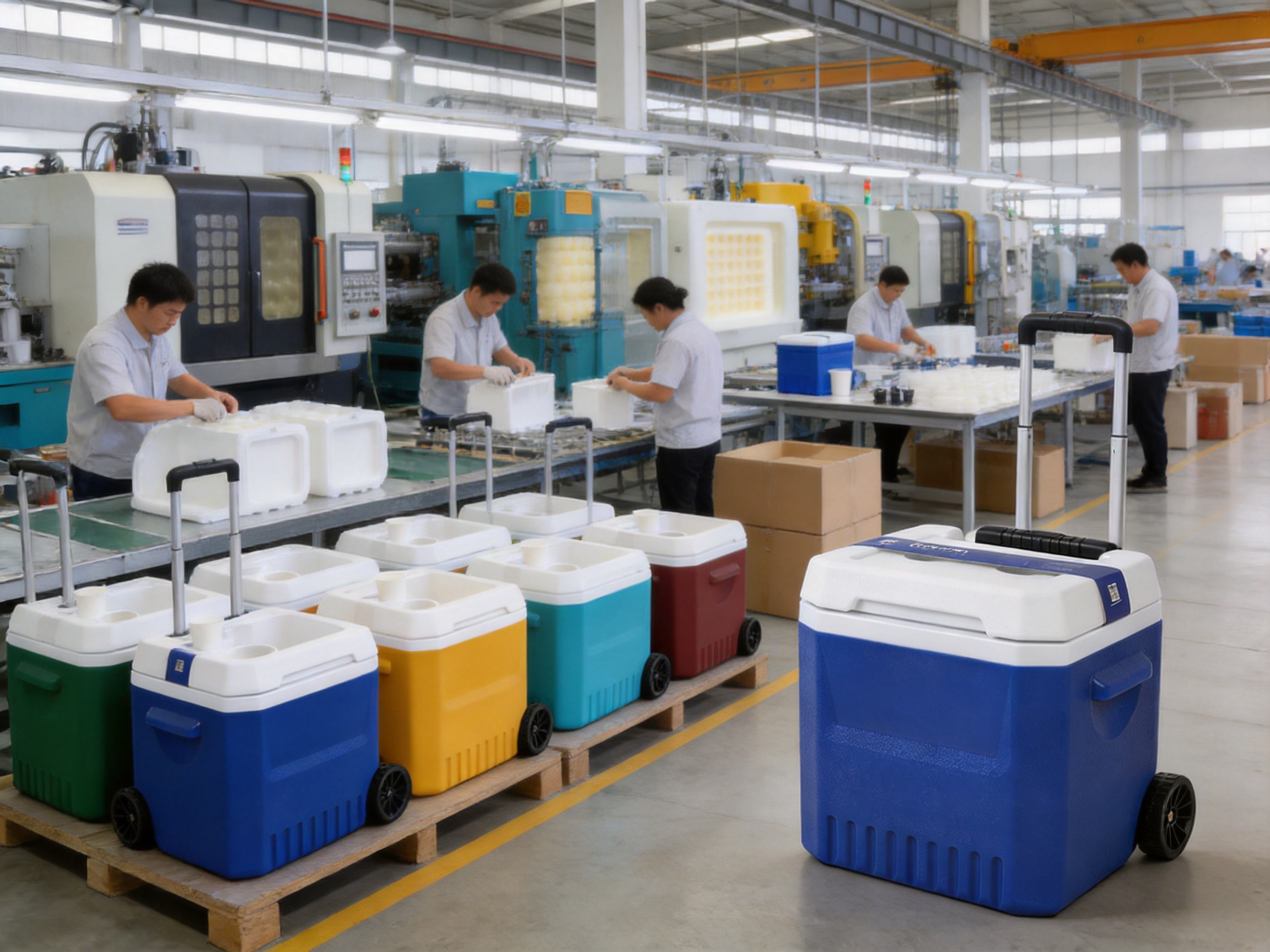
The performance of a molded insulated cooler depends significantly on how its components are produced and assembled. Ningbo Junlong Outdoor Products Co., Ltd. operates an independent factory of approximately 12,000 square meters and employs more than 100 people. Its production capabilities include automatic injection molding machines, blow molding machines, and foaming equipment.
Injection molding is suitable for manufacturing precise plastic components with consistent dimensions. It can be used for interior parts, exterior components, lids, handles, cup-holder structures, and other pieces that require repeatable geometry. Automated injection molding equipment helps improve production consistency and supports larger manufacturing orders.
Blow molding can be used to produce hollow or shell-like plastic structures with efficient material distribution. For cooler manufacturing, this process can contribute to the formation of durable outer components and support the creation of stable shapes suitable for insulation integration.
Foaming equipment is essential for producing the PU insulation layer. During the foaming process, the insulation material expands within the appropriate cavity or structural space. Consistent foaming helps support thermal performance and reduces the likelihood of weak areas in the insulation system.
Producing these processes within an integrated factory environment offers several advantages. It can improve coordination between product design, mold development, material selection, assembly, inspection, and packaging. It also allows manufacturing teams to identify production issues earlier and adjust processes more efficiently.
The combination of PP, PE, and PU requires careful control because each material serves a different purpose. The PP inner section must provide a suitable storage surface. The PE exterior must support the product against external handling and impact. The PU layer must occupy the intended insulating space and remain properly integrated with the surrounding components.
Manufacturing quality also depends on mold precision. Accurate molds help control dimensions, wall thickness, lid fit, handle alignment, and the position of cup holders. For wheeled products, correct alignment of the wheel and handle components is important for stable movement.
10. Product Development and Quality Management
Ningbo Junlong Outdoor Products Co., Ltd. was founded in 2000 and has developed experience in outdoor cooling and water storage products. The company integrates product development, production, and sales, allowing it to manage more stages of the product lifecycle than a trading business that relies entirely on external factories.
A dedicated R&D team supports the development of new product shapes, practical functions, and customized solutions. For a cooler box, development work may include evaluating capacity, insulation structure, lid design, handle placement, wheel configuration, material compatibility, and packaging requirements.
Quality management is important because cooler boxes must perform in several areas at once. A product may have good insulation but poor mobility, or a strong shell but an inconvenient lid. Effective quality control therefore needs to consider appearance, dimensions, assembly, closure, rolling function, surface quality, and insulation construction.
Production inspections can be used to verify that molded components meet the intended dimensions and that assembled products operate properly. Visual checks may identify scratches, molding defects, uneven surfaces, or color inconsistencies. Functional checks may examine lid closure, handle extension, wheel rotation, and the stability of the finished cooler.
For buyers ordering private-label products, consistent color, logo placement, packaging, and component assembly are also important. A structured quality management system helps manufacturers maintain repeatability across production batches and communicate more effectively with overseas customers.
The company’s factory resources and product specialization make it suitable for customers seeking a long-term manufacturing partner rather than a one-time generic product source. Its experience with ice buckets, cooler jugs, outdoor water containers, and cooler boxes gives it a broader understanding of plastic outdoor products and their common manufacturing requirements.
11. OEM and ODM Customization Capabilities
The cooler box can be supplied as a standard product or adapted for OEM and ODM programs. OEM customers may request their own logo, colors, labels, packaging design, or product presentation. ODM customers may work with the manufacturer to develop a product based on drawings, samples, performance requirements, or a target market concept.
Color customization is useful for retailers and brands that maintain a defined visual identity. Multiple-color inventory can also support different market segments, seasonal promotions, team colors, or coordinated outdoor product collections.
Logo customization can turn the cooler into a promotional product for corporate events, sporting clubs, travel businesses, hospitality companies, beverage brands, and outdoor organizations. Depending on the branding method, logos may be applied to suitable exterior surfaces through processes selected for durability and visual clarity.
Packaging customization allows buyers to adjust the product presentation for retail shelves, e-commerce fulfillment, wholesale distribution, or promotional campaigns. Packaging may include product information, handling guidance, barcodes, brand identity, and carton specifications required by a particular sales channel.
Product development based on drawings or samples can be useful when a customer needs a modified handle, a different wheel structure, a new lid arrangement, altered dimensions, or a unique color combination. The feasibility of each change depends on tooling, order volume, material requirements, safety considerations, and production cost.
Working with an experienced manufacturer during customization can help buyers identify practical issues before mass production. These issues may include mold draft, wall thickness, assembly tolerance, packaging space, transport strength, and the relationship between the internal capacity and external dimensions.
12. Advantages for Importers, Retailers, and Distributors
For importers, the 18L wheeled cooler offers a clear product proposition: medium capacity, rigid insulation, integrated mobility, and multipurpose outdoor use. These features can help differentiate it from simple cool bags and uninsulated storage containers.
Retailers may position the cooler in several product categories, including camping equipment, picnic accessories, outdoor cooking products, travel goods, fishing equipment, sporting goods, and seasonal summer merchandise. Its practical design gives it relevance beyond a single activity.
Distributors serving hospitality, catering, event management, and corporate promotional markets may also find value in its customization potential. A branded wheeled cooler can function as both a useful product and a visible marketing item.
The product’s medium size can make logistics more manageable than very large coolers. Its 3,000-gram unit weight is substantial enough to support a rigid construction while remaining more accessible for handling, storage, and display. Exact carton dimensions, loading quantities, and shipping arrangements should be confirmed for each order.
Multiple colors can help a distributor create a broader product range without changing the fundamental design. Standardized components may also simplify product training, spare-part planning, and after-sales communication.
13. Comparison with Common Cooler Types
| Cooler Type | Typical Strength | Potential Limitation | Position of the 18L Wheeled Cooler |
|---|---|---|---|
| Soft cooler bag | Lightweight and foldable | Less rigid support and more difficult to clean after spills | Offers a stronger molded structure and easier transport when loaded |
| Basic plastic box | Simple storage and low complexity | May have little or no thermal insulation | Adds PU insulation in the lid and body |
| Small personal cooler | Easy to carry for one person | Limited capacity | Provides more useful space for day trips and small groups |
| Large family cooler | High storage volume | Heavier and more difficult to store or move | Provides a more manageable medium-capacity format |
| Stationary ice chest | Strong storage capability | Requires lifting or carrying | Includes wheels, a telescoping handle, and side handles |
| Insulated delivery container | Designed for specific transport tasks | May not include recreational features | Adds cup holders and outdoor-oriented portability |
This comparison does not mean that one cooler type is suitable for every application. Instead, it shows how this model is positioned. It is intended for users who want more structure and thermal support than a soft bag, more functionality than an ordinary plastic box, and easier handling than a large stationary cooler.
14. Care, Cleaning, and Storage
Regular care helps preserve the appearance and function of the cooler. After use, the interior should be emptied and cleaned with mild soap and clean water. Food residue, melted ice, and spilled beverages should not be left inside for extended periods. The interior should be dried before the lid is closed for storage.
Harsh chemicals, abrasive pads, and aggressive solvents may damage plastic surfaces or affect printed graphics. A soft cloth or non-abrasive sponge is generally more suitable for routine cleaning. If the cooler is used for strong-smelling food, fish, or other materials, cleaning should take place as soon as possible.
The wheels and handle should be checked after use in sand, mud, or gravel. Removing debris from moving parts can help maintain smooth operation. The handle should be extended and retracted without excessive force, and the cooler should not be pulled at an angle that places unnecessary stress on the structure.
During long-term storage, the cooler should be kept in a dry, ventilated area away from sharp objects and extreme heat. Avoid placing heavy items on the lid if they could deform the cup holders or closure area. The product should be stored with the interior clean and dry.
Users should follow appropriate food-safety practices. The cooler helps maintain temperature but does not replace safe food handling. Perishable foods should be loaded cold, kept protected, and consumed or refrigerated according to applicable food-safety guidance.
15. Safety and Responsible Use
The cooler is intended for storing and transporting food, beverages, and suitable temperature-sensitive items. It should not be used as a sealed container for hazardous chemicals, flammable materials, or substances that may react with plastic components.
When the cooler is heavily loaded, users should pull it at a controlled speed and avoid sudden changes in direction. On slopes, stairs, deep sand, or uneven ground, lifting with the side handles may be safer than rolling. Two-person lifting may be appropriate for heavier loads.
The cooler should not be used as a seat, step, or climbing platform unless the manufacturer has specifically rated it for those purposes. Children should not ride on the cooler or play with the telescoping handle and wheels without supervision.
Although the cooler can help maintain cold or warm conditions, it should not be exposed unnecessarily to open flames, high-temperature equipment, or direct intense heat. Keeping the product in shade can help support thermal performance and protect the exterior.
16. Why Manufacturing Location and Capability Matter
Manufacturing capability is an important consideration when purchasing plastic cooler boxes for commercial distribution. A product may appear simple, but it requires coordination between design, mold construction, plastic processing, insulation, assembly, inspection, and packaging.
Ningbo Junlong Outdoor Products Co., Ltd. is located in Cixi, Ningbo, Zhejiang Province, an established manufacturing area in the Yangtze River Delta. The company’s location provides access to industrial resources, component suppliers, logistics services, and skilled manufacturing personnel.
Its independent 12,000-square-meter factory supports greater control over production scheduling and process coordination. More than 100 employees contribute to product development, manufacturing, quality management, sales, and customer service. This organizational structure can be valuable to international customers who need consistent communication throughout an OEM or ODM project.
The combination of automatic injection molding, blow molding, and foaming equipment allows the company to address several important stages of cooler production internally. This reduces dependence on unrelated suppliers and can make it easier to coordinate modifications when a product requires changes.
The company’s specialization in cooling and water-storage products also supports focused product knowledge. Instead of treating the cooler as a general-purpose plastic item, the manufacturer can consider insulation, mobility, cleaning, outdoor handling, and customer applications as connected parts of the final design.
17. Frequently Asked Questions
Q1: What is the capacity of this cooler box?
The cooler has an 18-liter capacity. It is classified as a medium cooler box within the 15-liter to 38-liter category. This size is suitable for drinks, packed meals, snacks, groceries, and cooling packs for day trips or small groups.
Q2: What are the outside dimensions?
The approximate outer dimensions are 37 cm × 32 cm × 33.5 cm. These dimensions make the cooler suitable for many vehicle trunks, rear seats, storage rooms, tents, and outdoor setups.
Q3: What are the internal dimensions?
The approximate inner dimensions are 29.5 cm × 23 cm × 27 cm. The upright internal space allows users to organize bottles, cans, food containers, and ice packs according to their needs.
Q4: What materials are used?
The inner material is polypropylene, or PP. The outer material is polyethylene, or PE. The insulation layer is polyurethane, or PU. Each material serves a different function in the cooler’s structure and performance.
Q5: How long can the cooler retain cold temperatures?
The product information describes the insulated lid and body as supporting cooling performance for up to 48 hours under appropriate conditions. Actual results depend on ice quantity, ambient temperature, pre-cooling, lid-opening frequency, loading method, and exposure to sunlight.
Q6: Does the cooler have wheels?
Yes. The product includes wheels and a telescoping handle for pulling. It also includes side handles for lifting when rolling is not practical.
Q7: Is the handle retractable?
Yes. The telescoping handle can be extended for transportation and retracted for storage or vehicle placement.
Q8: Does the lid have additional features?
Yes. The lid includes built-in cup holders and a secure closure system. The cup holders provide a convenient place for bottles, cans, and cups during outdoor activities.
Q9: Can the cooler be used for hot items?
The PU insulation layer can help maintain suitable temperatures for both cold and warm contents. Users should load hot food safely, keep the lid closed, and follow appropriate food-handling practices. The cooler is not intended for direct contact with open flames or cooking equipment.
Q10: Is the cooler suitable for camping and picnics?
Yes. Its 18-liter capacity, insulation, wheels, telescoping handle, side handles, and lid cup holders make it suitable for camping, picnics, beach outings, road trips, tailgate events, fishing, and other outdoor activities.
Q11: Can the product be customized?
OEM and ODM customization is available. Possible options may include color, logo, packaging, and product development based on drawings or samples. Specific customization requirements should be reviewed with the manufacturer.
Q12: Can different colors be supplied?
Yes. The product information indicates multi-color inventory. Color availability, minimum order quantities, and custom color options should be confirmed for each project.
Q13: What manufacturing equipment does the supplier operate?
The manufacturer operates automatic injection molding machines, blow molding machines, and foaming equipment. These capabilities support the production of molded plastic components and PU-insulated cooler structures.
Q14: What is the unit weight?
The approximate unit weight is 3,000 grams, or 3 kilograms. The actual shipping weight will be higher after packaging and may vary slightly according to production configuration.
Q15: How should the cooler be cleaned?
Empty the cooler after use and clean the interior with mild soap, clean water, and a soft cloth or non-abrasive sponge. Dry the interior before storage, and remove debris from the wheels and handle after use on sand or muddy ground.
Q16: What types of businesses may purchase this product?
Importers, outdoor retailers, camping suppliers, sporting-goods distributors, promotional-product companies, beverage brands, event organizers, catering businesses, and private-label brands may all consider this cooler for commercial programs.
18. Conclusion
The 18L wheeled insulated cooler box provides a balanced solution for users who need more than a basic storage container but do not want the bulk of a large family cooler. Its rigid PE outer shell, PP inner compartment, and PU insulation layer create a durable and practical structure for outdoor and everyday use. Insulation in both the lid and body supports extended temperature retention, while the 48-hour performance description gives the product a strong functional position when used under suitable conditions.
The integrated wheels and telescoping handle are important advantages for transporting a loaded cooler. Side handles provide additional flexibility when lifting is more appropriate. Built-in cup holders add convenience at picnics, sporting events, campsites, beach outings, and tailgate gatherings. The 18-liter capacity, compact dimensions, and 3-kilogram unit weight create a useful balance between storage volume and portability.
For commercial buyers, the product is supported by a manufacturer with long-term experience in outdoor cooling and water-storage products, an independent factory, multiple plastic-processing capabilities, dedicated product development resources, and OEM/ODM customization services. Color, logo, packaging, and product development options can help adapt the cooler to different sales channels and market identities.
As an alternative to soft cooler bags, uninsulated plastic boxes, and oversized stationary ice chests, this model offers a combination of thermal protection, structural durability, rolling mobility, and outdoor convenience. It is a practical platform for personal use, retail distribution, private labeling, promotional programs, and customized outdoor product collections.
References
1. Product specification sheet for the 18L wheeled insulated cooler box, including capacity, dimensions, materials, weight, and functional features.
2. Manufacturer-provided information on PU insulation in the cooler lid and body and the stated cooling performance under suitable conditions.
3. Manufacturer profile describing factory area, personnel, product development, production equipment, quality management, and OEM/ODM capabilities.
4. General material reference information for polypropylene, polyethylene, and polyurethane applications in molded plastic and insulated products.
5. General outdoor food-storage and cooler-use guidance concerning pre-cooling, ice placement, cleaning, transport, and safe food handling.
Product: 18L Wheeled Insulated Cooler Box for Outdoor Camping Picnic Trips

Product Recommendation
link
Office
- TEL: +86-574-63787606
- Phone: +86-13777994798
- E-mail: sales@nbjunlong.com
- WhatsApp: 13777967488
- Address: No. 1, Lane 3, Development Road, Longtouchang, Longshan Town, Cixi City, Zhejiang Province, China
Get In Touch
Copyright © Ningbo Junlong Outdoor Products Co., Ltd. All Rights Reserved.
China Plastic Insulated Cooler Box Manufacturer Custom Cooler Box Supplier
